
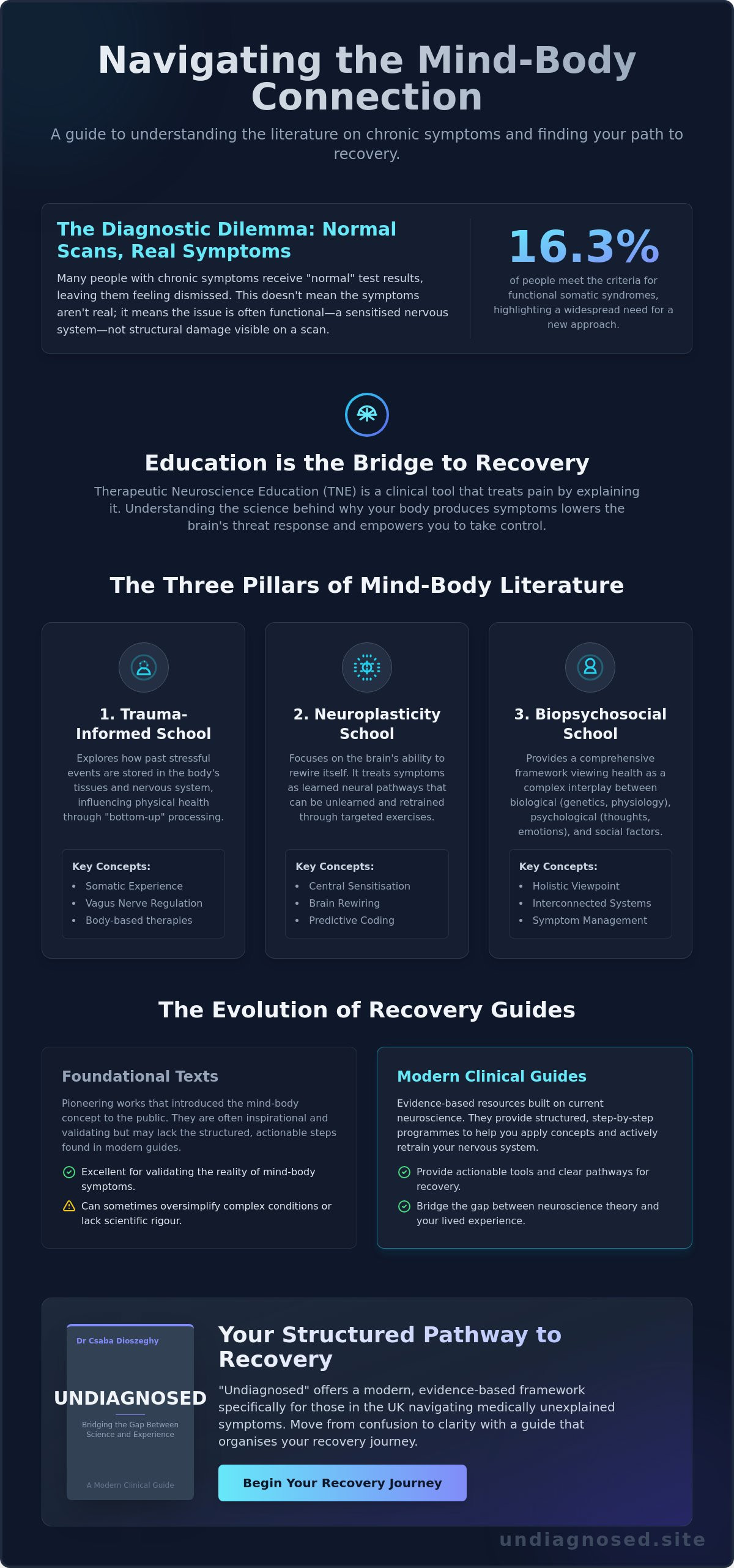
What if the chronic pain you feel isn't a sign of a failing body, but a protective response from an overwhelmed nervous system? You've likely spent years searching for answers, only to feel dismissed by clinicians or confused by the noise of the wellness industry. Finding a credible mind-body connection book shouldn't feel like another chore in an already exhausting journey. It's frustrating to live in a body that feels like a mystery whilst being told your symptoms are "functional" without guidance. Recent research from 2020 indicates that 16.3% of people meet the criteria for functional somatic syndromes, yet many remain without a roadmap for recovery.
This guide explores the essential literature of 2026, moving beyond superficial advice to offer rigorous, evidence-based insights. You deserve a scientific explanation that validates your pain rather than dismissing it. We will examine how modern clinical guides help you move from uncertainty to progress, providing the actionable tools you need to finally organise your path toward health. By bridging the gap between neuroscience and human experience, you can transform your understanding of your symptoms and begin a journey of genuine recovery.
Key Takeaways
- Learn why "normal" scans are not the end of your diagnostic journey but the beginning of a deeper understanding of your nervous system's behaviour.
- Distinguish between the three primary schools of literature to identify which clinical approach aligns best with your unique physical experience.
- Identify the most effective mind-body connection book for your specific symptoms, from central sensitisation in chronic pain to the sensory-motor loops of functional dizziness.
- Compare the strengths and limitations of foundational texts with modern clinical guides to ensure your recovery is built on current neuroscience.
- Discover how Dr Csaba Dioszeghy’s "Undiagnosed" provides a structured pathway for those navigating medically unexplained symptoms in the UK.
Why Read a Mind-Body Connection Book When Tests are Normal?
Receiving a "normal" test result after months of debilitating fatigue or chronic pain feels like a hollow victory. Whilst a clear scan rules out structural damage, it fails to explain why your body still hurts. This disconnect occurs because the mind-body connection isn't a vague psychological theory; it's a bidirectional communication system. Your brain and body constantly exchange signals through the nervous system, and sometimes, those signals become distorted. A credible mind-body connection book serves as a bridge between these two states, offering a scientific framework for symptoms that traditional medicine often struggles to categorise.
The Gap Between Scans and Symptoms
Traditional medicine excels at identifying structural issues like broken bones or tumours. However, it often overlooks functional dysregulation, where the "hardware" of the body is intact but the "software" is malfunctioning. You aren't imagining your symptoms. They're real, physical experiences driven by a nervous system that has become sensitised. Understanding the mind-body interventions that address this sensitisation is vital for long-term health. Most clinicians lack the time to explain how biological, psychological, and social factors intertwine to create your physical experience. This gap in care leaves many patients feeling abandoned in their own bodies, searching for answers amongst contradictory wellness advice.
Education as a Therapeutic Tool
Clinical research suggests that education itself is a form of treatment. This is known as Therapeutic Neuroscience Education (TNE). When you learn why your body is producing pain or dizziness, your brain begins to lower its internal threat response. It's like finally finding the manual for a complex machine you've been trying to operate in the dark. By engaging with medically unexplained symptoms self-help resources, you shift from a state of fear to a state of agency.
Knowledge validates your experience whilst providing a clear roadmap for recovery. It isn't about "thinking yourself well" or ignoring your physical limitations. Instead, it's about retraining the nervous system to stop overreacting to everyday stimuli. Choosing the right mind-body connection book provides the vocabulary to describe your journey and the practical tools to begin changing your physiological state. This process isn't just passive reading; it's the first step in a structured, evidence-based recovery programme that respects the reality of your physical pain.
The Three Pillars of Mind-Body Literature
Finding the right mind-body connection book requires a clear map of the current landscape. The literature isn't a monolith; it's divided into three distinct schools of thought that address recovery from different angles. First, the Trauma-Informed School explores how past events reside in the body's tissues. Second, the Neuroplasticity School focuses on the brain's ability to rewire dysfunctional pathways. Finally, the Biopsychosocial School, which includes the work of Dr Csaba Dioszeghy, examines the complex interplay amongst biology, psychology, and social environments. Evidence from the Washington University School of Medicine suggests the mind-body connection is built into brain networks, reinforcing that these schools aren't just theoretical. They're biological realities.
Trauma and the Somatic Experience
Trauma-focused books are immensely popular for a reason. They highlight "bottom-up" processing and the role of the vagus nerve in maintaining physical health. These texts help patients move away from the idea that their symptoms are "all in their head" by showing how the body stores stress. Whilst these works are transformative, they sometimes fail to cover the full spectrum of functional symptoms that aren't strictly trauma-rooted. They remain a vital piece of the puzzle for understanding medically unexplained symptoms, but they aren't the whole picture for every patient.
Neuroscience and Central Sensitisation
This school treats the nervous system like a sophisticated soundboard. When the "volume control" of the brain is turned up too high, normal sensory signals are interpreted as intense pain or dizziness. This is known as central sensitisation. Books in this category explain the neuroscience of MUS, showing how the brain can create real physical experiences without structural damage. Understanding this mechanism is often the turning point for recovery, as it replaces fear with a logical explanation for one's distress.
Choosing a mind-body connection book that aligns with your specific experience is essential for progress. If you're looking for a guide that integrates these three pillars into a single, cohesive framework, Dr Dioszeghy’s Undiagnosed - The Mind and Body Connection offers a clinical yet compassionate starting point. By categorising your reading, you can stop feeling overwhelmed by contradictory advice and start focusing on the specific mechanisms driving your symptoms. This structured approach ensures you aren't just reading for interest, but reading for recovery.
Comparing the "Big Three" vs. Modern Clinical Guides
To select the most effective mind-body connection book, you must understand the legacy of the "Big Three" whilst recognising where modern science has moved forward. John Sarno, Bessel van der Kolk, and Gabor Maté have defined this field for decades, yet their work offers varying degrees of clinical utility for today's patients. John Sarno’s pioneering work on Tension Myoneural Syndrome (TMS) provided a vital starting point by validating pain in the absence of structural damage. However, his heavy emphasis on repressed rage can feel reductive or even stigmatising to those dealing with complex functional neurological symptoms. Whilst his theories broke new ground, they often lack the neurobiological depth required for a comprehensive recovery in 2026.
Bessel van der Kolk and Gabor Maté have successfully brought the impact of trauma and societal stress into the mainstream. These authors excel at providing emotional validation and systemic insight. For a modern UK patient, however, there's often a gap between understanding that "the body keeps the score" and knowing how to change that score. Clinical utility requires more than just insight; it requires a structured, evidence-based pathway. Modern clinical guides have evolved to fill this space, moving away from older "psychosomatic" labels that implied symptoms were purely psychological. Instead, they embrace functional frameworks that treat the nervous system as a physical, adaptable organ.
The Evolution of Mind-Body Theory
The transition from Sarno’s "TMS" to today’s biopsychosocial approach marks a significant shift in patient care. We've moved from blaming the personality to understanding the physiology. This evolution represents the foundation of mind-body integration, where the focus is on the brain’s predictive processing rather than just childhood trauma. In 2026, the most effective literature prioritises neurobiology over metaphor. This change ensures that patients feel heard without feeling judged, providing a neutral ground where recovery becomes a matter of retraining rather than repressing.
Choosing Between Popular and Clinical Texts
Bestsellers are excellent for general insight and reducing the isolation of chronic illness. They help you realise you aren't alone. However, when the goal is recovery from specific functional symptoms, a clinical guide is often safer and more effective. You should be cautious of "red flag" books that promise miracle cures or lack rigorous scientific references. Look for literature that offers practical mind-body balance tools grounded in clinical practice. A clinician-led mind-body connection book provides the "how" of recovery, offering a stabilizing influence through clear, easy-to-navigate information that respects both the science of the brain and the reality of your physical experience.
A Symptom-Specific Reading Guide: Which Book for You?
Whilst the underlying science of a sensitised system is universal, the way you apply those principles depends entirely on your specific physical manifestation. A generic mind-body connection book might offer comfort, but resolving persistent symptoms requires a more precise manual. You need literature that speaks directly to your experience, whether that involves the sharp sting of nerve pain or the disorienting sway of functional dizziness. By selecting a resource tailored to your diagnosis, you move away from general wellness advice and toward a targeted, clinical strategy for recovery.
Navigating Chronic Pain Literature
For those living with persistent discomfort, it is vital to distinguish between "coping" books and "recovery" books. Coping literature teaches you how to endure the burden, whilst recovery literature aims to reduce the pain by addressing the biopsychosocial approach to chronic pain. Central sensitisation is the biological process where the nervous system becomes over-protective, essentially turning up the volume on safe signals. Effective texts help you identify "danger-in-me" signals and replace them with "safety-in-me" signals to recalibrate this internal alarm system.
Addressing Functional Neurological Disorders (FND)
FND patients often find that general self-help lacks the necessary focus on the sensory-motor loop. Recovery from tremors, weakness, or functional seizures requires more than just psychological insight; it demands practical brain-retraining. You should look for literature that integrates physical exercises with cognitive tools to help the brain relearn how to control the body. This dual focus is a cornerstone of any successful functional neurological disorder recovery journey, providing the physical steps needed to regain motor control.
If you experience functional dizziness (PPPD) or chronic fatigue, your reading should focus on autonomic nervous system regulation and pacing. These conditions often involve a "glitch" in how the brain processes vestibular information or manages energy reserves. Pacing is not just a scheduling tool; it is a neurological strategy to keep the system out of a high-threat state. To begin your structured recovery with a guide designed specifically for these challenges, explore Undiagnosed - The Mind and Body Connection. By choosing the right mind-body connection book, you validate your physical experience whilst building a foundation for long-term health.
Undiagnosed: Bridging the Gap Between Science and Experience
Whilst the previous sections have categorised the broader landscape of recovery literature, finding a resource that specifically addresses the UK clinical experience is vital for sustained progress. Dr Csaba Dioszeghy’s work serves as a definitive mind-body connection book for those who have reached the end of traditional diagnostic pathways without finding relief. It moves beyond the general theories of neuroplasticity or trauma to provide a structured, biopsychosocial framework that validates the patient’s journey. This approach ensures that you aren't just reading about a concept, but engaging with a methodology designed to bridge the gap between clinical neuroscience and your daily physical reality.
A Consultant Physician’s Perspective
Medical credibility is often the missing ingredient in self-help literature. Having a resource authored by a Consultant Physician provides a level of authority that helps silence the internal and external doubt often associated with functional symptoms. In Undiagnosed - The Mind and Body Connection, Dr Dioszeghy addresses the stigma of medically unexplained symptoms directly and compassionately. The core philosophy of the text revolves around a dual commitment: validating the pain whilst investigating the cause. This binary focus ensures that your experience is never dismissed as psychological, even as the book explores the neurological mechanisms driving your distress.
From Reading to Recovery
This guide is designed to function as a workbook for daily symptom management rather than a passive text. It includes specific, practical tools such as regulated breathing, sleep strategies, and targeted relaxation techniques that are essential for autonomic nervous system health. These exercises are not merely suggestions; they are the fundamental building blocks of a recovery programme. By integrating the "Undiagnosed" curriculum into a broader recovery plan, you can transition from understanding your symptoms to actively modulating them. The text is designed to be a partner to the Mind and Body Connection Online Course, allowing for a seamless transition between theoretical knowledge and practical application. Begin your recovery journey with the "Undiagnosed" book and course to finally move beyond the frustration of a "normal" test result toward a life of physical agency.
Reclaiming Agency in Your Recovery Journey
Understanding the neurobiology of your symptoms is the essential first step toward reducing the nervous system's threat response. Whilst foundational texts offer emotional validation, modern recovery requires a structured, clinical approach that bridges the gap between theory and practice. You don't have to navigate this path in isolation or settle for contradictory wellness advice. By choosing a credible mind-body connection book, you shift from a state of uncertainty to a state of evidence-based progress. This transition from being a passive patient to an active participant is vital for long-term health.
Dr Csaba Dioszeghy, a UK Consultant Physician, has developed a resource based on the evidence-backed biopsychosocial model to provide this exact roadmap. His work includes practical tools for FND and MUS management, turning clinical insight into daily action. Order "Undiagnosed: The Mind and Body Connection" and start your recovery today. You possess the capacity to influence your nervous system; with the right guide, progress is not just possible but expected. Trust in the science of neuroplasticity and begin your journey toward a more stable, symptom-free life.
Frequently Asked Questions
Is a mind-body connection book enough to cure chronic pain?
A book is a powerful educational tool but often works best as part of a comprehensive recovery strategy. Whilst education reduces the threat response, many patients require the structured application found in a mind-body connection book alongside physical retraining or lifestyle adjustments. It provides the map for your journey, but you must still walk the path through consistent practice and nervous system regulation to see lasting results.
What is the best mind-body book for someone with no history of trauma?
If your symptoms aren't trauma-rooted, you should prioritise books focused on neuroplasticity and the biopsychosocial model. These texts explain how the brain's predictive processing can create real physical pain through central sensitisation without a history of emotional distress. Literature that addresses the "software" of the nervous system is often more relevant for those with functional symptoms driven by biological or social stressors.
Are these books based on scientific evidence or just theories?
Modern clinical guides are grounded in peer-reviewed neuroscience and the well-established biopsychosocial model of health. These aren't abstract theories but reflections of how the nervous system functions as a physical, adaptable organ. Credible literature cites specific research on brain-body communication, ensuring the strategies provided are both safe and evidence-based for those navigating symptoms that traditional tests fail to explain.
How do I know if my symptoms are "functional" or "structural"?
Functional symptoms occur when the body's hardware is intact but the software is misfiring, often confirmed when scans and blood tests return "normal". Structural issues involve visible damage, such as a fracture or tissue degeneration. If your clinicians haven't found a structural cause for your persistent pain or dizziness, your symptoms are likely functional. This means the nervous system is producing real sensations through dysregulation.
Can reading a book really change how my brain processes physical pain?
Yes, because education is a clinically recognised therapeutic intervention known as Therapeutic Neuroscience Education (TNE). When you understand the mechanism of your pain, your brain's amygdala reduces its threat signalling. This cognitive shift can physically lower the "volume" of pain signals by retraining the brain to interpret sensory data more accurately, effectively changing your physiological experience through the power of a mind-body connection book.
What is the difference between the biopsychosocial model and holistic medicine?
The biopsychosocial model is a rigorous clinical framework that examines the specific interplay amongst biology, psychology, and social factors. Whilst holistic medicine often takes a broad view of wellness, the biopsychosocial approach is deeply rooted in neurobiology and evidence-based medicine. It seeks to identify the precise mechanisms driving functional symptoms rather than relying on general wellness theories that may lack scientific depth.
Should I talk to my GP before starting a mind-body recovery programme?
You should always consult your GP to rule out structural pathology before beginning any new recovery approach. Once your doctor has confirmed that your tests are clear, a mind-body connection guide can safely complement your care. Most clinicians welcome patients who take an active, informed role in their recovery, especially when using evidence-based resources that validate the physical reality of their symptoms.
How long does it typically take to see results after implementing book strategies?
Recovery timelines vary significantly depending on the duration and intensity of your symptoms. Some individuals report a reduction in the "threat response" within weeks of understanding the science, whilst others require several months of consistent practice to rewire deep-seated neural pathways. Patience and consistency are vital; retraining a sensitised nervous system is a gradual process of building safety and resilience within the body.