Did you know that medically unexplained symptoms account for approximately 45% of all general practice consultations? If you have spent years searching for answers only to be met with clear scans and shrugs from specialists, you aren't alone. It's a wearying cycle where your physical pain is met with clinical silence, often leaving you to fear a hidden illness or feel gaslit by the very people meant to help you.
We understand that whilst your tests are clear, your suffering is undeniably real. This isn't about dismissive labels; it's about recognising that your symptoms are a functional disturbance in your brain-body circuitry. This guide will show you why your pain is biologically valid and how you can navigate the path to recovery using a biopsychosocial framework. It's time to stop searching for a broken part and start understanding a dysregulated system.
We'll explore the latest diagnostic shifts in medical science and provide practical tools to help you regain control of your daily life. By the end of this article, you'll see a clear route forward that respects both your clinical reality and your human experience. You'll move from a state of uncertainty to a position of informed, evidence-based hope.
Key Takeaways
- Validate physical sensations as real functional disturbances rather than structural damage to move past the stigma of "clear" test results.
- Discover how medically unexplained symptoms arise from "software" issues in the nervous system, where the brain becomes over-protective through central sensitisation.
- Transition from the limitations of the biomedical model to the breadth of the biopsychosocial framework to address the whole person.
- Utilise evidence-based tools like somatic tracking and pacing to observe physical sensations calmly and stabilise your daily activity levels.
- Understand how the "Undiagnosed" philosophy uses education as the foundational tool to begin rewiring your brain-body circuitry and reclaiming your life.
The Paradox of Normal Results: Validating Medically Unexplained Symptoms
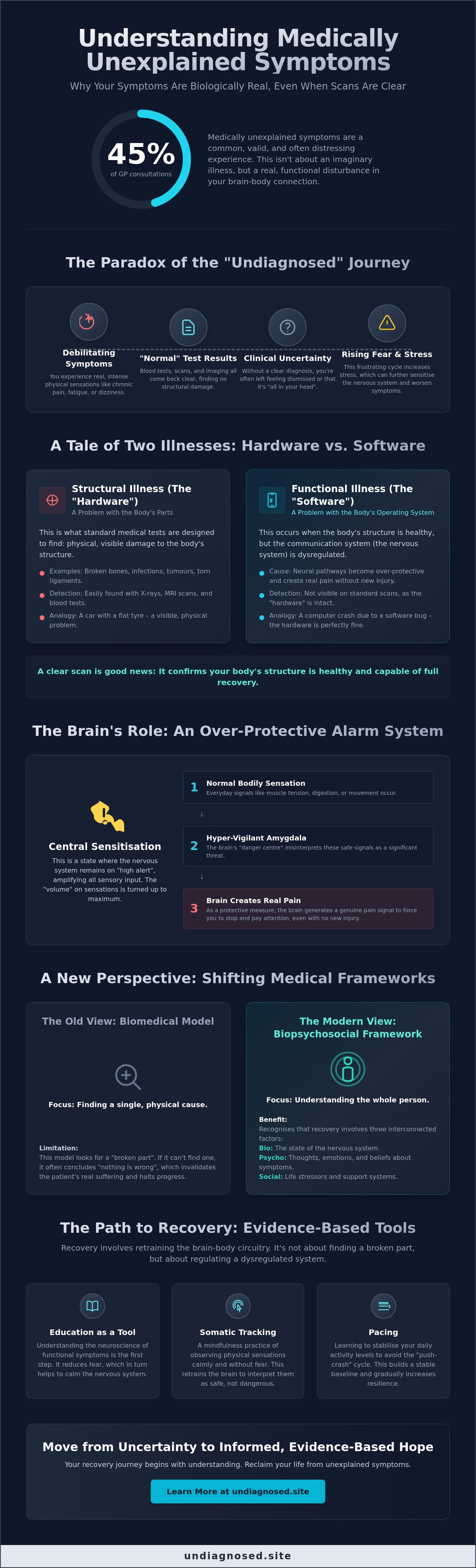
The silence of a "normal" test result can be louder than a diagnosis. You feel the persistent pain, the crushing fatigue, or the disorienting dizziness, yet the blood tests and imaging remain stubbornly unremarkable. This gap between your lived experience and clinical data is the defining characteristic of Medically Unexplained Symptoms. It's essential to recognise that "unexplained" doesn't mean "imaginary". It simply means that the tools we currently use to look for structural damage, such as breaks, tumours, or infections, aren't finding anything physically broken. Your suffering isn't a product of your imagination; it's a product of your biology.
To understand this, we must distinguish between structural illness and functional illness. If a car has a flat tyre, that's a structural problem. If the engine's timing is off, the car won't run correctly, but the parts themselves look fine; that's a functional problem. Your body operates similarly. In many cases of medically unexplained symptoms, your "hardware" is intact, but the "software" controlling your sensations is misfiring. This is why a clear scan is actually excellent news. It confirms that your body's structure is healthy and capable of full recovery, even whilst your internal systems are currently sounding a false alarm.
Common Functional Symptoms and Their Impact
Functional symptoms aren't subtle or "mild". They manifest as debilitating chronic pain, profound fatigue, persistent dizziness, or frightening heart palpitations. These sensations aren't just minor inconveniences; they often dismantle a person's ability to work, socialise, or even perform basic household tasks. A critical point to understand is that the intensity of your pain doesn't always correlate with tissue damage. Think of a paper cut; it's a tiny structural injury that causes significant, sharp pain. Conversely, some serious structural issues cause no pain at all. In functional conditions, the body's alarm system is simply turned up too high, creating high-intensity signals without a corresponding wound.
The Frustration of the "Undiagnosed" Journey
The journey toward an answer often feels like an exhausting trek through a fragmented system. Many people find themselves caught in a cycle of "doctor shopping," moving from specialist to specialist in hopes of finding the one test that was missed. This process is often driven by a valid fear of a hidden terminal illness, yet it frequently results in increased stress and a feeling of being gaslit by the medical community. When a doctor says "there's nothing wrong," it feels like they're saying you're making it up. We believe chronic pain validation is the first step toward healing. Acknowledging that your experience is real, even without a visible scar, provides the foundation of trust needed to begin the recovery process.
The Neuroscience of MUS: Understanding the Brain-Body Circuitry
The brain is the organ that constructs our physical reality. When dealing with medically unexplained symptoms, the issue rarely lies within the physical structure of the limbs or organs. Instead, we must look at the "software" of the nervous system. Just as a computer can crash due to a coding error whilst the physical circuit boards remain perfect, your body can experience intense pain because the neural pathways have become dysregulated. This isn't a psychological failing; it's a physiological state where the brain produces real, measurable pain signals in the absence of a fresh injury.
At the centre of this process is central sensitisation. This is a state where the nervous system stays in a high-alert mode, effectively turning up the "volume" on all sensory input. The amygdala, your brain's danger evaluation centre, becomes hyper-vigilant. It begins to interpret normal bodily sensations, such as the movement of digestion or the tension of a muscle, as significant threats. Once the brain decides you are in danger, it executes its most effective protective strategy: it creates pain to force you to stop and pay attention. You can find a medically unexplained symptoms overview on the NHS website that touches on these mind-body links, but modern neuroscience goes deeper into how these circuits actually rewire themselves over time.
Predictive Processing: How the Brain Creates Reality
Our brains don't simply record the world; they predict it. Predictive processing is the brain’s attempt to anticipate needs based on past data. If your system has been under prolonged stress or has experienced past trauma, it learns to "filter in" pain signals that a healthy system would normally ignore. It prioritises safety over accuracy. By anticipating pain before it even happens, the brain can inadvertently lock the body into a chronic cycle of discomfort. This predictive habit means the brain is reacting to what it expects to feel rather than what is actually happening in the tissues.
The Role of Emotions in Physical Circuitry
There is no biological wall between your feelings and your physical sensations. Emotional distress and physical pain share the same neural real estate in the brain, particularly within the anterior cingulate cortex. When you experience high levels of stress or suppressed emotion, the brain uses the same pathways to signal physical distress. Understanding emotions and physical pain is vital because it confirms that "emotional" does not mean "imaginary". If you want to dive deeper into these mechanisms, you might find Dr. Csaba Dioszeghy’s work at undiagnosed.site a helpful resource for understanding your specific circuitry.
The Biopsychosocial Lens: A Modern Framework for Recovery
Traditional medicine is peerless at treating acute trauma, yet it often falters when faced with medically unexplained symptoms. This struggle stems from a reliance on the traditional biomedical model, which views the body as a collection of isolated, mechanical parts. If a scan shows no fracture and a blood test shows no infection, the model reaches a dead end. The Biopsychosocial (BPS) model offers a more sophisticated alternative. It recognises that health isn't merely the absence of structural damage but a state of balance amongst biological processes, psychological patterns, and social realities. By shifting our focus from the part to the person, we find answers that a microscope alone will never reveal.
Treating only the "bio" in functional cases often leads to frustration because it ignores the environment in which the body operates. If we only look for a broken bone whilst ignoring a dysregulated nervous system, we miss the root cause of the distress. Patient-centred care within the BPS framework prioritises your lived experience, acknowledging that your symptoms are valid even when they don't fit into a tidy diagnostic box. It's a collaborative approach that seeks to understand what has happened to your system rather than just what is wrong with your anatomy.
Biological Factors: Beyond the Scan
Whilst structural damage may be absent, biological dysregulation is often very present. The "fight or flight" response is a physical state, not just a feeling; it involves real shifts in blood flow, muscle tension, and neurochemistry. When this response becomes chronic, it maintains physical symptoms through sheer physiological momentum. It's essential to work with your GP to ensure no structural pathologies have been missed. Once you have that reassurance, biological recovery becomes about system regulation. This involves:
- Prioritising restorative sleep to allow for neural repair and hormonal balance.
- Stabilising the system through consistent, anti-inflammatory nutrition.
- Engaging in gentle movement that signals safety rather than threat to the brain.
These actions provide the physical environment your nervous system requires to down-regulate. They aren't just lifestyle choices; they are biological interventions.
Psychological and Social Influences
The brain does not exist in a vacuum; it's constantly influenced by our internal narratives and external relationships. Clinical observation frequently reveals a link between medically unexplained symptoms and traits like perfectionism or chronic people-pleasing. These behaviours keep the body’s stress systems on a permanent "high-alert" setting, making the nervous system more prone to sensitisation. Social isolation and workplace pressures further compound this, acting as constant danger signals that the brain translates into physical distress. Early childhood experiences also prime the nervous system, making it more reactive in adulthood. Understanding these factors allows us to move beyond the frustration of clear scans and address the root causes of system overload.
Self-Help Strategies: Evidence-Based Tools for Symptom Management
Knowledge is the foundation, but consistent application is the architect of recovery. When managing medically unexplained symptoms, the goal isn't to fight the body, but to retrain it. Somatic tracking is a primary tool for this process. Instead of reacting to pain with panic, you observe the sensation with neutral curiosity. You describe the quality of the sensation, whether it's warm, pulsing, or tight, whilst reminding yourself that your tissues are safe. This practice sends "safe signals" to the amygdala, proving that the danger it perceives is a false alarm. Over time, this neutral observation helps the brain to de-classify the sensation as a threat.
Pacing is equally vital for long-term progress. Many sufferers fall into a "boom-and-bust" cycle, where they over-exert on good days only to collapse for a week. Pacing involves finding a baseline of activity that doesn't trigger a flare-up and sticking to it, even when you feel capable of more. By prioritising consistency over intensity, you teach your nervous system that movement is safe. Additionally, expressive writing can help process the emotional stressors that fuel physical sensations. Spending fifteen minutes writing about your frustrations or fears can lower the emotional load on your neural circuitry, reducing the overall pressure on your system.
Regulating the Nervous System
Immediate calming techniques are essential during a flare-up. The 4-7-8 breathing exercise is a clinical favourite for its speed and efficacy. Inhale through your nose for 4 seconds, hold for 7, and exhale slowly through your mouth for 8. This physiological hack stimulates the vagus nerve, forcing the body out of "fight or flight" mode. Grounding techniques, such as naming five things you can see and four you can touch, help pull the brain out of its internal danger loop and back into the present moment. These relaxation techniques are not just "nice to have"; they are active methods for lowering central sensitisation and reclaiming control.
Sleep and Routine as Recovery Pillars
Restorative sleep is the bedrock of a healthy pain threshold. Clinical data indicates that even partial sleep deprivation can significantly increase pain sensitivity the following day. To signal safety to the brain, implement a consistent wind-down routine: dim the lights, avoid screens, and engage in quiet activity. A steady daily rhythm, where you eat, move, and sleep at similar times, stabilises the autonomic nervous system. This predictability reduces the brain's need to be on high alert. If you are ready to move beyond these basics, the Mind and Body Connection Online Course provides a structured path for implementing these evidence-based tools.
Moving Forward: The Undiagnosed Recovery Path
Recovery is rarely a single, dramatic event. It is a process of deliberate reorganisation. For years, you may have searched for a missing piece of the clinical puzzle, yet for those living with medically unexplained symptoms, the answer isn't usually found in a new test or a rare diagnosis. It's found in the way your system functions. Dr. Csaba Dioszeghy’s "Undiagnosed" philosophy shifts the focus from an external cure to an internal recalibration. This approach doesn't promise a miracle; it provides a methodology. It transforms your role from a passive patient into an active architect of your own well-being.
Education is the primary engine of this change. When you learn the precise neuroscience behind your sensations, you begin the process of "rewiring" your brain. This isn't metaphorical. Understanding the biology of threat and safety allows your prefrontal cortex to soothe the hyper-vigilant amygdala. By replacing fear with insight, you lower the baseline of central sensitisation. The book Undiagnosed: The Mind and Body Connection serves as a foundational text for this journey, translating complex clinical concepts into a practical roadmap. It moves you away from the exhaustion of medically unexplained symptoms toward the clarity of a structured plan.
The Mind and Body Connection Course
This structured, neuroscience-based curriculum is designed to bridge the gap between theory and practice. Whilst reading about recovery is helpful, true change requires repetition and application. The course provides lifetime access, allowing you to return to key modules as you master the art of pacing. It moves beyond abstract ideas to deliver concrete exercises that target your specific nervous system responses. You aren't just learning about the mind-body connection; you are actively training your system to function with greater resilience and less pain.
Next Steps for the Reader
Your recovery begins with a single decision to view your health through a different lens. We encourage you to start by reading the introductory chapter of the Undiagnosed book or exploring our initial course modules. This path requires patience, yet the rewards are a return to functional ability and a life no longer dictated by physical distress. Whilst the journey is deeply personal, you are not alone in this process. Your system is capable of change, and we are here to provide the map. To begin your journey, Explore the Undiagnosed Mind and Body Connection Course today.
Reclaiming Your Life: The Path Beyond the Diagnosis
Understanding that your pain is biologically real, even without a structural diagnosis, is the first step toward lasting change. We have explored how medically unexplained symptoms are often the result of a hyper-vigilant nervous system rather than a broken body part. By moving from the traditional biomedical model to a biopsychosocial framework, you can begin to address the root causes of your distress. This shift allows you to stop searching for a hidden illness and start organising your recovery through regulated movement, restorative sleep, and neutral observation.
This journey requires a structured methodology founded on scientific rigour. Founded by Dr. Csaba Dioszeghy, a Consultant Physician, our evidence-based curriculum provides the practical tools you need for functional symptom management. You don't have to navigate this complex terrain alone. You can start your recovery journey with the Undiagnosed Online Course and gain access to a clear, step-by-step path toward wellness. Your system possesses an innate capacity for recalibration; it's time to provide it with the guidance it deserves. There is a way forward, and recovery is within your reach.
Frequently Asked Questions
What are medically unexplained symptoms exactly?
Medically unexplained symptoms are physical sensations, such as persistent pain or chronic fatigue, that do not have a clear structural or pathological cause identified through standard medical tests. These symptoms are functional rather than structural; the body's systems are healthy, but their operation is dysregulated. This category often includes conditions like fibromyalgia, irritable bowel syndrome, and chronic fatigue syndrome, where the "hardware" of the body is intact but the "software" is misfiring.
Can stress really cause severe physical pain or dizziness?
Yes, chronic stress directly alters your neurochemistry and activates the "fight or flight" response. This physiological state increases muscle tension, changes blood flow, and heightens sensory awareness across the entire body. When the brain perceives a constant state of threat, it produces real physical sensations like dizziness or sharp pain as a protective mechanism. These aren't just psychological reactions; they are the physical consequences of a nervous system under sustained pressure.
Is it possible that my doctor has simply missed something?
It is natural to feel that a rare illness has been overlooked when you feel so profoundly unwell. However, modern diagnostic tools are exceptionally effective at identifying structural damage or life-threatening pathologies. If multiple specialists and clear scans have ruled out structural disease, the focus should shift toward functional recovery. Trusting your "normal" results allows you to stop searching for a broken part and start healing your nervous system.
How long does it take to recover from functional symptoms?
Recovery timelines are highly individual and depend on the duration of your symptoms and the consistency of your retraining efforts. Some individuals notice significant improvements within weeks of implementing nervous system regulation tools, whilst others require several months to see lasting change. The goal is progress rather than perfection. Consistent application of pacing and somatic tracking creates the steady physiological environment required for the brain to de-sensitise over time.
Are medically unexplained symptoms the same as "all in my head"?
No, this is a harmful misconception that ignores the reality of human physiology. Whilst the brain processes all pain signals, the sensations you feel in your body are biologically real and measurable. Medically unexplained symptoms involve actual physiological changes in the nervous system and immune system. Labelling them as "all in your head" dismisses the complex brain-body circuitry that produces these very real, and often debilitating, physical experiences.
What is the biopsychosocial approach to medicine?
The biopsychosocial approach is a clinical framework that views health as an interaction between biological, psychological, and social factors. Instead of looking only at a scan, this model considers your genetics, your internal thought patterns, and your external environment. It is the gold standard for managing complex conditions because it addresses the whole person. This model recognises that your social support and emotional state are just as influential to your recovery as your physical biology.
Can breathing exercises really help with chronic physical symptoms?
Yes, specific breathing patterns act as a direct physiological "off switch" for the sympathetic nervous system. By lengthening your exhale, you stimulate the vagus nerve and signal to your brain that the body is safe. This reduces the production of stress hormones and can lower the intensity of pain or dizziness in the moment. It's a practical intervention that helps to dampen the central sensitisation driving your chronic symptoms.
When should I stop seeking more medical tests for my symptoms?
You should consider shifting your focus once your GP or a relevant specialist has ruled out structural disease or acute pathology. Continuing to seek the "one missing test" often increases health anxiety, which further sensitises the nervous system. Medically unexplained symptoms require a shift from diagnostic investigation to functional rehabilitation. Once the hardware is confirmed as safe, the focus must move to updating the software through evidence-based recovery strategies.