
What if the normal test results your doctor presents aren't evidence that nothing is wrong, but proof that your nervous system is communicating in a different language? For the 50 per 100,000 people living with functional neurological disorder, the gap between clinical data and physical reality can feel like a chasm. You know the frustration of fluctuating symptoms that disrupt your daily life, and the anxiety that follows their unpredictable nature. Effective functional symptoms management requires a shift in perspective. It's not about fixing a broken machine; it's about retraining a dysregulated system.
We understand the exhaustion of feeling overlooked by a healthcare system that often lacks a clear roadmap for your recovery. Recent 2026 clinical guidelines from the American Academy of Neurology now emphasise that your symptoms are real, physiological, and manageable through targeted psychological and physical interventions. This article promises to help you manage these complexities through evidence-based biopsychosocial strategies designed for long-term stability. We will examine the science of self-regulation and provide a clear framework to reduce symptom intensity, moving you from a state of uncertainty to a position of informed control.
Key Takeaways
- Learn to distinguish between structural damage and functional dysregulation by viewing your nervous system as software that can be retrained.
- Discover how the biopsychosocial model provides a comprehensive framework for functional symptoms management by addressing biological, psychological, and social factors.
- Identify specific top-down and bottom-up interventions to lower nervous system arousal and stabilise your daily physical experience.
- Understand why the boom and bust cycle hinders long-term recovery and how to pace your activities for consistent improvement.
- Explore why structured mind-body education serves as a primary treatment tool for moving from physical confusion to clinical clarity.
Understanding Functional Symptoms Management: Real Pain, Clear Scans
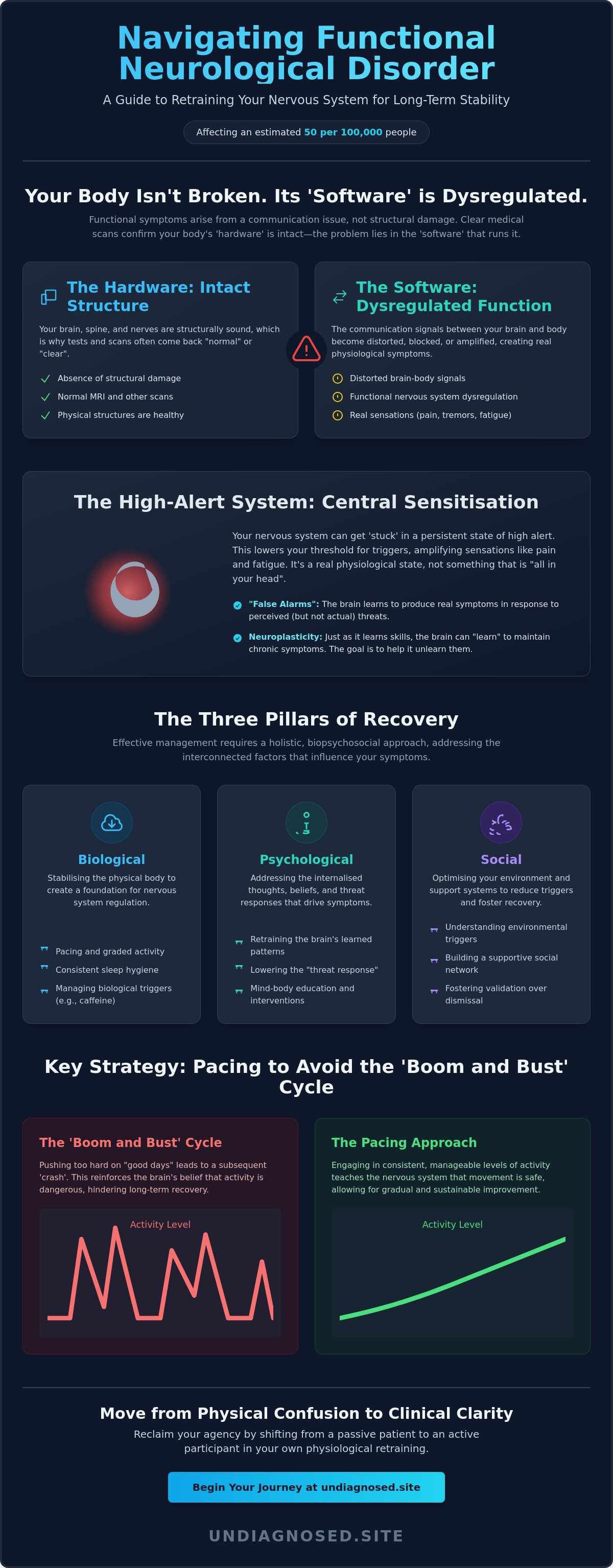
A normal MRI scan shouldn't be a source of confusion, yet for many, it feels like a dismissal. When medical professionals report that your "scans are clear", they're confirming the absence of structural damage; they aren't suggesting your symptoms are imaginary. To master functional symptoms management, you must first understand the distinction between hardware and software. If your brain and nerves are the hardware, functional symptoms represent a glitch in the software. The structure is intact, but the transmission is flawed.
Your nervous system is a sophisticated communication network. In functional conditions, the signals sent between the brain and the body become distorted, amplified, or blocked. This isn't a sign of a broken body, but of a dysregulated system. The brain acts as a prediction engine, constantly interpreting data to keep you safe. Sometimes, it learns to produce "false alarms", creating real, physiological sensations like pain, tremors, or fatigue in response to perceived threats that aren't visible on a standard scan.
The Science of the Mind-Body Connection
Recovery relies on the principle of neuroplasticity: the brain's ability to reorganise itself based on experience. Just as the brain can "learn" a new skill, it can also learn to maintain chronic symptoms through a process called central sensitisation. This is a state where the central nervous system stays in a persistent high-alert mode, lowering your threshold for pain and exhaustion. Because these changes occur at a functional level rather than a structural one, traditional imaging often fails to capture the complexity of Functional Neurological Symptom Disorder. It's a physiological reality that requires a physiological solution.
Moving Beyond the "All in Your Head" Stigma
For too long, medicine has operated under a false dualism, separating the physical from the psychological. This outdated view suggests that if a cause isn't visible in the tissues, it must be "psychogenic". We reject this binary. Functional symptoms are a complex interplay of biology, past experiences, and environmental triggers. They're not "all in your head"; they're in your nervous system. By shifting your focus from a desperate search for a hidden structural cause to actively managing the process of regulation, you reclaim your agency. You stop being a passive victim of an undiagnosed mystery and become an active participant in your own physiological retraining.
The Biopsychosocial Pillars of Recovery
The biopsychosocial model represents the gold standard for functional symptoms management, moving away from a narrow focus on tissue damage toward a holistic understanding of the individual. This framework recognises that your recovery isn't dependent on a single pill or procedure. Instead, it relies on the careful calibration of three intersecting domains: your biology, your psychology, and your social environment. While traditional medical models often leave patients waiting for a specialist referral, the biopsychosocial approach empowers you to begin the work of stabilisation immediately.
Biological Foundations: Stabilising the System
Biological factors form the bedrock of your nervous system's health. When your physical foundation is unstable, your brain is more likely to remain in a state of high alert. Consistent sleep hygiene is perhaps the most critical tool for regulation, as sleep deprivation directly amplifies pain signals and cognitive fog. You should also consider the impact of "biological triggers" such as excessive caffeine or irregular eating patterns, which can cause blood sugar fluctuations that the brain interprets as a threat.
Reconditioning the body requires a delicate balance. Pacing and graded motor imagery allow you to reintroduce movement without triggering a flare. This isn't about "pushing through" pain; it's about teaching your brain that movement is safe. As noted in this patient overview of FND, symptoms are real and physiological, but they are driven by how the brain sends signals rather than structural disease.
Psychological and Social Dynamics
The psychological pillar focuses on the internalised drivers of physical sensation. Traits like perfectionism or a high "threat response" can keep the nervous system in a state of chronic arousal. Understanding the deep connection between emotions and physical pain is vital; your brain uses the same neural pathways to process both. When emotional stress is suppressed, it often finds expression through the body.
Social dynamics also play a significant role in your allostatic load, which is the cumulative wear and tear on the body. Evaluating the impact of work stress, relationship tension, and societal expectations is necessary for long-term health. Setting firm boundaries isn't a luxury; it's a clinical requirement for recovery. If you're ready to move beyond fragmented advice, exploring the Undiagnosed curriculum can provide the structured guidance needed to integrate these pillars into your daily life.
Essential Techniques for Daily Symptom Regulation
Mastering the art of functional symptoms management involves more than just understanding the theory; it requires a practical toolkit of self-regulation strategies. These interventions are broadly categorised into "bottom-up" and "top-down" approaches. Bottom-up techniques use the body to calm the brain, whilst top-down strategies use the mind to soothe the body. The goal isn't to force symptoms away with intensity, but to retrain the nervous system through quiet, daily consistency. By applying these tools amongst your normal activities, you begin to dismantle the "false alarm" signals that keep your system in a state of high alert.
Breathing and Somatic Tracking
Diaphragmatic breathing is a primary bottom-up tool that signals safety to the autonomic nervous system. By slowing the breath and expanding the belly, you physically override the stress response. This works in tandem with somatic tracking, a practice where you observe physical sensations without judgment or fear. Instead of reacting to a tremor or pain with panic, you view it as a neutral data point. This is particularly effective for grounding yourself whilst experiencing chronic dizziness, as it helps the brain recalibrate its sense of balance without the interference of anxiety.
Cognitive Reframing and Relaxation
Top-down regulation focuses on identifying and interrupting "catastrophising" thoughts. When you think, "this will never end," you fuel the pain-fear cycle, which tells the brain to stay in a defensive mode. Evidence-based strategies for the Management of functional neurological disorder often include cognitive reframing to replace these narratives with realistic, grounded statements. Complementing this with progressive muscle relaxation helps release stored physical tension, whilst visualisation techniques create an internal sense of safety and calm. These practices aren't mere distractions; they're active methods of neurological retraining.
To handle acute spikes effectively, it's helpful to create a personalised "rescue kit". This is a pre-planned sequence of your most reliable grounding tools, such as a specific scent, a weighted blanket, or a short guided meditation. Having a plan reduces the panic that often accompanies a flare, ensuring that functional symptoms management remains a proactive process rather than a reactive struggle. Success in this journey is found in the small, repeated choices that prioritise regulation over reaction.
Addressing the Barriers to Long-Term Improvement
Recovery from functional conditions is rarely a linear progression; it's a series of peaks and valleys. In the context of functional symptoms management, these valleys are often misinterpreted as evidence of failure or permanent relapse. We must reframe setbacks as data points. They provide essential feedback on your nervous system's current capacity and its reaction to specific triggers. When you view a flare as information rather than an emergency, you lower the emotional arousal that keeps the symptom loop active.
One of the most significant obstacles to progress is the "boom and bust" cycle. On days when symptoms are low, it's tempting to over-exert yourself to compensate for lost productivity. This surge in activity often leads to a physical crash, which reinforces the brain's association between movement and danger. Long-term improvement requires a commitment to pacing. You must learn to stop whilst you still have energy, prioritising stability over short-term achievement. It's not about how much you can do on your best day, but how much you can sustain on your average day.
The Fear-Avoidance Model
Fear is a powerful architect of the nervous system. When you avoid specific activities because you're afraid of triggering pain or fatigue, you inadvertently strengthen the neural pathways that produce those very sensations. This is known as the fear-avoidance model. Breaking this cycle involves taking micro-steps toward the activities you fear. Safe, graded exposure teaches the brain that these movements aren't a threat. It's also common for symptoms to shift or change location as you begin this work. Don't let this unpredictability cause panic; see it as a sign that your system's rigid patterns are starting to change as you retrain your response.
Overcoming Medical Frustration
The search for chronic pain validation is often hindered by a medical system that prioritises structural damage over functional health. You might find yourself advocating for your reality amongst professionals who don't yet understand medically unexplained symptoms. To heal, you must eventually let go of the need for a "broken part" to justify your experience. Recovery begins when you stop looking for what is missing on a scan and start focusing on how your system is currently operating. Finding a clinician who utilises a biopsychosocial lens can provide the validation you deserve.
If you're tired of the cycle of medical frustration and are ready to move toward a more empowered approach, the Undiagnosed online course provides the tools to navigate these barriers effectively.
Advancing Your Journey with Structured Mind-Body Education
Clinical consensus now recognises that education is the primary intervention for functional symptoms management. It isn't merely a precursor to recovery; it's the foundation upon which recovery is built. When you understand the specific mechanisms of your nervous system, the symptoms that once felt like a betrayal begin to look like a miscommunication. This shift in perspective is the first step in moving from a state of physical confusion to one of clinical clarity. By demystifying the software glitch in your system, you provide your brain with the safety it needs to begin down-regulating its threat response.
The Power of Knowledge in Recovery
Neuroscience reveals that the more we understand a sensation, the less threat value the brain assigns to it. This reduction in perceived danger is essential for breaking the cycle of central sensitisation. You aren't just learning facts; you're actively retraining your brain to interpret data differently. You're empowering yourself to become an expert in your own nervous system regulation. Dr. Csaba Dioszeghy’s approach bridges the gap between clinical medicine and self-help by providing a rigorous scientific framework that remains deeply accessible to the individual in distress. This methodology ensures that you aren't just managing symptoms, but understanding the circuitry that produces them.
For those seeking a deeper clinical foundation, the book "Undiagnosed: The Mind and Body Connection" offers a comprehensive exploration of these concepts. It provides a tactile resource that you can return to during difficult periods, reinforcing the logic of your recovery plan. Meanwhile, the Mind and Body Connection Online Course offers a structured curriculum designed for those with fluctuating energy levels. The self-paced format respects your physical limits, allowing you to engage with the material whilst your system is calm, rather than forcing progress on days when you need rest.
Next Steps for Your Recovery
Your first 30 days of functional symptoms management should be focused on the small, sustainable wins that build momentum. Avoid the temptation to seek immediate, total remission. Instead, set realistic goals that prioritise stability, such as establishing a consistent sleep routine or practising somatic tracking for five minutes each morning. You don't have to undertake this process in isolation. Connecting with a community of individuals who are also using the biopsychosocial model can provide the validation and shared insight that accelerates the healing process.
The transition from feeling gaslit by normal test results to feeling empowered by functional insight is a profound shift. It marks the end of the search for what is broken and the beginning of the work to restore what is dysregulated. If you're ready to move beyond fragmented advice and into a cohesive, evidence-based plan, now is the time to commit to a structured path.
Explore the Mind and Body Connection Online Course to start your structured recovery today.
Reclaiming Control of Your Nervous System
The transition from physical confusion to clinical clarity marks the true beginning of your recovery. You've learned that clear scans don't mean your pain is imaginary; they mean your nervous system requires retraining rather than repair. Effective functional symptoms management relies on the steady application of biopsychosocial principles, moving away from the "boom and bust" cycle toward a state of regulated stability. By addressing the biological foundations, psychological drivers, and social triggers of your condition, you begin to lower the threat response that sustains your symptoms.
To move from understanding to action, you need a structured roadmap. Developed by Consultant Physician Dr. Csaba Dioszeghy, the "Undiagnosed" Online Course provides an evidence-based biopsychosocial curriculum. With lifetime access to recovery tools and resources, you can progress at a pace that respects your body's current capacity. Begin your recovery with the "Undiagnosed" Online Course today. You possess the agency to retrain your system and reclaim your health.
Frequently Asked Questions
Is functional symptoms management the same as psychological therapy?
Functional symptoms management is a multidisciplinary framework that is distinct from traditional psychotherapy. Whilst it utilizes psychological tools, the focus is on retraining the nervous system's signalling pathways rather than solely addressing mental health. This approach integrates biological stabilisation and social adjustments to create a comprehensive plan. It acknowledges that your physical sensations are a physiological reality that requires specific somatic interventions to lower the system's high-alert state.
How long does it take to see improvements using a biopsychosocial approach?
Recovery timelines vary for everyone, but consistency in your practice is the most reliable predictor of success. Research from a one-year follow-up study showed that 38.7% of patients with functional motor disorders experienced symptom remission when using structured interventions. You might notice subtle shifts in your internal regulation within several weeks, whilst more significant stability often develops over months. Progress is typically gradual and non-linear rather than immediate.
Can functional symptoms ever be fully cured, or just managed?
Full remission is a realistic and achievable goal for many individuals. Functional symptoms are driven by reversible changes in how the brain processes information; they aren't the result of permanent structural damage. Because of neuroplasticity, your brain has the capacity to "unlearn" these dysregulated patterns. Whilst some people continue to use management tools to maintain stability, many reach a point where symptoms no longer disrupt their daily lives or limit their potential.
What should I do if my doctor says my symptoms are just caused by stress?
It's helpful to reframe the "stress" narrative as a "threat response" within your nervous system. If a doctor dismisses your experience, you can advocate for a biopsychosocial perspective by explaining that stress is a trigger, not the underlying cause. Focus on the fact that your symptoms are real and physiological disturbances in nerve signalling. Finding a clinician who understands the software glitch model will provide the validation and clinical clarity you need to move forward.
Are there specific medications that help with functional symptoms management?
There is no single medication that cures functional conditions, and standard prescriptions often prove ineffective. The American Academy of Neurology’s 2026 guidelines specifically advise against the routine use of antiseizure medications for functional seizures. Some doctors may prescribe medication to address secondary issues like sleep disturbances or anxiety, but the core of functional symptoms management lies in non-pharmacological retraining. Always consult your medical professional before making changes to your prescriptions.
How can I explain my functional symptoms to my family and friends?
Using the hardware and software analogy is the most effective way to provide your loved ones with a clear mental model. Explain that your "hardware" (the brain and nerves) is healthy and intact, but the "software" (the way signals are sent) is experiencing a glitch. This validates that your symptoms are real and physical without suggesting you have a degenerative disease. It helps others understand that you don't need a "fix" for a broken part, but time to reboot the system.
Can breathing exercises really help with physical pain and dizziness?
Diaphragmatic breathing is a physiological intervention that directly influences the autonomic nervous system. By slowing your breath, you send a signal of safety to the brain, which can lower the intensity of pain and dizziness signals. This isn't just about "relaxing"; it's a targeted tool that reduces the high-arousal state of a sensitised system. It acts as a grounding mechanism that helps the brain recalibrate its sensory input amongst the noise of a flare.
Is it safe to exercise when I am experiencing functional symptoms?
Exercise is generally safe and is considered a key protective factor in achieving symptom remission. The goal isn't to push through intense pain, but to use graded movement to teach the brain that activity is safe. Physical therapy is often a central part of a successful functional symptoms management plan. By starting with micro-steps and slowly increasing your activity level, you help your brain regain confidence in your body's ability to move without triggering an alarm response.