
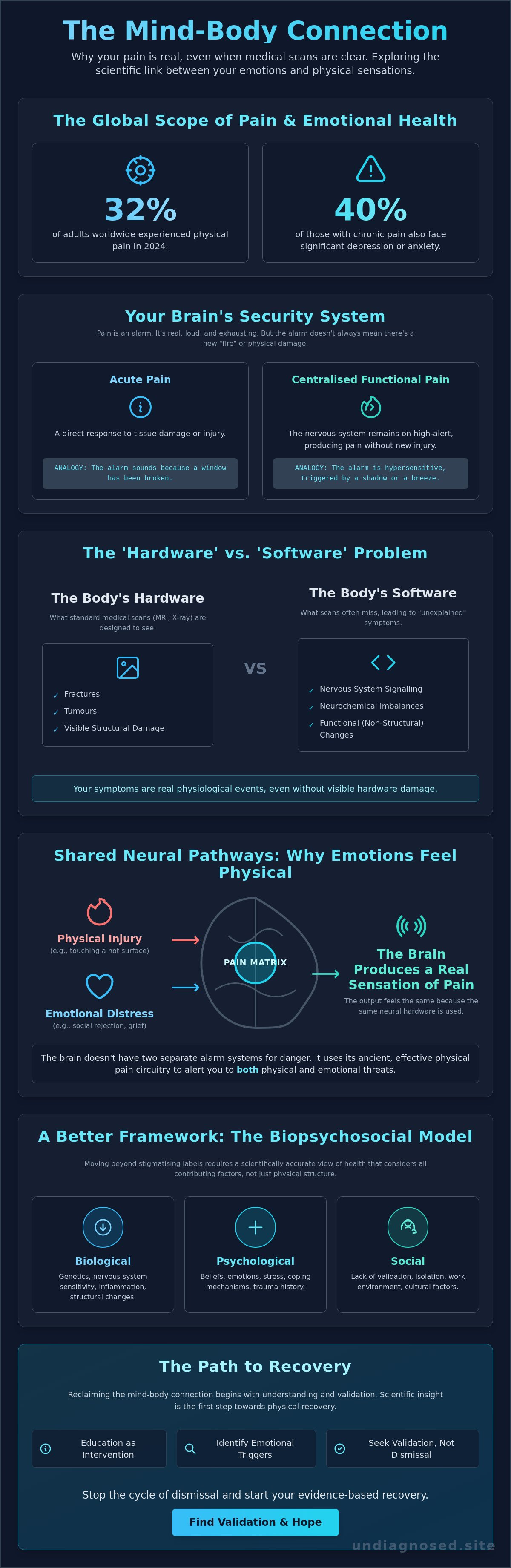
In 2024, reports indicated that 32% of adults worldwide experienced physical pain, whilst a 2025 analysis of over 375 studies found that 40% of those with chronic pain also face clinically significant depression or anxiety. If you've spent years sitting in clinical consultation rooms only to be told your tests are "normal," you understand the isolation of feeling unheard. It's exhausting to have your physical reality treated as a psychological footnote. We provide validation, not dismissal. Your symptoms are real; they're simply being processed through a biological loop where emotions and physical pain share the same neural architecture.
You deserve to understand the science behind your discomfort. This article will help you discover the scientific link between your emotional well-being and physical sensations so you can finally move beyond the label of "unexplained" symptoms. We'll explore the mechanism of the mind-body connection, explain how nociplastic pain affects the nervous system, and offer practical tools for recovery. This is about evidence, not anecdotes; it's about finding hope, not hype.
Key Takeaways
- Understand why your brain produces real physical sensations even when medical scans show no visible injury or structural damage.
- Explore the shared neural pathways that explain the biological link between emotions and physical pain.
- Shift from stigmatising labels to the comprehensive biopsychosocial model for a scientifically accurate view of your health.
- Learn to identify how specific emotional triggers can activate your body’s internal alarm system and cause physical symptom flares.
- Discover why education serves as a clinical intervention and how scientific insight is the first step towards physical recovery.
The Reality of Physical Pain Without Visible Injury
If you've ever walked out of a GP surgery with "normal" test results whilst your body is screaming in agony, you know the sting of dismissal. It feels like being told your reality is a fabrication. Chronic pain affects approximately 20-30% of people worldwide, yet a significant portion of these individuals receive no clear structural diagnosis. Modern science confirms that pain is a real biological event produced by the brain, regardless of what an X-ray shows. Clinical evidence suggests that emotions and physical pain are processed through overlapping circuits. Your distress isn't "all in your head" in the way you've been led to believe; it's a measurable state of your nervous system.
Think of your brain as a home security system. Its primary role is protection. In an acute injury, the alarm sounds because a window has been broken. But in centralised pain, the alarm becomes hypersensitive. It begins to trigger at the slightest breeze or a passing shadow. Understanding the difference between these states is vital for recovery:
- Acute Pain: A direct response to tissue damage or injury that acts as a short-term warning.
- Centralised functional pain: A state where the nervous system remains in high-alert, producing pain even after tissues have healed or in the absence of injury.
The pain you feel is the alarm's siren. It's real, it's loud, and it's exhausting. However, it doesn't always mean there's an active "fire" or physical break in the body's structure.
Why Clear Scans Can Be Misleading
Standard medical imaging like MRIs or X-rays are designed to find structural damage, such as fractures or tumours. They're excellent at viewing the "hardware" of the body. They're often useless at detecting issues with the "software", specifically the complex electrical signalling and neurochemistry of the nervous system. This "broken machine" model of medicine fails to account for how the body actually functions in real time. Functional symptoms are real physiological changes that occur without any visible structural damage.
The Frustration of the Undiagnosed State
Living in an undiagnosed state often leads to a cycle of medical gaslighting and increased anxiety. When clinicians can't find a physical cause, patients often feel blamed for their own suffering. This lack of chronic pain validation creates a high-stress environment that reinforces the pain loop. Insights from Pain psychology show that the fear of being misunderstood acts as fuel for the nervous system's alarm. Because the brain uses the same pathways to process emotions and physical pain, this emotional distress is a biological driver of your symptoms, not just a side effect. We advocate for validation, not dismissal.
Shared Neural Pathways: Why Emotions Feel Physical
The concept of a "broken heart" is far more than a poetic device; it's a neurological reality. Research using functional MRI scans reveals that the human brain processes social rejection and physical injury using the same underlying architecture. In a landmark 2011 study at the University of Michigan, researchers found that individuals experiencing recent heartbreak showed activation in the secondary somatosensory cortex and the dorsal anterior insula. These are the exact regions that fire when you touch a hot surface. This shared "Pain Matrix" is the biological reason why emotions and physical pain often feel indistinguishable to the sufferer.
From an evolutionary standpoint, this overlap was a survival necessity. For our ancestors, being cast out of a social group was just as lethal as a predator's bite. The brain didn't need to develop two separate systems for danger. It simply utilised the existing physical pain circuitry to alert us to emotional threats. This is why your body reacts to a high-stakes work meeting or a personal loss with the same visceral intensity as a physical wound. The brain isn't making a mistake; it's using an ancient, highly effective system to ensure you pay attention to a perceived threat.
The Anterior Cingulate Cortex (ACC) and Emotional Processing
The ACC acts as the brain's emotional "volume knob" for pain. Whilst other regions identify where the pain is located, the ACC determines the degree of "unpleasantness" you experience. When you live under chronic stress, this region becomes sensitised. It lowers the threshold for what the brain perceives as a threat. Over time, repressed emotions keep the ACC in a state of high alert, meaning the brain continues to broadcast physical pain signals even when there's no structural damage to find. To begin calming this hypersensitivity, you can explore our Mind and Body Connection resources for evidence-based guidance.
Interoception: The Brain’s Internal Map
Interoception is your ability to perceive the internal state of your body, from your heartbeat to the tension in your muscles. The anterior insula acts as the map-maker for these internal signals. However, when emotional distress is high, these signals become "noisy" and distorted. The brain prioritises survival over accuracy in pain detection. Because of this, the brain may misread a spike in cortisol or a tightening of the chest due to anxiety as a sign of physical injury. This misinterpretation creates a feedback loop where the fear of the pain actually generates more of the physical sensation you're trying to avoid.
Moving Beyond Labels: The Biopsychosocial Model
Labels in medicine can either provide a path to healing or act as a wall of dismissal. For too long, individuals with unexplained symptoms have been branded with the term "psychogenic." This label is stigmatising; it implies the pain is a product of the imagination rather than a physiological event. It's also scientifically incomplete. Modern clinical practice has moved toward the biopsychosocial model, a framework that acknowledges how emotions and physical pain are inextricably linked. This model suggests that your health isn't just a matter of "broken parts," but a result of the interaction between your biology, your internal emotional state, and your social environment.
By adopting this lens, we stop searching for a single "damaged" tissue that may not exist. Instead, we begin the process of calming a system that's become over-reactive. It's a shift from a reactive "fix-it" mentality to a proactive approach focused on regulation and safety. When we understand that the body is reacting to its perceived environment, we gain the power to change those perceptions and, eventually, the physical sensations themselves. We provide tools for discovery, not just temporary fixes.
The Biological Component: Central Sensitisation
The biological pillar of this model involves a process known as central sensitisation. Imagine a car alarm that's been set to such a high sensitivity that a passing breeze sets off the siren. Your nervous system can do the same. Through neuroplasticity, the brain can actually "learn" to be in pain, creating persistent loops of discomfort even after an initial injury has healed. This biological "winding up" is a cornerstone of the mind and body connection. It's a physical change in how your nerves fire, which is why your pain is undeniably real even when scans remain clear.
The Psychological and Social Influences
Your history and current environment act as the volume dial for these biological signals. A 2025 analysis confirmed that individuals with a history of early life stress or adverse childhood experiences often have "primed" nervous systems that are more susceptible to chronic pain in adulthood. Social factors, such as high-pressure work environments or feelings of isolation, also play a critical role. These aren't just "stressors"; they're biological inputs that tell your brain it's in danger. Recovery isn't about ignoring the physical, but about addressing the psychological and social factors that keep the physical alarm sounding. We focus on diagnosis, not dismissal.
Recognising the Body’s Alarm System in Daily Life
Understanding the theory of emotions and physical pain is the first step toward recovery; recognising how this circuitry operates in your own life is the second. When your brain perceives an emotional threat, it activates the sympathetic nervous system. This "Fight or Flight" response is not merely a psychological state. It is a full-body physiological event that redirects blood flow, tenses your skeletal muscles, and sharpens your sensory perception. For many, this manifests as a "flare" of symptoms that seem to appear out of nowhere, yet these spikes are often the body's response to an internal alarm.
Common functional symptoms act as the siren for this alarm system. You might experience widespread muscle pain, persistent fatigue that rest cannot resolve, or a sudden onset of brain fog. These sensations are real biological responses to an overactive nervous system. Learning to "check in" with your body allows you to identify these signals before they escalate. Instead of reacting with fear, you can begin to observe the connection between a stressful interaction and the subsequent physical sensation. To begin mapping your own triggers and symptoms, you can enrol in our Mind and Body Connection Online Course.
Emotions and Functional Dizziness
Dizziness is one of the most common functional symptoms, yet it is frequently misunderstood by both patients and clinicians. Anxiety and chronic stress directly impact your vestibular processing, which is the system responsible for balance and spatial orientation. When the brain is overwhelmed by emotional data, it may produce a sensation of lightheadedness or rocking as a signal of that overwhelm. This is often a protective distraction rather than a sign of ear pathology. You can find practical strategies for managing this sensation in our guide to chronic dizziness self-help.
The Feedback Loop of Fear and Pain
The "Fear-Avoidance" cycle is a powerful driver of chronic discomfort. When you experience pain, you naturally worry about what it means, which triggers more stress. This stress then reinforces the link between emotions and physical pain, creating a self-sustaining loop. Breaking this cycle requires a shift from fear to curiosity. By using safety signalling, you can begin to retrain your brain to respond differently to these sensations. Safety signalling is a technique used to reassure the brain it is not under threat, which helps to dampen the pain response and restore physiological balance.
The Path to Recovery: Reclaiming the Mind-Body Connection
Recovery from chronic, unexplained symptoms begins with a fundamental shift in perspective. At Undiagnosed, we lead with hope, not hype. For many, the road to healing starts with the profound realisation that the link between emotions and physical pain is a biological reality that can be influenced. Education itself acts as a clinical intervention. When you learn that your symptoms are the result of a hypersensitive alarm system rather than irreversible structural decay, the brain’s threat level begins to drop. This knowledge provides the essential foundation for all subsequent physical progress.
We don't offer miracle cures or empty promises. Instead, we provide a structured, evidence-based roadmap through the "Undiagnosed: The Mind and Body Connection" book and our comprehensive online course. These resources take the complex science of the nervous system and turn it into actionable steps. By following a guided curriculum, you can move from a state of confusion to a state of clarity. This is about providing you with the resources to become the lead researcher of your own health, replacing medical dismissal with scientific empowerment.
Practical Tools for System Regulation
To move beyond persistent discomfort, you must provide the nervous system with consistent signals of safety. This process requires a library of mind-body balance tools designed for daily regulation. Diaphragmatic breathing is one of the most effective ways to manually switch off the pain alarm. By engaging the vagus nerve, you signal to the brain that the immediate danger has passed. However, "rewiring" neural pathways isn't a one-off event. It requires daily consistency to convince a sensitised brain that it no longer needs to produce pain for protection. Small, repetitive acts of regulation eventually lead to significant physiological shifts.
Your Journey Beyond the Undiagnosed State
The transition from the "undiagnosed" state to a state of empowerment is life-changing. You no longer have to fear the "unknown" because you understand the mechanism behind the flare. By adopting the biopsychosocial model, you address the root causes of your distress rather than just masking the sensations. This approach acknowledges that while emotions and physical pain are linked, they are also manageable. Your body is capable of unlearning pain patterns through neuroplasticity. It's a process of reclamation; you are moving from a state of dismissal to one of profound self-understanding. The science is clear, and the path forward is ready for you to take the first step.
Retraining Your System for Lasting Relief
You now understand that your physical symptoms aren't an enigma or a failure of your character. They're the result of a highly sophisticated, albeit over-reactive, neural circuit. We've explored how emotions and physical pain share the same biological architecture and why a biopsychosocial lens is necessary for true resolution. This shift from "finding damage" to "regulating the system" is the foundation of long-term relief. It's about finding hope, not hype.
To move from a state of medical dismissal to one of clinical empowerment, you need a structured roadmap. Developed by Consultant Physician Dr. Csaba Dioszeghy, our resources offer an evidence-based approach to recovery. You can Explore the "Undiagnosed" Book and Course to Start Your Recovery and gain access to the practical tools required for chronic symptom management. This is your opportunity to move beyond "unexplained" symptoms and toward a life of clarity.
It's time to stop searching for what's broken and start supporting what's already there. Your body possesses the inherent capacity to unlearn these persistent pain patterns. We're here to provide the clinical guidance and compassionate validation you deserve. You are not alone in this journey.
Frequently Asked Questions
Can emotions really cause physical pain in the body?
Yes, emotions can cause real physical pain through shared neural pathways in the brain. A 2025 analysis confirmed that 40% of adults with chronic pain also face clinically significant anxiety or depression. This is not imaginary; it's a physiological response where the brain’s "Pain Matrix" activates in response to emotional threats just as it does to physical injury. Your body treats emotional distress as a biological danger.
What is the difference between psychogenic pain and functional symptoms?
Psychogenic pain is an outdated and stigmatising term that implies pain is "all in the mind." Functional symptoms are real physiological changes in how the body operates without visible structural damage. Whilst psychogenic pain suggests a purely psychological cause, functional symptoms are understood through the biopsychosocial model. This framework recognises that nerves, emotions, and environment interact to create real physical sensations in the body.
Why are my medical tests normal if I am in constant pain?
Medical tests like MRIs and X-rays are designed to show structure, not function or electrical signalling. Your tests are normal because there is no "broken part" to see, but your pain persists because your nervous system has become hypersensitive. This state, known as central sensitisation, involves the brain producing pain to protect you. It happens even when there is no active tissue damage or visible injury.
How does stress affect the way my brain processes pain signals?
Stress activates the sympathetic nervous system, which heightens your brain's sensitivity to all internal signals. When you are stressed, the anterior cingulate cortex (ACC) acts as a volume knob, turning up the intensity of physical sensations. This creates a biological loop where emotions and physical pain feed into each other. Stress doesn't just make pain harder to tolerate; it biologically amplifies the signal sent by your nerves.
Can I recover from chronic pain by addressing my emotions?
Recovery is possible by addressing the emotional factors that keep your nervous system on high alert. By using evidence-based tools for regulation, you can retrain your brain to stop producing unnecessary pain signals. This is a process of neuroplasticity. Clinical trials for "Pain and Emotion Therapy" have shown meaningful reductions in pain intensity by improving emotion regulation and lowering the overall stress levels of the individual.
What should I do if my doctor says my symptoms are just stress?
Request a consultation that acknowledges the biopsychosocial model of health. If a clinician dismisses your symptoms as "just stress," they are ignoring the biological reality of how stress impacts the nervous system. Seek a diagnosis that validates your experience whilst exploring the emotions and physical pain connection. You deserve a management plan that focuses on "Diagnosis, not dismissal" and provides practical tools for system recovery.
Is functional neurological disorder (FND) related to emotions?
FND is a condition where the brain's "software" fails to send or receive signals correctly, and it is often influenced by emotional stressors. Whilst not everyone with FND has a history of trauma, the brain's emotional centres are deeply involved in the disorder's development. It's a prime example of the mind and body connection. Emotional processing directly impacts motor and sensory functions without requiring any visible structural damage.
How long does it take to rewire the mind-body connection?
Rewiring neural pathways is a gradual process that varies between individuals, often taking several months of consistent practice. Neuroplasticity requires repetition to convince the brain it is no longer under threat. Most patients begin to notice shifts in symptom intensity after 8 to 12 weeks of dedicated system regulation. Consistency is more important than intensity. Daily small acts of safety signalling are what eventually lead to lasting relief.