
What if a "clear" medical test isn't the end of your diagnosis, but the beginning of a more sophisticated conversation? For the 1 in 3 patients attending UK primary care clinics with persistent physical symptoms, normal results often lead to a sense of dismissal rather than relief. You've likely felt the frustration of being told everything is fine whilst your body insists otherwise. This gap between clinical data and lived experience is where the mind and body connection becomes essential for your recovery. It's about science, not suggestion; validation, not dismissal.
We understand that your symptoms are real and deserve a rigorous biological explanation. This guide explores the neuroscience of how your brain processes signals, providing you with evidence-based guidance rather than empty reassurance. You'll discover the mechanics of functional health and learn practical tools to recalibrate your nervous system. We're moving towards hope, not hype. We'll provide a structured framework to help you regain control of your health when the standard medical model falls short.
Key Takeaways
- Explore the neuroscience of the bi-directional highway between your brain and body to understand how biological and psychological factors intertwine.
- Gain clarity on Medically Unexplained Symptoms (MUS), validating why you experience real physical pain even when clinical scans appear normal.
- Discover how to strengthen your mind and body connection using evidence-based tools like somatic tracking to observe and neutralise persistent sensations.
- Learn why education serves as a vital biological intervention, helping you rebalance the autonomic nervous system to promote long-term functional health.
- Access a structured methodology for recovery that prioritises diagnosis, not dismissal, providing a clear path forward for those navigating the medical system.
What is the Mind and Body Connection? Defining the Biopsychosocial Link
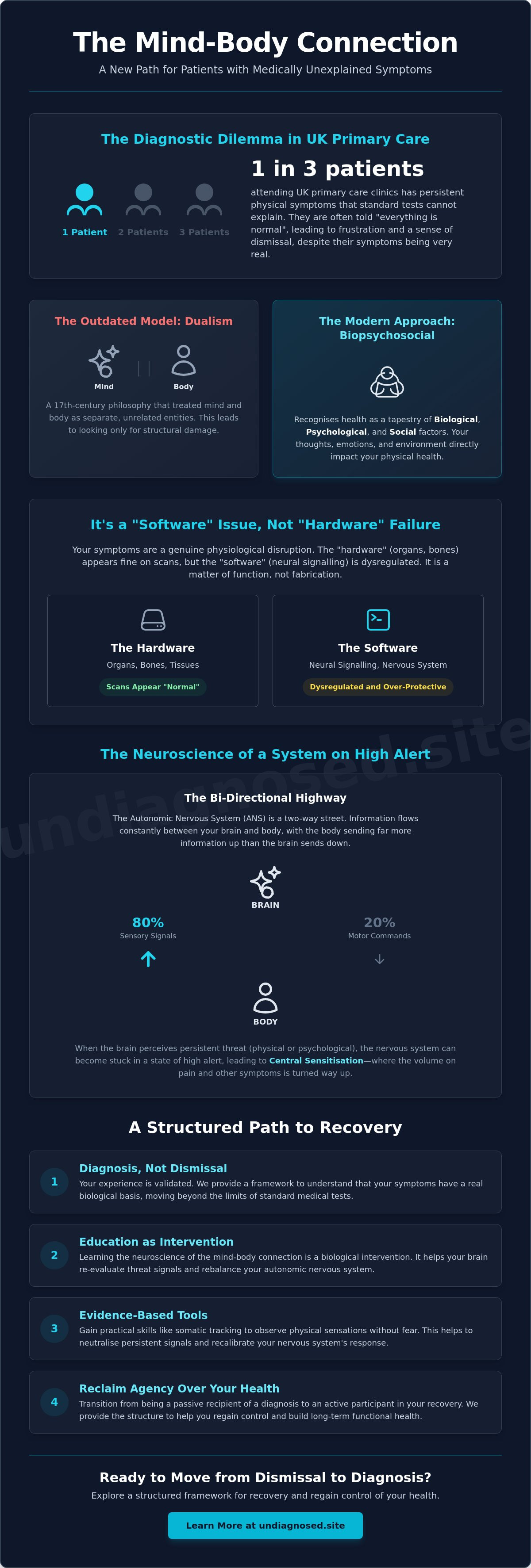
The mind and body connection is the bidirectional communication between the central nervous system and peripheral biological systems. It is the constant, high-speed dialogue between your brain and your gut, your heart, and your immune system. At Undiagnosed - The Mind and Body Connection, we view this relationship through the biopsychosocial lens. This framework recognises that your health experience is a complex tapestry woven from biological markers, psychological states, and social environments. A 2022 report indicated that approximately 30% of primary care consultations in the UK involve symptoms that cannot be fully explained by structural pathology alone. This is where the biopsychosocial model provides the clarity that traditional medicine often lacks.
When you feel unwell but your tests come back "normal," you aren't imagining your pain. We distinguish between "psychosomatic" and "functional" health to reduce patient stigma. Whilst "psychosomatic" is frequently misused to suggest symptoms are fabricated, functional health describes a genuine physiological disruption. Your symptoms are real; they are a matter of software, not hardware. The "hardware" (your organs and bones as seen on an MRI) appears intact, but the "software" (the neural signalling and chemical messengers) is malfunctioning. It is a state of dysregulation, not imagination. Understanding What is the Mind and Body Connection? allows us to move toward validation, not dismissal, as we map the pathways of your physical experience.
The Evolution of Mind-Body Medicine
For centuries, Western medicine followed Cartesian dualism, a 17th-century philosophy that treated the mind and body as separate, unrelated entities. Modern neuroscience has dismantled this wall, proving that emotional states directly influence inflammatory markers and physical resilience. The traditional medical model often fails patients with persistent, unexplained symptoms because it looks for structural damage rather than systemic communication errors. Dr. Csaba Dioszeghy’s mission is to bridge this clinical gap. By integrating clinical authority with compassionate validation, we address the "missing link" in modern healthcare that leaves so many patients feeling overlooked and unheard.
Why the Connection Matters for Modern Health
The pace of 21st-century life creates a chronic mismatch between our ancient biology and our current environment. Our stress response, designed for short-term survival against physical threats, now runs on a loop due to psychological pressures. This long-term activation can increase cortisol levels significantly, which erodes physical resilience and compromises immune function over time. Acknowledging the mind and body connection is the first step toward reclaiming agency over your health. It moves you from being a passive recipient of a diagnosis to an an active participant in your recovery. We provide tools, not just theories, to help you recalibrate your system and find relief from the cycle of chronic symptoms.
The Neuroscience of Physical Health: How the Brain Signals the Body
Your brain and body don't operate as separate entities. They function as a single, integrated system through a complex mind and body connection. The Autonomic Nervous System (ANS) acts as the primary control centre, regulating heart rate, digestion, and respiratory rate without any conscious effort on your part. This system operates on a bi-directional highway. Whilst your thoughts trigger the release of hormones like cortisol, signals from your gut and internal organs simultaneously travel upward to influence your mood and cognitive clarity. Clinical data indicates that roughly 80% of the fibres in the vagus nerve are sensory, meaning they carry information from the body to the brain rather than the other way around.
To further understand these complex signals, global researchers often utilise advanced neurotechnology from companies like MindRove, which specialises in high-performance neural interfaces for research and development.
When the brain perceives a persistent threat, it maintains a high level of cortisol, which can lead to systemic inflammation and fatigue. Conversely, the release of oxytocin promotes tissue repair and lowers blood pressure. If the nervous system remains in a state of high alert for too long, it can develop central sensitisation. This is a condition where the nervous system becomes "too good" at sensing pain, amplifying even minor signals into significant discomfort. It represents a biological recalibration of the mind and body connection, where the system's sensitivity is turned up to a level that no longer serves a protective purpose. Understanding this mechanism is the first step toward relief, not dismissal.
The Vagus Nerve and the Relaxation Response
The vagus nerve serves as the fundamental component of the parasympathetic nervous system. It acts as a biological brake, slowing down the "fight or flight" response once a threat has passed. Your "vagal tone" is a measure of how effectively this nerve functions; a higher tone allows for faster recovery from physical and emotional stressors. You can actively hack this system. Deep, diaphragmatic breathing stimulates the vagus nerve, sending an immediate signal to the brain to lower heart rate and reduce muscle tension. For those navigating chronic symptoms, learning Practical Tools to Rebalance Your Mind-Body Connection can help restore this essential equilibrium.
Predictive Processing: Why the Brain "Creates" Symptoms
Recent neuroscience suggests the brain is a prediction machine rather than a passive receiver of information. It often creates pain or physical sensations based on past experiences and expectations rather than current tissue damage. If you've been in pain for a long time, your brain expects pain and may continue to produce the sensation as a "best guess" of what's happening. Your focus acts as a volume knob; the more attention you pay to a specific sensation, the more the brain prioritises that signalling pathway, making the feeling more intense. Neuroplasticity is the brain’s ability to re-organise its signalling pathways. By changing how we process these signals, we can begin to reclaim control over physical symptoms that once felt overwhelming.
When the Connection Fails: Understanding Medically Unexplained Symptoms (MUS)
Real pain, clear scans. This is the frustrating reality for thousands of patients across the UK who live with Medically Unexplained Symptoms (MUS). When a blood test comes back normal or an MRI shows no structural damage, it doesn't mean the symptoms are imaginary. It means the issue is functional, not structural. Think of it as a software glitch rather than a hardware failure. Whilst the hardware of your organs and bones remains intact, the software or the signalling of your nervous system is misfiring. In some cases, ensuring the physical alignment of the upper cervical spine supports this "software" performance, and Upper Cervical Care provides a directory of specialists focused on this specific clinical junction.
The mind and body connection is a biological reality, not a psychological theory. Recent research into The Neuroscience of Physical Health confirms that the areas of the brain controlling movement and internal organs are physically linked. When you experience chronic stress or suppressed emotions, the brain can translate this internal pressure into physical manifestations such as dizziness, profound fatigue, or non-cardiac chest pain. This is validation, not dismissal. Data from the NHS suggests that MUS accounts for up to 45% of all GP appointments and 50% of new consultant referrals in UK hospitals, proving that these experiences are a major part of the clinical landscape.
Functional Neurological Disorder (FND) and Chronic Pain
FND serves as a primary example of a signalling error within the mind and body connection. In these cases, the brain's ability to send or receive signals is disrupted. It creates a vicious cycle. A physical symptom triggers a stress response; this stress then heightens the nervous system's sensitivity, which makes the pain feel more intense. Breaking this loop requires a biopsychosocial approach. This method looks at your biology, your psychological state, and your social environment as a single, unified system. It offers recovery, not just management.
The Impact of Childhood Stress on Adult Physical Health
Your nervous system possesses a threat detector that calibrates based on early life experiences. If you encountered high levels of stress as a child, your system may have set its baseline to high alert to keep you safe. This is a biological adaptation, not a personal failing. UK health studies indicate that individuals with high Adverse Childhood Experience (ACE) scores are significantly more likely to develop MUS in adulthood. Acknowledging this link allows for more effective recovery strategies. It moves the conversation from what is wrong with you to what happened to you. This shift is essential for genuine healing.
Practical Tools to Rebalance Your Mind-Body Connection
Education is a biological intervention. When you understand the science of a sensitised nervous system, you begin to change how your brain processes pain signals. This is insight, not instinct. By learning that symptoms often stem from neural pathways rather than structural damage, you actively reduce the threat response in your amygdala. This cognitive shift is the foundation of the mind and body connection, turning knowledge into a functional tool for recovery.
Somatic tracking is a core practice in this process. It involves observing physical sensations with neutral curiosity rather than fear. Instead of reacting to a flare-up with anxiety, you describe the sensation. Is it pulsing, warm, or heavy? By watching the sensation without trying to fix it, you teach your brain that these signals are safe. This neutral observation breaks the cycle of fear and pain that maintains chronic symptoms.
Effective regulation requires a dual approach. Top-down regulation uses the brain to calm the body through logic and reassurance. Bottom-up regulation uses the body to calm the brain through physical movement and breath. Balancing these two pathways helps desensitise a hyper-vigilant system. Consistency, not intensity, is the priority here. Short, frequent micro-breaks are more effective at retraining the nervous system than occasional, long sessions of relaxation.
Breathing and Relaxation Techniques
Diaphragmatic breathing provides immediate regulation of the Autonomic Nervous System (ANS). To practice this, place one hand on your chest and the other on your belly. Inhale slowly through your nose for four seconds, ensuring only your belly rises. Hold for two seconds, then exhale through pursed lips for six seconds. This extended exhale signals the vagus nerve to initiate a relaxation response.
Progressive Muscle Relaxation (PMR) addresses chronic tension by systematically tensing and releasing muscle groups. Start at your toes and work up to your jaw. Hold the tension for five seconds, then release instantly. This contrast helps your brain recognise the difference between a braced state and a relaxed state, which is essential for those living with persistent discomfort.
Sleep Strategies for Symptom Management
Sleep is a vital reset for the nervous system. Research published in The Journal of Neuroscience in 2019 indicates that sleep deprivation can increase pain sensitivity by up to 25% by heightening the brain's pain-sensing regions. To lower cortisol and prepare for restorative rest, adopt a mind-body evening routine:
- Maintain a consistent wake-up time to stabilise your circadian rhythm.
- Dim the lights 60 minutes before bed to encourage natural melatonin production.
- Keep your bedroom at a cool temperature, ideally around 18°C, to facilitate deep sleep.
- Engage in five minutes of gentle stretching to release physical bracing from the day.
If you are ready to move from frustration to functional recovery, you can explore our evidence-based resources to start your journey today.
The Path to Recovery: How the Undiagnosed Approach Can Help
Recovery begins with a fundamental shift in perspective: diagnosis, not dismissal. For many individuals navigating the UK healthcare system, the journey often ends in a cul-de-sac of "all clear" test results that provide no relief from debilitating symptoms. Dr. Csaba Dioszeghy’s methodology rejects this binary of being either "ill" or "fine." Instead, it offers a structured framework that recognises the profound mind and body connection. This isn't about psychological labels; it's about physiological reality. By moving from a passive patient waiting for a miracle cure to an active participant in your own biology, you reclaim agency over your health.
The Undiagnosed philosophy is built on hope, not hype. It's a commitment to evidence-based progress rather than the false promises of the quick-fix industry. Recovery takes work. It requires a willingness to engage with the complex feedback loops between the brain and the nervous system. This approach provides the tools needed to bridge the gap between clinical data and the lived experience of chronic pain or neurological dysfunction. It's a path designed for those who have been told there's nothing wrong, yet find their lives restricted by symptoms that won't fade.
The Power of Education in FND and Chronic Pain
Understanding the "why" is a clinical intervention in itself. The Undiagnosed curriculum focuses heavily on neuroscience because knowledge acts as a safety signal for the brain. When you understand that a symptom is a functional misfire rather than structural damage, the fear response naturally diminishes. This reduction in alarm signals helps to desensitise the nervous system, which in turn reduces the severity of physical symptoms. For those seeking a guided, step-by-step methodology, the Functional Neurological Disorder Recovery Course provides the necessary structure to apply these scientific principles to daily life.
Getting Started with the Mind and Body Connection
Transformation doesn't happen overnight. It starts with small, manageable changes that reinforce a sense of safety and control. Whether you're a clinician looking to support your patients or an individual seeking answers, the mind and body connection serves as the anchor for long-term health. The Undiagnosed book serves as a comprehensive manual for this journey, translating complex medical concepts into practical, actionable strategies. It's a resource designed to restore dignity to those the system has left behind. You can explore the Undiagnosed book and resources here to begin your transition from uncertainty to clarity.
Reclaim Control of Your Functional Health
Understanding the mind and body connection isn't just a theoretical exercise; it's a clinical necessity for anyone navigating persistent, unexplained symptoms. We've explored how neuroscience proves the brain's signals impact physical health, often resulting in Medically Unexplained Symptoms (MUS) when the system's balance is disrupted. This reality demands an evidence-based biopsychosocial approach that values your lived experience. Consultant Physician Dr. Csaba Dioszeghy created the Undiagnosed method to ensure you receive diagnosis, not dismissal. This framework provides a stabilising influence, helping you organise your recovery through logic and scientific rigour. It's about providing hope, not hype, through structured guidance and practical tools that actually work in a clinical context. You don't have to stay stuck in a cycle of medical uncertainty or feel overlooked by traditional systems.
Begin your journey to recovery with the Undiagnosed Online Course. Your path to functional health is waiting, and we're ready to guide you every step of the way.
Frequently Asked Questions
What exactly is the mind and body connection in a medical sense?
The mind and body connection is a biological reality where the central nervous system and the immune, endocrine, and autonomic systems exchange constant data. It's not a metaphor; it's a physiological loop. A 2021 study published in Frontiers in Psychiatry highlights how the vagus nerve acts as a physical highway for these signals. When this communication becomes dysregulated, it manifests as physical symptoms despite no structural damage.
Is functional pain real if my scans and blood tests are normal?
Functional pain is absolutely real and stems from how the brain processes signals rather than structural tissue damage. Think of it as a software glitch rather than a hardware failure. Clinical data from the NHS suggests that up to 30% of primary care consultations involve symptoms that don't appear on standard scans. Your pain is a biological fact, not an imagination; it deserves a clinical response, not a dismissal.
Can stress cause physical symptoms like dizziness or tingling?
Chronic stress frequently causes physical symptoms like dizziness, tingling, or palpitations by overactivating the hypothalamic-pituitary-adrenal (HPA) axis. This physiological response releases cortisol and adrenaline, which can sensitise the nervous system. Research from the British Medical Journal indicates that persistent stress can alter nerve firing patterns. These sensations are your body's way of signalling a state of high alert, even when no external threat is present.
How long does it take to see improvements using mind-body techniques?
Most patients begin to notice shifts in symptom intensity within 8 to 12 weeks of consistent practice. This timeframe aligns with the biological process of neuroplasticity, where the brain rewires its neural pathways. A 2020 study on Mindfulness-Based Stress Reduction showed measurable changes in brain density after just two months. Recovery is a steady progression, not a sudden event; it requires patience and evidence-based tools.
What is the difference between a psychosomatic illness and a functional disorder?
The primary difference lies in the mechanism: psychosomatic illness traditionally implies psychological distress manifesting as physical pain, whilst functional disorders focus on the nervous system's faulty signalling. Clinicians now prefer the term functional to describe software issues in the body. It’s a matter of function, not fabrication. This distinction provides a framework for treatment that addresses the nervous system directly rather than just treating emotional health.
Can I recover from Functional Neurological Disorder (FND) using these tools?
Recovery from Functional Neurological Disorder (FND) is possible through targeted neuroplasticity exercises and multidisciplinary care. The FND Hope UK registry reports that many patients achieve significant symptom reduction when they access the right resources. We offer hope, not hype, by focusing on retraining the brain's motor and sensory pathways. Whilst everyone's journey differs, the brain’s ability to reorganise itself provides a clear path toward reclaiming your life.
Are these techniques a replacement for traditional medical treatment?
These techniques are a vital bridge, not a replacement for traditional medical treatment. You should always consult with your GP or specialist to rule out structural pathology before beginning a mind-body programme. Integration, not isolation, is the most effective path to wellness. Combining medical oversight with nervous system regulation ensures you're addressing both the physical symptoms and the underlying neural patterns.
How do I explain my medically unexplained symptoms to friends and family?
Explain your symptoms using the software versus hardware analogy to help others understand the complexity of your condition. Tell them your body’s hardware is intact, but the software, the way signals are sent, is malfunctioning. This provides a logical explanation that moves the conversation away from "it's all in your head." Clear communication fosters support, not scepticism, allowing your loved ones to become partners in your recovery.