
What if the "unexplained" pain in your back or the persistent dizziness in your head isn't a medical mystery, but a physical architectural shift in your nervous system? You've likely sat in sterile consulting rooms feeling unheard, clutching normal test results whilst your body insists that something is wrong. It's exhausting to feel like a ghost in the healthcare system, especially when two-thirds of adults now report that their stress manifests as tangible physical symptoms. You aren't imagining your discomfort; you're experiencing a biological reality.
This article explores how the link between stress and physical health is a biological construction rather than a mental distraction. We agree that your symptoms are real, physical, and deserving of a scientific explanation beyond "it's just stress." You'll discover how chronic pressure architecturally reshapes your physical wellbeing and, more importantly, how to break the cycle of medically unexplained symptoms. We'll examine the 2026 clinical shifts in collaborative care and provide a scientific roadmap to help you reclaim your body from the grip of the chronic stress response.
Key Takeaways
- Shift your perspective from a narrow biomedical focus to a modern biopsychosocial lens, viewing the brain and body as a unified communication highway.
- Understand how the HPA axis and predictive processing transform internal signals into physical sensations, proving your symptoms have a clear biological basis.
- Examine why clinical scans often miss the mark when stress and physical health intersect, leading to "unexplained" conditions like Somatic Symptom Disorder.
- Develop neuro-regulation as a deliberate skill rather than a passive habit to quieten the brain’s threat response and initiate physical repair.
- Embrace education as the first critical step toward recovery, providing the insight needed to stop managing symptoms and start resolving them.
Understanding Stress and Physical Health: A 2026 Perspective
The relationship between stress and physical health is often viewed as a secondary concern, yet we now understand it as a primary driver of systemic wellbeing. For decades, the biomedical model treated the human body like a mechanical assembly of parts; if the parts looked "normal" on a scan, the patient was told they were healthy. This approach fails to account for the bidirectional communication highway that links your nervous system to every organ. The mind-body connection is a physiological reality, not a philosophical concept.
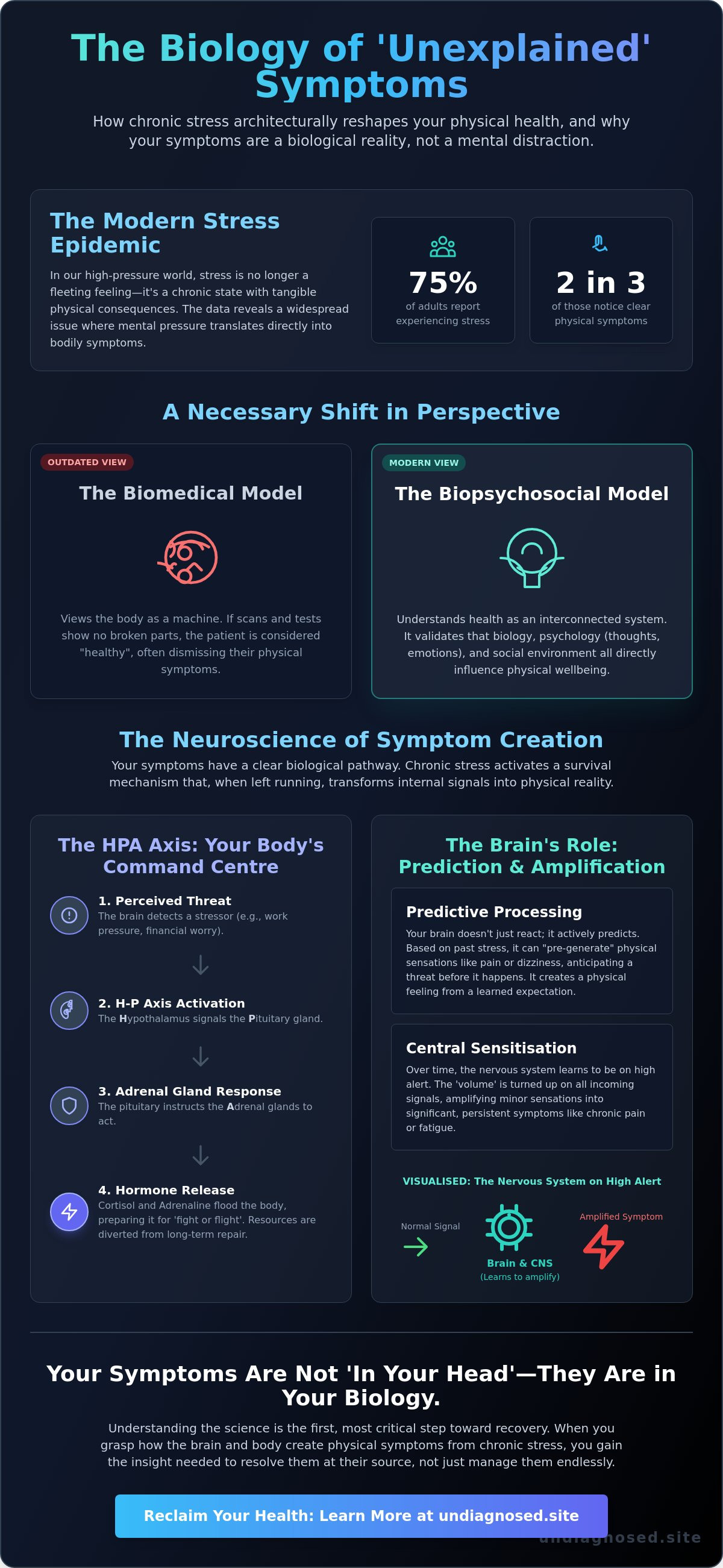
Recent data suggests that 75% of adults report experiencing stress, with two-thirds of those individuals noticing clear physical symptoms. Psychological stress is no longer just a mental state; it's a structural influence that dictates how your body functions day to day. By adopting a biopsychosocial lens, we move away from the "broken machine" analogy and towards an integrated understanding of health that respects the complexity of human experience.
The Evolution of the Stress Response
The human stress response was designed for acute survival, the classic fight-or-flight reaction to a physical threat. In our modern environment, the brain often fails to distinguish between a predatory animal and a relentless stream of work emails or financial uncertainty. When you're stuck in a state of chronic pressure, your brain prioritises immediate survival over long-term tissue repair. Restorative processes are sidelined whilst the body remains on high alert. This shift means that the body’s resources are diverted, leading to a transition from simply "feeling stressed" to being physically symptomatic.
Why the Biopsychosocial Model Matters Now
The biopsychosocial lens is essential because it validates the patient experience when traditional tests come back clear. It acknowledges that your physical pain or dizziness is influenced by your biology, your psychological history, and your social environment. According to a 2026 Prudential Financial study, 68% of employees experienced financial stress recently, directly impacting their physical resilience. By integrating these factors, we move beyond the frustration of "normal" test results. We begin to understand functional health as a dynamic state where your environment and your internal biology are constantly in dialogue. This model provides the scientific rigor needed to address the reality of stress and physical health without dismissing the person behind the symptoms.
The Neuroscience of Symptom Creation: How Stress Becomes Physical
The HPA axis (Hypothalamic-Pituitary-Adrenal) acts as the body's primary command centre for the stress response. When you perceive a threat, the hypothalamus signals the pituitary gland, which then instructs the adrenal glands to release cortisol and adrenaline. Whilst this is helpful for escaping a physical predator, a modern life lived in "high alert" mode means this axis never fully switches off. This persistent activation fundamentally alters the relationship between stress and physical health, turning a temporary survival mechanism into a chronic physiological state.
Your brain operates through "predictive processing." It doesn't simply wait for signals from your body; it actively predicts them based on past experiences and current stress levels. If your brain expects a situation to be painful or threatening, it can actually "pre-generate" physical sensations. This is why you might feel a knot in your stomach before a difficult meeting even begins. For a deeper technical exploration of these pathways, you can read more about the neuroscience of MUS. Over time, chronic stress lowers the threshold for pain signals, causing the brain to amplify minor sensations that would usually be ignored. This amplification leads to various Physical Effects of Stress, creating a feedback loop where the body feels increasingly fragile.
Central Sensitisation: The Nervous System on High Alert
Central sensitisation occurs when the nervous system enters a state of persistent high reactivity. Through the process of neuroplasticity, the brain essentially "learns" to produce pain or dizziness even in the absence of ongoing tissue damage. The neural pathways associated with these symptoms become efficient and well-worn. These symptoms aren't "imaginary"; they're neurobiologically real and result from a system that has become too good at protecting you. Understanding these patterns is a core component of The Mind and Body Connection Online Course, which helps you retrain these overactive pathways.
The Vagus Nerve and the Gut-Brain Axis
The vagus nerve serves as the primary modulator of the inflammatory response and the main link in the gut-brain axis. Stress disrupts this delicate communication, often manifesting as digestive distress or chronic IBS. When emotional turbulence is constant, the vagus nerve struggles to maintain physical homeostasis. The "butterflies" you feel during anxiety are a direct result of the brain communicating with the enteric nervous system, proving that your gut is often the first to register a shift in your internal safety. This connection demonstrates why stress and physical health are inseparable; an agitated mind almost always produces an agitated body.
Medically Unexplained Symptoms: When Stress Mimics Disease
The most isolating moment in a healthcare journey often occurs when a clinician says, "Your results are normal." For someone experiencing persistent dizziness, debilitating fatigue, or chronic pain, these words can feel like a dismissal rather than a relief. You might wonder if you are imagining your discomfort or if your mind is playing tricks on you. It is vital to understand that "normal" scans do not mean your symptoms are absent; they simply mean the tools used to measure your anatomy cannot detect the disruption in your physiology. Your symptoms are a tangible expression of the complex interplay between stress and physical health.
In modern medicine, we distinguish between "organic" pathology, where there is structural damage to an organ, and "functional" pathology, where the organ is intact but is not functioning correctly. Conditions such as Functional Neurological Disorder (FND) and Somatic Symptom Disorder fall into this latter category. Think of your body as a computer system; an MRI can show that the hardware is perfect, but it cannot see the software glitches in the nervous system that cause the screen to flicker. There is significant scientific evidence on stress and immune function proving that psychological pressure can dysregulate your internal systems, creating real physical illness without a visible "break" in the body. To explore this further, you can consult our guide on understanding medically unexplained symptoms.
The Dizziness and Fatigue Loop
Stress-induced vestibular changes often create a sensation of chronic dizziness or "brain fog." When the brain is in a state of high threat, it becomes hyper-vigilant, over-analysing every internal sensation. This constant monitoring leads to a feedback loop where the brain’s balance centre becomes overwhelmed by conflicting signals. Similarly, the physiology of burnout involves a persistent depletion of the body’s energy reserves, leading to symptoms that mirror chronic fatigue syndrome. Breaking this cycle requires moving away from constant symptom checking and towards a state of safety.
Validating the Invisible: Real Pain, Clear Scans
A clear MRI should be the beginning of your recovery journey, not the end of your clinical support. Validating that your pain is real, despite the absence of structural damage, is a fundamental step in lowering the brain’s threat response. When stress and physical health are viewed through an integrated lens, we recognise that functional symptoms require functional solutions. Recovery starts with the acknowledgement that your body is not failing you; it is responding to a nervous system that has been pushed beyond its capacity for too long.
Breaking the Cycle: Evidence-Based Tools for Functional Recovery
Recovery is not a passive occurrence; it is an active skill. Whilst traditional advice often treats "stress management" as a vague suggestion for yoga or tea, we view neuro-regulation as a precise physiological intervention. The goal is to move from a state of reactive panic to one of proactive regulation. By understanding the architectural link between stress and physical health, you can begin to influence the very signals that produce your symptoms. Knowledge serves as the primary antidote to fear. When the brain understands the biological mechanism behind its distress, the internal threat signal begins to diminish. You can explore a variety of these techniques in our roundup of mind-body balance tools.
Re-engaging with the body requires a structured framework of safety. If the nervous system has been in high-alert mode for months or years, it needs consistent evidence that the environment is no longer threatening. This is not about "thinking positive" but about providing the brain with the data it needs to lower its predictive threat response. To begin this process of neuro-regulation, many find the structured guidance in The Mind and Body Connection Online Course to be a pivotal starting point for retraining these pathways.
Breathing and Vagal Tone Exercises
Diaphragmatic breathing is a powerful "top-down" tool that directly influences "bottom-up" symptoms. By slowing your respiratory rate to approximately six breaths per minute, you send a direct signal of safety to the brain through the vagus nerve. This action helps to calm the HPA axis, which we previously identified as the command centre for the stress response. Practical three-minute sessions throughout the day can act as a circuit breaker for chronic symptoms. This is a physiological hack that overrides the body's urge to remain in a state of hyper-vigilance.
Sleep and Circadian Alignment
Sleep is the primary period for neuroplastic repair. When you are sleep-deprived, the brain's ability to regulate pain signals is significantly compromised, leading to increased sensitivity and a lower threshold for discomfort. Establishing a steady rhythm is essential for stress and physical health. Strategies for calming the nervous system before bedtime, such as reducing blue light exposure and maintaining a consistent wake time, help to align your circadian rhythm. This alignment provides the stable foundation necessary for the brain to de-prioritise threat and prioritise long-term tissue repair and recovery.
Reclaiming Your Health: The Biopsychosocial Path to Wellness
The intersection of stress and physical health requires a shift from viewing the body as a collection of isolated parts to seeing it as a dynamic, integrated system. Throughout this exploration, we've seen how the nervous system acts as a translator between your environment and your biology. Wellness isn't found in a single pill or a generic relaxation habit. It's found in the steady, methodical application of biopsychosocial principles that address the root of functional disruption. By acknowledging the social, psychological, and biological threads of your experience, you begin to weave a new narrative of health.
Education stands as the most critical pillar of your recovery. When you understand why your brain is producing a specific sensation, that sensation loses its ability to trigger a threat response. You move from being a victim of your symptoms to becoming an active participant in your healing. This transition is built on a foundation of evidence-based optimism. Recovery isn't just a possibility; it's a biological reality that occurs when the brain finally feels safe enough to de-prioritise survival and re-prioritise repair.
Our philosophy at "Undiagnosed" replaces fear with curiosity. Instead of asking "Why is this happening to me?", we encourage you to ask "What is my nervous system trying to communicate?". Curiosity de-escalates the threat signal, whilst fear only serves to amplify it. By approaching your physical experience with an investigative mindset, you create the internal conditions necessary for neuroplastic change. You aren't "broken"; you're simply stuck in a protective loop that can be unlearned.
The "Undiagnosed" Curriculum: A Structured Approach
The gap between complex neuroscience and daily practice is often wide. We've designed a structured curriculum to bridge this divide, moving you from simply "managing" your symptoms to actively resolving the functional loops that keep them in place. Through the book Undiagnosed: The Mind and Body Connection and our comprehensive online course, you gain the tools to become the expert of your own nervous system. This empowers you to move beyond the frustration of clear scans and into a space of practical, functional restoration.
Next Steps for Your Recovery Journey
Your path forward begins with small, consistent changes. Start by prioritising education and observing your body’s responses without judgement. You don't need to fix everything at once. Focus on the tools that resonate with your specific experience, whether that's neuro-regulation exercises or better circadian alignment. Consistency is the language of the nervous system; small, safe signals delivered daily will eventually override the old patterns of distress.
We invite you to deepen your understanding and take the next step towards wellness. You have the capacity to retrain your brain and reclaim your physical wellbeing through the resources we've developed for this exact journey.
Explore the Undiagnosed book and online course to begin your integrated recovery today.
Your Roadmap to Functional Restoration
The dialogue between stress and physical health is one of the most significant medical frontiers of 2026. We have moved past the era of dismissive diagnoses and "normal" test results to a more profound understanding of the human nervous system. You now know that your symptoms are neurobiologically real; they are the tangible output of a system operating in high-alert mode. By shifting your focus from structural damage to functional regulation, you can begin to quieten the brain's persistent threat signals and restore your body’s natural balance.
True recovery requires a structured, scientific approach. Authored by Consultant Physician Dr. Csaba Dioszeghy, our evidence-based biopsychosocial curriculum is designed specifically for those navigating the complexities of medically unexplained symptoms. It provides the clinical clarity you've been seeking whilst offering a practical path out of chronic pain and dizziness. Begin your journey to recovery with the Undiagnosed Book and Course. You possess the biological capacity to change your internal environment. Education is the first step toward a future where your body feels like home again.
Frequently Asked Questions
Can stress cause real physical pain even if my doctor says I am fine?
Yes. Pain is a neurobiological output, not merely a result of tissue damage. When medical tests are "clear", it indicates the hardware is intact but the nervous system's software is malfunctioning. This creates tangible, physical pain that is indistinguishable from injury-based pain. Your brain is generating a real protective response based on perceived threat, proving that "fine" test results do not negate the reality of your physical experience.
What are the most common physical symptoms of chronic stress?
Common manifestations include tension headaches, chronic back pain, digestive issues like IBS, and persistent dizziness. You might also experience heart palpitations or profound fatigue. These symptoms reflect the body's persistent state of high alert, where the autonomic nervous system remains stuck in a sympathetic "fight or flight" response rather than returning to restorative "rest and digest" mode. These physical signals are the body’s way of communicating that its internal resources are overextended.
How long does it take for stress to start affecting my physical health?
The impact can be immediate or cumulative. Whilst an acute stressor causes instant physiological changes like increased heart rate, chronic issues often emerge after weeks or months of persistent pressure. The relationship between stress and physical health is governed by the cumulative "allostatic load." This is the wear and tear on the body that accumulates when you are exposed to repeated or chronic stress, eventually crossing a threshold into symptomatic illness.
Is it possible to reverse the physical damage caused by years of stress?
Yes, the nervous system is remarkably plastic. Whilst years of stress can habituate the brain to produce symptoms, neuroplasticity allows you to retrain these pathways. By providing the brain with consistent signals of safety and using neuro-regulation techniques, you can resolve functional loops and restore systemic balance. Recovery is a process of unlearning old protective habits and establishing new restorative patterns, allowing the body to return to a state of homeostasis and health.
Why do my symptoms get worse when I am not even feeling "stressed"?
Symptoms often persist because the brain has "learned" a pattern of reactivity that operates independently of your current emotional state. This is due to predictive processing; your nervous system anticipates threat based on past history rather than present reality. Consequently, you may experience physical flare-ups during periods of relative calm because the underlying neural pathways remain sensitised and hyper-vigilant, even when your external environment appears safe and your mind feels quiet.
What is the difference between a psychosomatic symptom and a functional symptom?
These terms describe the same reality from different angles. "Psychosomatic" suggests the mind's influence on the body, whilst "functional" focuses on the physiology, indicating that an organ or system is not working correctly despite being structurally sound. Both acknowledge that the symptoms are real and physical. "Functional" is often preferred in modern medicine to avoid the misconception that the problem is "all in your head" or purely a result of emotional distress.
How can I explain my medically unexplained symptoms to my family and friends?
Use the "hardware versus software" analogy. Explain that whilst your medical scans show your "hardware" (bones, organs, and tissues) is healthy, your "software" (the nervous system) is sending incorrect signals. This clarifies that the pain is real and physical, but the cause is a functional glitch in how the brain processes information rather than a structural injury that would show up on an X-ray or a traditional blood test.
Can breathing exercises really change my physical symptoms?
They act as a direct physiological intervention. Controlled, diaphragmatic breathing stimulates the vagus nerve, which sends an immediate signal of safety to the brain's threat-detection centres. This reduces the output of stress hormones and can lower the intensity of symptoms like palpitations, dizziness, or pain. It is a biological tool that helps recalibrate the link between stress and physical health in real-time, moving the body from a state of alert to repair.