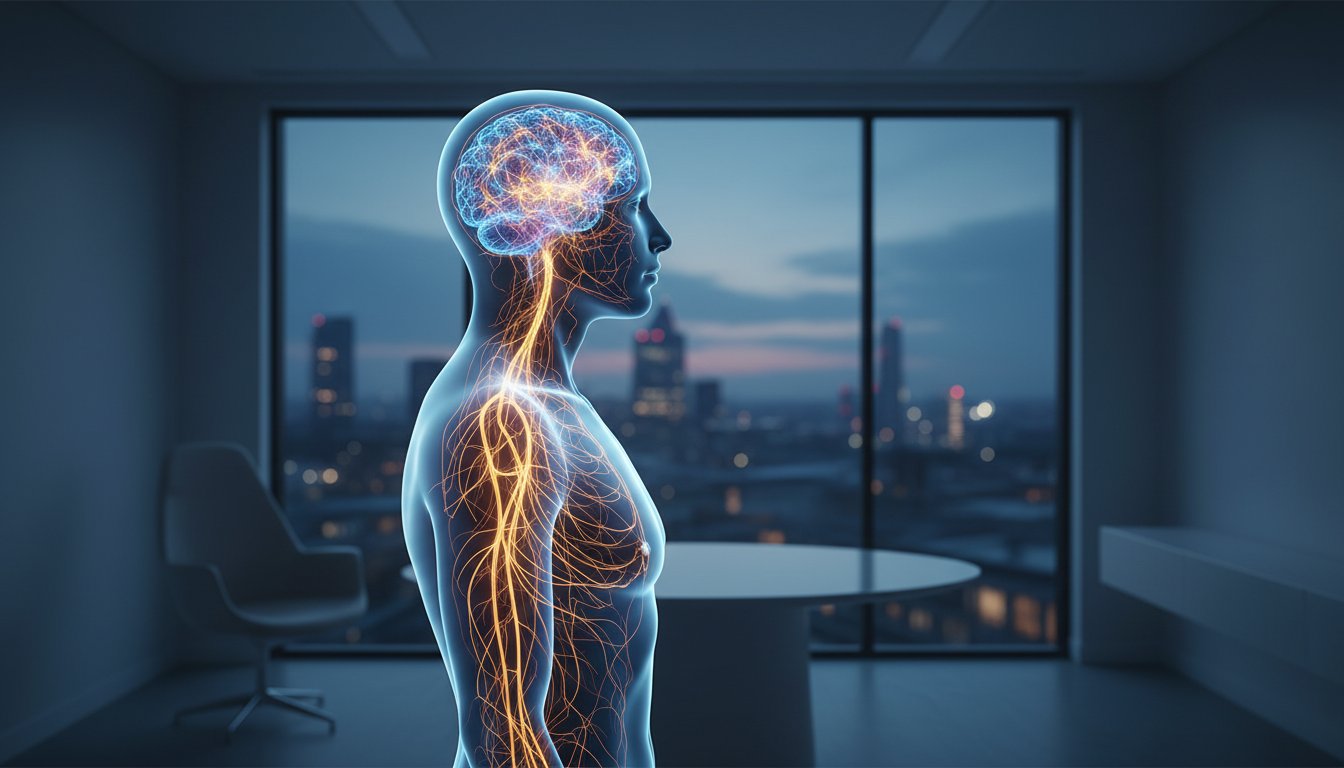
What if the symptoms that have left your doctors baffled and your tests clear aren't a mystery at all, but a predictable biological response? It's exhausting to be told your pain or fatigue is "unexplained" when it's the most real thing you're experiencing every day. You've likely felt the sting of dismissal or the quiet fear that your body is failing in a way science can't see. You aren't alone; current data indicates that Medically Unexplained Symptoms (MUS) account for approximately 20% of all new consultations in primary care. The neuroscience of MUS reveals that these sensations are not "all in your head." They're the physical output of a sensitised nervous system.
Understanding this connection is about validation, not dismissal. You deserve to know why your brain creates these signals and how you can begin to quiet them. We will explore the neurobiological mechanisms behind these symptoms, including how the brain's predictive coding can generate real pain or motor issues. This guide provides an evidence-based look at the brain-body connection and outlines actionable steps for nervous system regulation. You'll discover that whilst your tests may be normal, your experience is biologically valid. Recovery is a matter of science, not luck.
Key Takeaways
- Understand that "unexplained" symptoms refer to a lack of structural damage, not a lack of a biological cause or physical reality.
- Explore the neuroscience of MUS to see how your brain acts as a prediction machine, generating sensations based on past experiences and stress levels.
- Recognise that whilst structural scans like MRIs may appear normal, they cannot capture the functional reality of a sensitised nervous system.
- Learn how to harness neuroplasticity to reorganise neural pathways, allowing the brain to "unlearn" persistent and distressing symptom patterns.
- Discover the practical tools needed to bridge the gap between mind and body, moving from a state of medical dismissal to evidence-based recovery.
The Neuroscience of MUS: Moving Beyond "Medically Unexplained"
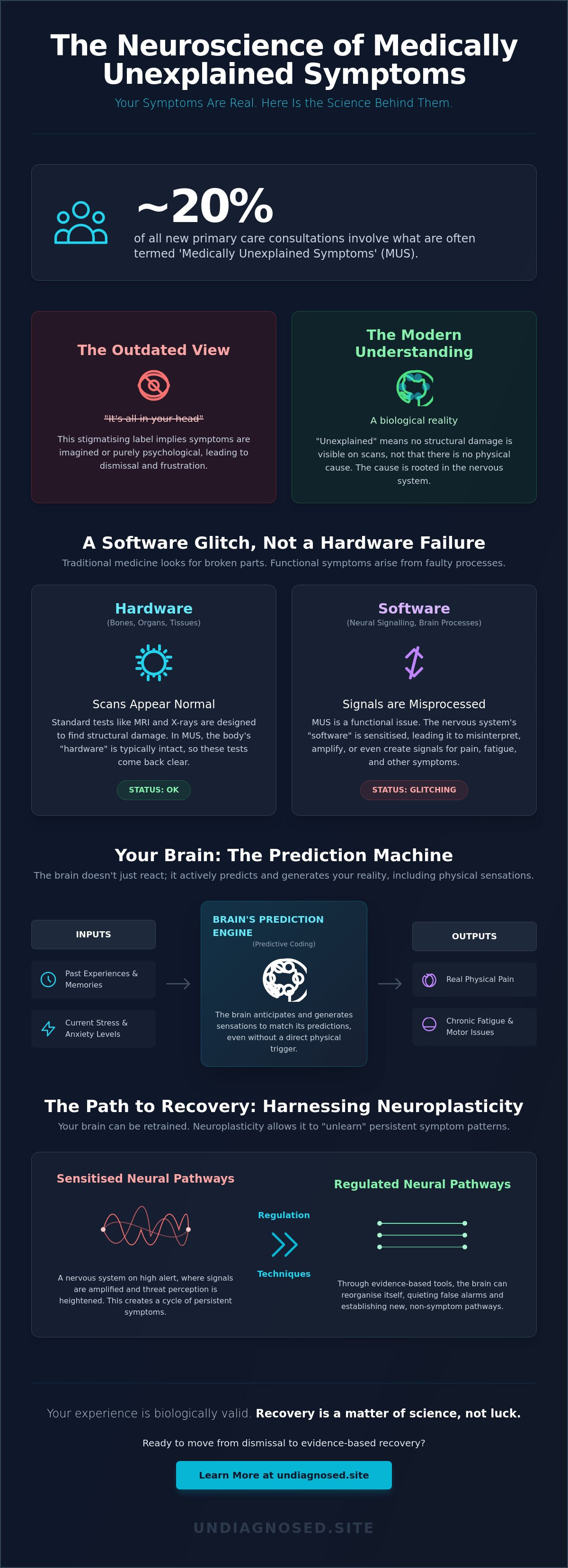
For decades, the medical community labelled symptoms that didn't appear on a scan as "unexplained." This term is misleading. It suggests a mystery when, in reality, the Medically unexplained physical symptoms observed in clinical practice have a clear origin within the nervous system. The neuroscience of MUS teaches us that "unexplained" simply means the absence of structural damage, not the absence of a cause. Whilst traditional diagnostics look for broken parts, we are now looking at broken processes. Data indicates that these symptoms account for approximately 20% of all new consultations in primary care, yet many patients leave those appointments feeling dismissed rather than diagnosed. This section serves as a guide for both patients and clinicians who are ready to trade outdated labels for evidence-based clarity.
The Shift from Psychology to Neurobiology
The old "psychosomatic" label is both outdated and stigmatising. It implies that symptoms are imagined or purely the result of emotional distress. Modern science has moved past this reductive view. We now use functional MRI (fMRI) to observe the brain in real-time, and the results are definitive. These scans show real changes in brain behaviour amongst those experiencing MUS, even when standard MRIs appear perfectly normal. We see heightened activity in the regions responsible for pain processing and threat detection. These are not "psychological" problems; they're biological realities. Validating the physical nature of your symptoms is the first step toward recovery. It moves the conversation away from "it's all in your head" and toward "your brain is working differently."
Functional Symptoms: A Software Issue, Not a Hardware One
To understand the neuroscience of MUS, it's helpful to use a computer analogy. In traditional medicine, doctors are trained to find "hardware" failures, such as a fractured bone or a diseased organ. When the hardware is intact, they often reach a dead end. However, the brain and body operate on "software"—the complex neural signalling that tells us how to feel, move, and react. In cases of MUS, the hardware is fine, but the software is glitching. The signals are being amplified, distorted, or misread by the central nervous system. Functional symptoms are real physical experiences driven by altered neural processing rather than tissue damage. This perspective changes everything. Whilst you cannot always fix damaged hardware, software can be updated and reprogrammed. This is the foundation of our work: moving from a state of "unexplained" distress to a methodology of neural regulation and relief.
Neural Networks and Predictive Coding: Why the Brain Generates Symptoms
The brain is not a passive receiver of data. It's a sophisticated prediction machine. Instead of waiting for signals from the body, it constantly "guesses" what is happening based on past experiences and current stress levels. This process, known as predictive coding, is central to the neuroscience of MUS. If your brain expects a sensation because of a previous injury or a period of high anxiety, it can create that sensation even in the absence of an external stimulus. Research into the role of psychology in MUS suggests that these predictions are heavily influenced by our internal state. This is why understanding the stress impact on health is vital for anyone seeking recovery. It is a matter of biology, not imagination.
The brain relies on specific regions to interpret these internal predictions:
- The Insula: This area acts as a monitor for interoception, the sense of the internal state of the body.
- The Anterior Cingulate Cortex: This region assigns emotional significance to sensations, deciding if a signal represents a threat.
Central Sensitisation and the Volume Control Problem
Think of your nervous system as having a volume dial. In a healthy state, the dial is set to a level that allows you to feel necessary signals without being overwhelmed. In cases of MUS, the nervous system becomes "stuck" on high. This state, known as central sensitisation, means the brain amplifies normal bodily signals into intense pain, dizziness, or fatigue. It's a "danger sensing" system that has become too efficient. This mechanism is nearly identical to the neuroscience of chronic pain, where the brain continues to produce a pain response long after any physical injury has healed. The brain is essentially shouting to get your attention about a threat that no longer exists in the tissues.
The Role of the Amygdala in Symptom Persistence
The amygdala acts as the brain's alarm system. When we focus on a symptom or "check" our bodies for changes, we inadvertently send a signal to the amygdala that we are under threat. This creates a feedback loop; fear reinforces the neural pathways, making the symptom more likely to persist. The alarm stays on. This chronic state of alert triggers the HPA (hypothalamic-pituitary-adrenal) axis, flooding the body with cortisol and contributing to systemic inflammation. Breaking this cycle requires more than just willpower; it requires specific tools for neural retraining. Those looking for a structured way to begin this process can explore The Mind and Body Connection Online Course to learn how to lower the brain's alarm response and restore balance.
Diagnosis, Not Dismissal: Why Normal Scans Do Not Mean "No Pathology"
Few experiences are as isolating as receiving a "normal" test result whilst your body is in a state of crisis. It feels like a dismissal of your pain. You might leave the clinic feeling as though your doctor believes you're imagining your symptoms. This tension exists because traditional medicine is built to find "broken parts," such as tumours, fractures, or visible inflammation. It isn't designed to find "miscommunicating systems." The neuroscience of MUS validates that your symptoms are real; they simply exist in the realm of function rather than structure. A clear MRI confirms your anatomy is intact, but it says nothing about how your nervous system is firing.
A "clean" scan shouldn't be the end of your journey. It's actually a starting point for a different kind of investigation. Understanding the various Explanatory models of MUS helps us see that pathology can exist in the function of the nervous system even when the structure remains pristine. We offer "Hope, not hype" by recognising that if the hardware is healthy, the software can be reprogrammed. This is the power of the mind and body connection: a functional problem requires a functional solution, not a surgical one.
The Limitations of Modern Medical Testing
Standard blood tests and imaging have significant blind spots. An MRI is a static, 2D snapshot of your anatomy; it cannot see the 86 billion neurons in your brain as they fire in real-time. It cannot measure the delicate balance of neurotransmitters or the speed of electrical signalling across your nerves. A "normal" result is actually good news. It rules out irreversible tissue damage or life-threatening disease. This means your body is capable of change. You don't have a structural defect that requires a permanent fix; you have a sensitised system that needs regulation.
Reframing the Patient-Clinician Dialogue
Changing how you talk to your doctor can shift your care from dismissal to discovery. Instead of asking "What is wrong with me?", try asking "How is my nervous system functioning?" This subtle shift in language invites your clinician to look at the biopsychosocial factors affecting your health. Education is your most powerful tool in this dialogue. When you understand the neuroscience of MUS, you can explain that your symptoms are the result of neural circuit amplification. You aren't looking for a miracle cure; you're looking for evidence-based strategies to retrain a system that has become stuck in a protective state. This clarity reduces anxiety and builds a foundation of trust between you and your medical team.
Harnessing Neuroplasticity: Evidence-Based Tools for Regulation
Neuroplasticity is the brain's remarkable ability to reorganise its structure and function in response to experience. It is the biological mechanism that allows us to learn new skills; it is also the mechanism that allows the brain to "learn" chronic symptoms. If your nervous system has learned to produce pain or fatigue through the neuroscience of MUS, it possesses the inherent capacity to unlearn those patterns. Recovery is not about "fixing" a broken part. It's about retraining a dynamic system. By engaging in consistent, evidence-based practices, you can guide your brain back to a state of balance. This process is the core of mind-body recovery.
Bottom-Up Tools: Calming the Body to Quiet the Brain
Bottom-up regulation focuses on using the body to influence the brain. The vagus nerve, which serves as the primary "off-switch" for the body's danger signals, plays a central role here. When you engage in slow, diaphragmatic breathing, you send an immediate signal of safety to the autonomic nervous system. This physical relaxation acts as a corrective data point for the predictive brain. It proves that there is no immediate threat, allowing the brain to lower the volume on physical sensations. These tools are essential for managing the acute "glitches" in neural signalling. They provide a physical foundation for safety that the brain cannot ignore.
Top-Down Tools: Changing the Narrative
Top-down regulation involves using the conscious mind to change how the brain interprets signals. One of the most effective tools is Somatic Tracking, a technique of non-fearful awareness. Instead of reacting to a sensation with panic or "checking" behaviour, you observe it with curiosity and neutrality. This reduces the danger signal at the source. Education is equally vital. Simply understanding the neuroscience of MUS can lower the brain's threat perception. When you know why a symptom is happening, it becomes less frightening, and a less frightened brain is a quieter brain.
You can begin to recalibrate your system today with a simple 3-step daily routine:
- Morning Regulation: Spend five minutes practising paced, deep breathing to set a baseline of physiological safety.
- Mindful Observation: During a symptom flare, spend two minutes in Somatic Tracking, observing the sensation without trying to change it.
- Cognitive Reframing: Remind yourself that the sensation is a functional glitch, not structural damage, to reinforce a sense of safety.
To deepen your understanding and access specific exercises for your recovery, you can explore the resources in our book Undiagnosed: The Mind and Body Connection.
The Mind and Body Connection: Practical Steps for Recovery
The neuroscience of MUS provides the biological "why" behind your experience; however, knowing the cause is only half the battle. True resolution requires a move from theory into practice. The Undiagnosed philosophy serves as this bridge, transforming complex neurological concepts into a daily framework for health. By adopting a biopsychosocial lens, we look at the whole person. This involves addressing the biological sensitisation of the nerves, the psychological patterns of threat detection, and the social stressors that keep the system on high alert. Recovery is a skill that can be practised and mastered through the consistent application of these principles. It is a process of retraining, not a search for a hidden cure.
Why Structured Education Matters
Fragmented advice found in online forums often lacks the clinical rigour needed for deep neural retraining. Following a structured curriculum ensures that you're building your recovery on a solid foundation of evidence-based guidance. Dr. Csaba Dioszeghy’s approach is unique because it integrates the latest neurology with a deeply compassionate understanding of the patient experience. This methodology moves beyond the "undiagnosed" state, offering a clear roadmap where others offer only confusion. Within this framework, validation becomes a catalyst for change, and community support reinforces the reality that your symptoms are biological. When you follow a clinical path, you replace guesswork with a logical, organised methodology.
Your Journey Beyond the Undiagnosed State
Your symptoms have been a signal from a protective brain, but they are not a life sentence. The state of being symptomatic, which the DSM-5 notes typically persists for more than 6 months in these cases, can be interrupted. You have the tools to update your brain's "software" and return to a life of movement and ease. The neuroscience of MUS proves that your body is capable of change because your neural pathways are dynamic. It's time to stop searching for what is "broken" and start focusing on how to regulate your system.
For those ready to commit to a structured path, our book, Undiagnosed: The Mind and Body Connection, offers the deep insights and practical tools necessary for long-term resolution. You can also explore The Mind and Body Connection Online Course for a guided, step-by-step experience. We offer you hope, not hype; your recovery is supported by science and driven by your own capacity for neuroplastic change.
Reclaim Your Health Through Neural Retraining
The journey from medical dismissal to functional recovery begins with a shift in perspective. You've discovered that your symptoms aren't a mystery; they're the result of a sensitised nervous system and predictive coding glitches. By recognising that your clear scans are a sign of healthy hardware, you can focus on updating the neural software that drives your physical experience. This evidence-based understanding of the neuroscience of MUS transforms your symptoms from a source of fear into a signal for regulation. Recovery isn't a matter of luck; it's a skill you can master with the right guidance.
You don't have to navigate this path alone. Developed by Consultant Physician Dr. Csaba Dioszeghy, our resources integrate the latest biopsychosocial research to provide you with practical tools for functional symptom management. Whether you're dealing with chronic pain, fatigue, or motor issues, a structured approach is essential for long-term resolution. Explore the evidence-based tools for recovery in Undiagnosed: The Mind and Body Connection to begin your journey toward lasting relief. Your brain is capable of unlearning these patterns. It's time to move beyond the undiagnosed state and reclaim your life with hope, not hype.
Frequently Asked Questions
Is the neuroscience of MUS the same as saying the symptoms are psychological?
No, the neuroscience of MUS identifies these symptoms as biological malfunctions in neural processing rather than purely psychological distress. Whilst emotions can influence the nervous system, the symptoms themselves are the physical output of a sensitised brain. This shift in understanding moves us away from the outdated idea that pain is "all in your head" and toward a model of functional neurological impairment.
Can the brain really create physical pain without any injury?
Yes, the brain can generate intense physical pain without acute tissue damage through a process called predictive coding. In these cases, the brain's "danger sensing" system remains active, producing pain signals based on past experiences or perceived threats. This is a well-documented neurological phenomenon, similar to how phantom limb pain occurs in the absence of a physical limb.
How long does it take for neuroplasticity to reduce functional symptoms?
Timelines for recovery vary significantly, but most individuals begin to see changes within 4 to 12 weeks of consistent neural retraining. Neuroplasticity is a gradual process of "unlearning" symptom patterns and reinforcing new pathways. It isn't a quick fix; it's a steady recalibration of the nervous system that requires patience and daily practice of regulation tools.
Why did my doctor not explain the neuroscience of my symptoms to me?
Traditional medical training focuses primarily on structural pathology, or "hardware" issues, such as tumours or fractures. Many clinicians aren't yet trained in the functional "software" models that explain the neuroscience of MUS. This often leads to a diagnosis of exclusion rather than a positive identification of a sensitised nervous system, leaving patients feeling dismissed.
Does stress always cause medically unexplained symptoms?
Stress is a significant trigger, but it isn't the sole cause of these symptoms. Factors such as past physical injury, viral infections, or even genetic predispositions can prime the nervous system for sensitisation. Stress acts as a volume dial that amplifies these existing neural patterns, making the brain more likely to produce a protective symptom response.
What happens if I ignore the mind-body connection and just treat the physical symptoms?
Treating only the physical symptoms often leads to temporary relief followed by symptom recurrence or migration. If the underlying neural "software" glitch isn't addressed, the brain will continue to produce signals of distress. A biopsychosocial approach ensures that you're treating the source of the signalling rather than just the end-stage sensation in the body.
Are there specific tests that can prove my symptoms are functional?
There isn't a single blood test for the neuroscience of MUS, but clinicians can identify "positive signs" during a physical examination. For example, Hoover’s sign can demonstrate functional weakness in a leg that is otherwise structurally sound. These tests prove that the nervous system is capable of normal function but is currently experiencing a signalling error.
Can I recover from MUS if I have had symptoms for many years?
Yes, recovery is possible regardless of how long you've been symptomatic. Neuroplasticity remains active throughout your entire life, meaning the brain never loses its ability to reorganise and heal. Whilst long-standing patterns may take more time to shift, the biological capacity to retrain your nervous system and reduce symptom intensity remains intact.