What if the persistent ache in your back or the relentless pressure in your head isn't a sign of structural damage, but a sophisticated error in your body’s alarm system? For the 15.5 million people in England living with chronic pain, according to 2023 Government data, the search for answers often leads to a frustrating dead end of clear MRI scans and clinical dismissal. You know the pain is real, yet you're left wondering why your body refuses to heal. Understanding the neuroscience of chronic pain reveals that your symptoms are a physical reality, not a psychological fabrication. It's a matter of biology, not belief.
We'll explore how your nervous system can become overprotective through a process called central sensitisation, effectively learning to be in pain. This article provides evidence-based guidance to help you shift from a state of high-alert to one of recovery. You'll discover how to utilise brain-based techniques to dampen these signals and regain control. We're moving towards science, not speculation; we're offering tools, not just talk. By the end of this guide, you'll have a clear framework to begin rewiring your neural pathways for lasting relief.
Key Takeaways
- Distinguish between sensory signals and the brain’s protective response, shifting your perspective from structural damage to neural processing.
- Explore the neuroscience of chronic pain to understand central sensitisation—a state where your nervous system’s "volume control" remains stuck on high.
- Examine the biopsychosocial factors that influence your symptoms, recognising how past experiences and emotional states shape the brain's evaluation of danger.
- Harness the power of neuroplasticity to move from persistent symptoms to recovery, learning how the brain can unlearn pain patterns it once adopted.
- Implement evidence-based strategies, such as optimised sleep hygiene and circadian rhythm alignment, to lower nervous system arousal and support long-term healing.
Understanding the Neuroscience of Chronic Pain: Why Your Brain Creates Sensation
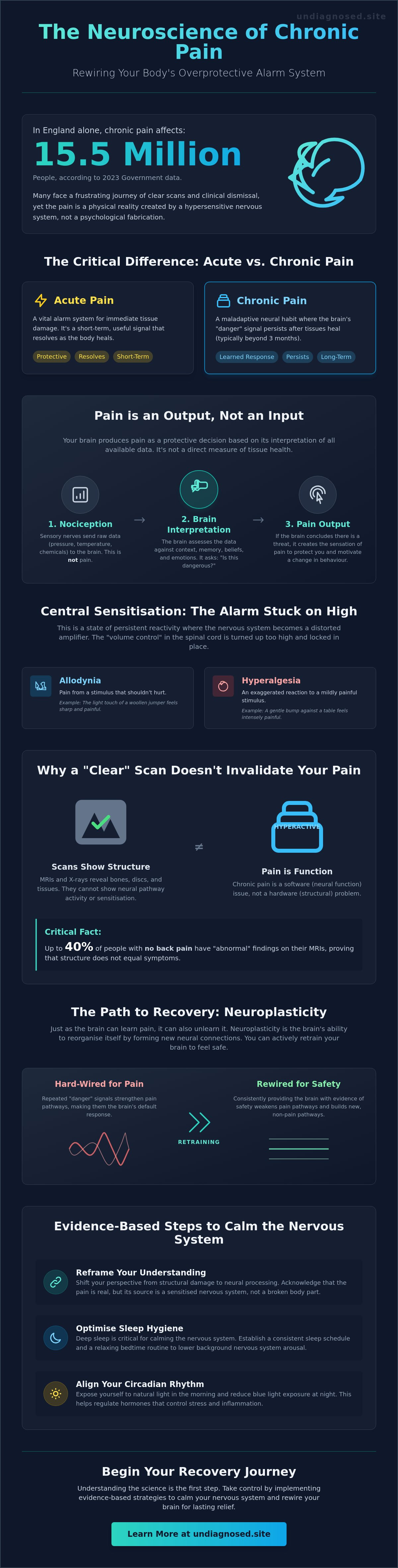
Pain isn't just a reaction to tissue damage. It's a protective mechanism. The Understanding Pain framework explains that the brain acts as a central hub, weighing up sensory data against perceived threats. In the neuroscience of chronic pain, we see this system become hyper-vigilant. It stops being a reflection of current physical injury and starts acting as a persistent "danger" signal. This signal can remain active long after the original injury has healed, usually defined as the three-month mark in clinical settings.
There's a vital distinction between nociception and pain. Nociception is the raw data sent by nerves; pain is the brain's interpretation of that data. If your brain perceives a threat, it produces pain as an output to force a change in behaviour. This isn't a glitch; it's a sophisticated survival strategy that's become miscalibrated. We must be clear: this pain isn't imaginary. Functional MRI studies show that brain-generated pain activates the same neural regions as pain from a fresh injury. It's physically real, measurable, and often more debilitating than acute trauma. It's a matter of biology, not personality.
The Difference Between Acute and Chronic Pain Pathways
Acute pain serves as a vital alarm system for immediate tissue damage. It's the sharp sting of a burn that makes you pull your hand away. Chronic pain is different. It represents a shift from a physical warning to a maladaptive neural habit where the brain learns to stay in a state of high alert. Neuroplastic pain is a learned response of the nervous system. This transition involves the strengthening of neural pathways, much like how a musician strengthens the pathways for a specific melody through repetition.
Why Clear Scans Do Not Mean the Pain is Not Real
Patients often feel dismissed when an MRI or X-ray comes back clear. These scans only show structure, not function. They can't detect the "Predictive Processing" model, where the brain anticipates pain based on past experiences and triggers the sensation before a physical stimulus even occurs. Research indicates that up to 40% of people with no back pain actually have "abnormal" findings on MRIs, proving that structure doesn't always equal symptoms. Understanding the mind and body connection is the key to decoding these functional neural circuit changes. This perspective offers hope, not hype. If the brain can learn pain, the neuroscience of chronic pain suggests it can also learn safety. It's about diagnosis, not dismissal.
The Alarm That Never Stops: Central Sensitisation and Neural Pathways
Central sensitisation represents a fundamental shift in how your body processes sensation. It's a state of persistent reactivity where the nervous system remains winded up, even after physical tissues have healed. Instead of the nervous system acting as a reliable messenger, it becomes a distorted amplifier. Within the neurobiology of chronic pain, this is often described as the volume control in the spinal cord being turned up too high and locked in place. This mechanism ensures that the brain prioritises survival over comfort, leading to a state of constant, exhausting vigilance.
This hypersensitivity manifests through two primary symptoms: allodynia and hyperalgesia. Allodynia occurs when a stimulus that shouldn't hurt, such as the brush of a woollen jumper against the skin, triggers a sharp pain response. Hyperalgesia is an exaggerated reaction to something mildly painful. These aren't imaginary sensations; they're the result of specific brain regions like the amygdala and the anterior cingulate cortex (ACC) working overtime. While the amygdala processes the threat and fear associated with the sensation, the ACC assigns it an emotional weight. It's a process of validation, not dismissal, acknowledging that the pain is real even if the original injury is gone. For individuals navigating the challenges of nerve-related hypersensitivity, the Neuropathy Relief Project offers specialised support and a free consultation to help you manage these symptoms.
How Neural Pathways Become "Hard-Wired" for Pain
The brain is a masterpiece of efficiency, constantly refining its connections through neuroplasticity. When pain signals travel the same route repeatedly, the brain gets better at sending them. Clinicians often cite Hebb’s Law: neurons that fire together, wire together. Through sheer repetition, the brain learns to be in pain. Environmental triggers, like a stressful workplace or a lack of social support, act as danger messages that reinforce these pathways. Understanding this connection between mind and body is the first step toward rewiring these circuits. The neuroscience of chronic pain shows us that just as the brain learns pain, it can also be taught safety.
The Role of the Glial Cells in Maintaining Inflammation
Glial cells were once thought to be simple glue for neurons, but we now know they act as the brain's dedicated immune system. When the body is under prolonged stress, these cells become overactive, releasing pro-inflammatory cytokines that keep the nervous system in a state of neuro-inflammation. This explains why symptoms can persist long after a 2017 research paper might show a physical injury has technically healed. Systemic stress acts as fuel for this fire, keeping the glial cells in a defensive posture. This internal inflammation maintains the pain loop, creating a cycle of physical distress and neural sensitivity that requires a targeted, evidence-based approach to break.
Beyond the Physical: How the Biopsychosocial Lens Explains Persistent Pain
Modern medicine often tries to separate the body from the mind. The neuroscience of chronic pain suggests this is a fundamental mistake. We use the biopsychosocial model to understand why symptoms persist. This framework views biology, psychology, and social factors as an integrated system rather than isolated parts. Your brain acts as a sophisticated radar, constantly evaluating signals to determine if you're in danger. It doesn't just process data from your nerves; it filters that data through your history, your current mood, and your environment.
Past experiences play a decisive role in how your nervous system regulates itself. The 1998 CDC-Kaiser Permanente study on Adverse Childhood Experiences (ACEs) revealed a clear link between early life stress and adult health. Individuals with high ACE scores are 2.7 times more likely to report chronic pain conditions. This isn't a psychological flaw. It's a biological adaptation. Early stress can "set" the nervous system to a higher baseline of arousal, making the brain more likely to produce pain as a protective mechanism later in life.
Recovery begins with diagnosis, not dismissal. Validating your experience is scientifically necessary. When a clinician acknowledges that your pain is real, it lowers the brain's threat perception. We offer hope, not hype, by focusing on the evidence-based reality of how your brain creates your experience.
Emotions as Fuel for the Pain Circuitry
The brain doesn't have a single "pain centre." Instead, it uses a complex network. The anterior cingulate cortex and the insula are responsible for both emotional processing and physical sensation. This neurobiological link explains why repressed or unprocessed emotions can manifest as physical symptoms. This is somatisation, a process where the brain translates internal distress into bodily signals. It's a physical manifestation of a nervous system under pressure. By increasing emotional awareness, you can begin to calm the "alarm" system that keeps the neuroscience of chronic pain active in your daily life.
Social and Environmental Triggers of Pain
Your environment sends constant signals to your brain. High-pressure work environments, relationship conflict, or social isolation act as "danger" signals. These triggers keep the nervous system on high alert. Consider these common social factors:
- Workplace Stress: Constant deadlines and lack of autonomy act as persistent threats to your stability.
- Relationship Strain: Conflict with loved ones removes a primary source of safety, increasing the nervous system's sensitivity.
- Social Isolation: Humans are wired for connection; loneliness signals a lack of protection to the primitive brain.
Medical gaslighting is a significant social trigger. When patients are told "nothing is wrong" despite their agony, it creates intense anxiety. This anxiety reinforces the pain loop. A supportive and validating social environment acts as a powerful "safety" signal that encourages the brain to de-escalate its defensive pain response.
Neuroplasticity and Recovery: Rewiring the Brain-Body Connection
The brain's architecture isn't fixed in stone. It's a dynamic, living system capable of self-directed neuroplasticity. This means that while your nervous system has become highly efficient at producing pain signals, it retains the capacity to dismantle those same pathways. Recovery is a process of unlearning, not just healing. It's about retraining, not just resting. If the brain can learn to produce pain in the absence of tissue damage, it can also learn to return to a state of ease.
Therapeutic Neuroscience Education (TNE) serves as the primary clinical intervention in this process. Understanding the neuroscience of chronic pain changes the context of your physical sensations. When you learn that your pain is a protective output rather than evidence of structural damage, the threat level in the amygdala drops. This shift in meaning is physiological. A 2021 study published in JAMA Network Open found that 66% of chronic back pain patients were pain-free or nearly pain-free after just four weeks of brain-focused therapy. It moves the brain from a state of high-alert survival to one of safety and repair.
Graded Exposure and Movement Without Fear
Movement often feels like a threat when you're in pain. Graded exposure helps you reintroduce physical activity in small, manageable increments. The core principle is simple: hurt does not equal harm. You're teaching your brain that movement is safe. By breaking the cycle of fear-avoidance, you stop the brain from over-anticipating injury. This gradual approach builds confidence, proving to your nervous system that your body is resilient, not fragile.
Somatic Tracking and Mindfulness Techniques
Somatic tracking involves observing physical sensations with curiosity rather than fear. This technique engages the prefrontal cortex to down-regulate the alarm signals from the emotional centres of the brain. You can find detailed exercises on this in our mind-body recovery guide. It's about changing your relationship with the sensation. When the brain perceives a sensation as neutral or interesting rather than dangerous, the neuroscience of chronic pain dictates that the signal will eventually fade. You're essentially teaching your brain that the "fire alarm" is going off when there is no fire.
Ready to start your recovery journey with evidence-based tools? Explore our clinical resources.
Practical Steps to Calm the Nervous System: The Undiagnosed Approach
The Undiagnosed philosophy shifts the focus from structural damage to neurological regulation. It provides evidence-based guidance for those living with functional symptoms that traditional medicine often overlooks. By applying the neuroscience of chronic pain, we can move from a state of constant threat to one of physiological safety. This isn't about "mind over matter"; it's about using biological levers to influence the brain's output and reduce the intensity of persistent symptoms.
Sleep hygiene and circadian rhythm are foundational to this process. Research suggests that disrupted sleep patterns can increase pain sensitivity by up to 25 per cent. Establishing a regular sleep-wake cycle helps lower nervous system arousal by signalling to the hypothalamus that the environment is secure. Similarly, specific breathing techniques serve as a direct line to the vagus nerve. When you lengthen your exhale, you activate the parasympathetic system, sending a clear message to the brain that the body is no longer in danger. Dr. Csaba Dioszeghy’s curriculum acts as the vital bridge here, translating these complex scientific principles into a practical daily programme for lasting relief.
Building Your Personal "Safety" Toolkit
Recovery requires daily habits that signal safety to your brain. This involves a structured approach to movement, rest, and emotional regulation:
- Pacing: Avoid the "boom-and-bust" cycle by breaking tasks into smaller, manageable chunks to prevent the nervous system from hitting its threshold.
- Safety Signals: Engage in activities that spark genuine joy or social connection, which release oxytocin to dampen pain signals.
- Rescue Breathing: Use the "4-7-8" technique during a flare-up to rapidly engage the parasympathetic system and interrupt the alarm response.
These tools don't just mask the pain. They change the brain's data input, gradually reducing the need for protective symptoms through consistent, gentle reinforcement.
The Power of Education and Community
Understanding the neuroscience of chronic pain is a therapeutic intervention in itself. When you learn that pain is a protective output rather than a sign of ongoing tissue damage, the fear-pain cycle begins to break. This shift in perspective is often the first step toward physical change. The "Undiagnosed" book and our structured course provide a clear path forward, moving you from a state of confusion to one of clarity.
This is a journey of recovery, not a quick fix. We offer hope, not hype; providing the clinical resources and community support you need to reclaim your life. By combining scientific insight with practical application, you can begin to rewire your response to pain and find the relief you deserve.
Rewiring the Path to Recovery
The journey from persistent symptoms to lasting relief starts with understanding how the brain processes threat. We've explored how central sensitisation keeps the body's alarm system active long after an initial injury has healed. By applying a biopsychosocial lens, it's possible to see that pain is a complex output influenced by biological, psychological, and social factors. The neuroscience of chronic pain proves that while the brain can learn to create persistent sensations, its inherent neuroplasticity means it can also learn to find safety.
You don't have to navigate this transition alone. Founded by Dr. Csaba Dioszeghy, a Consultant Physician specialising in the biopsychosocial approach, Undiagnosed provides the evidence-based guidance you need to move forward. Our curriculum is used by both patients and clinicians to bridge the gap between physical sensation and neurological response. We focus on diagnosis, not dismissal, for every medically unexplained symptom. This approach offers hope, not hype, for those seeking a practical way out of the cycle of distress.
Take the next step in your recovery journey today. Explore the science of recovery in our Mind and Body Connection Online Course. There's a way back to the life you recognise.
Frequently Asked Questions
Is chronic pain all in my head?
No, your pain is real and physically felt in your body. Whilst the sensation is processed by the brain, this doesn't mean it's imaginary or made up. In the neuroscience of chronic pain, we understand that the brain's alarm system can become stuck in an "on" position. Research from the University of Manchester shows that chronic pain affects approximately 28 million adults in the UK, proving this is a widespread biological reality, not a psychological fabrication.
Can neuroplasticity actually cure persistent pain?
Neuroplasticity allows your nervous system to change its structure and function in response to new input. This means that just as your brain learned to produce pain, it can learn to produce safety. Studies indicate that 70% of patients using neuroplasticity-based techniques report a reduction in symptom intensity. It's a process of retraining, not a miracle cure. You're teaching your brain to stop misinterpreting normal signals as dangerous threats.
Why do my symptoms flare up when I am stressed or emotional?
Stress triggers the release of cortisol and adrenaline, which heightens the sensitivity of your nervous system. When you're under emotional pressure, your brain perceives a higher level of threat and increases pain output as a protective measure. This is a biological reflex, not a sign of weakness. Data from the NHS suggests that 60% of people with long-term conditions experience worsened symptoms during periods of high anxiety or emotional distress.
How long does it take to rewire the brain for pain relief?
Most patients begin to notice shifts in their pain perception within 4 to 12 weeks of consistent practice. Rewiring the brain is a gradual process that requires daily engagement to see measurable changes. Clinical trials on Mind-Body Syndrome (MBS) interventions often show the most significant improvements after 3 months of focused effort. We focus on hope, not hype; your brain needs time to build new, non-pain neural pathways through steady repetition.
What is the biopsychosocial approach to chronic pain management?
This model treats pain by addressing biological, psychological, and social factors simultaneously rather than looking at the body in isolation. It's the gold standard in modern pain science, moving beyond the outdated "find it and fix it" surgical model. Evidence-based guidance from the British Pain Society confirms that multidisciplinary programmes using this model are twice as effective as standard medical care. It provides a framework for recovery, not just a temporary way to mask symptoms.
Can breathing exercises really change how I feel physical pain?
Yes, specific breathing techniques stimulate the vagus nerve to switch your body from a "fight or flight" state to a "rest and digest" state. This reduces the production of inflammatory cytokines and calms the overactive nerves responsible for chronic sensations. A study published in the journal Frontiers in Psychology found that 15 minutes of rhythmic breathing can lower pain intensity by 20% in some individuals. It's a practical tool that provides immediate physiological feedback to your central nervous system.
What should I do if my doctor says my tests are normal but I am still in pain?
You should seek a clinician who understands the neuroscience of chronic pain and functional disorders. Normal MRI or X-ray results are common; in fact, 80% of adults over 50 show "abnormal" spinal findings despite having no pain at all. This suggests your symptoms are driven by neural circuit sensitivity rather than tissue damage. Focus on recovery, not just further testing. You deserve a diagnosis, not dismissal, and a plan that addresses the brain's role.
How does childhood trauma affect my physical health as an adult?
Early life stress can prime the nervous system to remain in a state of high alert, increasing the risk of developing chronic pain later in life. Childhood adversity alters the development of the brain's stress-response systems. The landmark ACE Study (Adverse Childhood Experiences) showed that individuals with high scores are 2.7 times more likely to suffer from chronic pain conditions as adults. These experiences create a biological predisposition toward a sensitised nervous system, but these pathways can be changed with the right tools.