
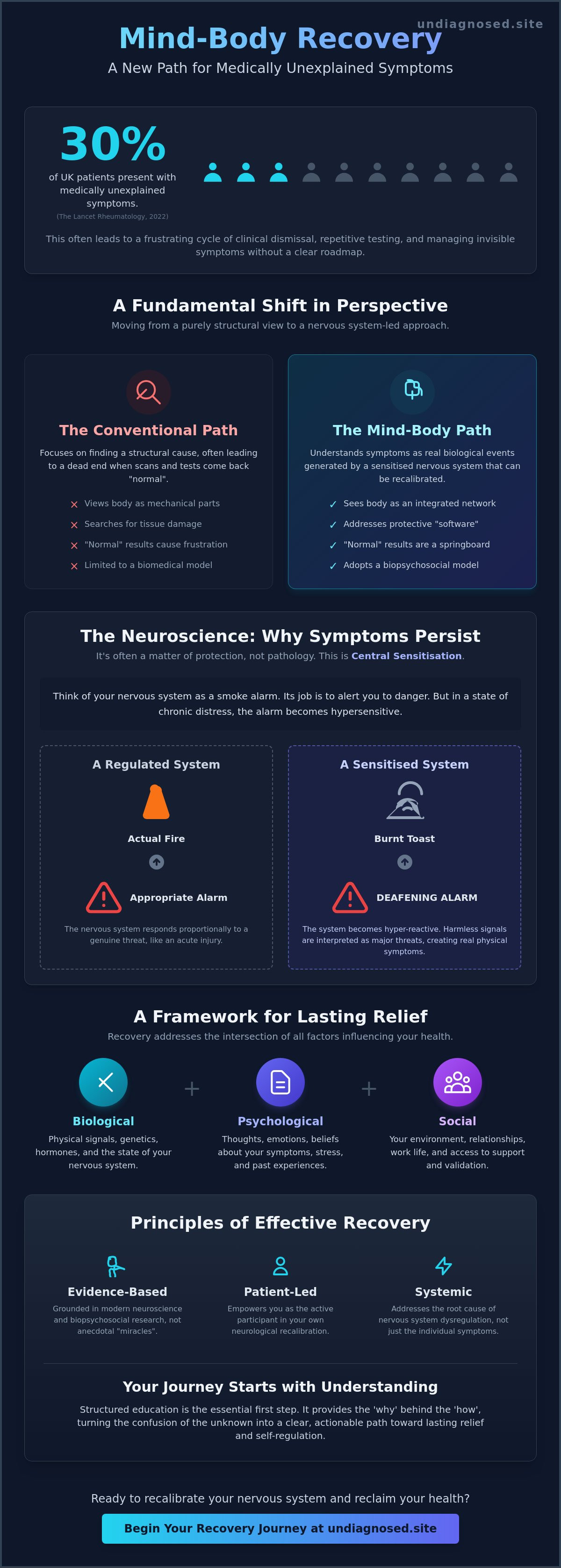
What if the chronic pain or fatigue that dictates your daily life isn't a permanent flaw in your biology, but a reversible state of your nervous system? For the 30% of UK patients who, according to a 2022 study in The Lancet Rheumatology, present with medically unexplained symptoms, the search for answers often leads to a dead end. You've likely experienced the sting of clinical dismissal or the anxiety of managing invisible symptoms without a clear roadmap. This is where the science of mind-body recovery changes the conversation, offering a bridge between your physical experience and neurological reality.
A recently published book, Undiagnosed - Impact of Stress and Emotions on Health , gives an extraordinarily clear insight into this process, linking everyday reality of long queuing in A&E departments with frustrated dismissal hours later and the root cause of frightening symptoms which can – and should be – successfully addressed only once understood.
It's frustrating to rely on temporary fixes that ignore the root cause of your distress. We believe in evidence, not empty promises; we provide validation, not gaslighting. In this guide, you’ll learn how to recalibrate your nervous system and reclaim your health using the latest neuroscience and biopsychosocial recovery strategies. We'll break down the complex mechanics of neural pathways and provide you with a structured path toward long-term relief and self-regulation.
Key Takeaways
-
Understand how mind-body recovery works to down-regulate a sensitised nervous system, moving your focus from acute injury healing to neurological recalibration.
-
Discover the neuroscience behind central sensitisation and why the brain maintains real physical symptoms as a protective "guarding" response.
-
Shift from a limited biomedical view to a comprehensive biopsychosocial approach that addresses the intersection of biological, psychological, and social factors.
-
Master practical "tools, not toys" to establish a daily routine that calms the autonomic nervous system and builds a foundation for lasting relief.
-
Learn why structured education serves as the essential first step in successfully navigating the recovery journey for FND and medically unexplained symptoms.
Table of Contents
What is Mind-Body Recovery? Defining the Path to Wellness
Mind-body recovery is the physiological process of down-regulating a sensitised nervous system. It represents a fundamental shift from treating the body as a collection of mechanical parts to understanding it as an integrated, communicative network. Whilst acute injury healing focuses on structural tissue repair, chronic symptom recalibration addresses the brain's protective software. This is hope, not hype. Recovery is an evidence-based reality for those who have exhausted the traditional medical model. Conventional pathways often fail to address functional symptoms because they prioritise structural damage over systemic dysregulation. In the UK, where clinical time is often restricted, the nuances of a sensitised system are frequently overlooked, leaving patients in a cycle of repetitive testing without resolution.
The Difference Between Cure and Recovery
Recovery isn't just the absence of disease; it's the active re-training of the brain's response to internal signals. When a clinician tells you that your blood tests or scans are "normal", it shouldn't be a source of frustration. These results are a springboard for mind-body recovery work. They provide the clinical assurance that your physical structure is sound, which allows you to focus on the neural pathways that generate your symptoms. This process places patient agency at the centre of the journey. You aren't a passive recipient of a "fix"; you're the active participant in your own recalibration. By utilising mind-body interventions, you learn to interpret your body's signals without the interference of a hyper-vigilant alarm system.
Diagnosis, Not Dismissal: Validating the Experience
We champion diagnosis, not dismissal. Your physical symptoms are genuine biological events, even when they lack a structural signature on an MRI. The term "psychosomatic" has been historically weaponised to imply that a patient's suffering is imaginary. In reality, it describes the measurable interaction between the psyche and the soma. Research indicates that roughly 1 in 3 primary care consultations in the UK involve symptoms that don't have a clear structural cause. We view the "Undiagnosed" state as a vital transition point rather than a permanent label. It's the bridge between the confusion of the unknown and the practical application of mind-body recovery tools. Validating your experience is the first step in lowering the nervous system's threat response.
-
Evidence-based: Grounded in neuroscience rather than anecdotal "miracles".
-
Patient-led: Shifting the power from the clinician to the individual.
-
Systemic: Addressing the root cause of nervous system dysregulation.
The Neuroscience of Persistent Symptoms: Why the Brain Creates Real Pain
Persistent symptoms are often a matter of protection, not pathology. To understand why physical sensations linger long after an initial injury has healed, we must look at the brain's internal security system. Think of your nervous system as a domestic smoke alarm. Its primary job is to alert you to danger. However, in a state of chronic distress, this alarm becomes hypersensitive. It no longer requires a fire to trigger a deafening siren; it begins to scream at the scent of burnt toast or the presence of harmless steam. This is the essence of mind-body recovery: recalibrating a system that has become too efficient at sounding the alarm.
The autonomic nervous system acts as the body's primary guardian. When it perceives a threat, whether that threat is a physical injury or a period of intense emotional stress, it shifts into a defensive posture. This "guarding" behaviour manifests as muscle tension, increased heart rate, and heightened sensitivity to sensory input. Whilst this response is life-saving in an emergency, staying in this state indefinitely creates a feedback loop of discomfort. By understanding The Biopsychosocial Model of Pain, we can see how biological signals, psychological states, and social environment converge to keep the alarm sounding. It's a state of high alert that eventually becomes the body's new baseline.
Central Sensitisation and the Protective Brain
Central sensitisation is the medical term for a nervous system that has become wound up and hyper-reactive. In plain English, it means the volume control on your pain signals is stuck at maximum. When you experience prolonged stress or past trauma, your brain lowers the threshold for what it considers dangerous. Data from clinical studies suggests that individuals in high-stress environments can experience a 35 per cent increase in pain sensitivity compared to those in regulated states. The brain begins to sense danger in ordinary movements or minor sensations, creating real, physical pain as a misguided attempt to keep you safe. This danger-sensing behaviour is an adaptive response that has simply outlived its usefulness.
Neuroplasticity: Rewiring the Mind-Body Connection
The brain is not a static machine; it's a dynamic organ capable of constant structural change. This adaptability is known as neuroplasticity. Just as the brain can learn to produce pain through repetitive signalling, it can also unlearn these patterns. This is particularly evident in Functional Neurological Disorders (FND), where the software of the brain sends incorrect signals to the hardware of the body despite no structural damage being present. Neuroplasticity is the biological basis for mind-body recovery. By using targeted evidence-based tools, you can begin to prune away old, painful neural pathways and strengthen new, calmer ones. It's a process of neural retraining, not a miracle cure. Through consistent practice, the brain can be taught that it is safe, allowing the smoke alarm to finally fall silent.
The Biopsychosocial Model: A Framework for Lasting Relief
Traditional medicine often relies on the biomedical model, treating the human body like a machine with isolated, broken parts. If an MRI doesn't show a visible tear or a blood test doesn't reveal a specific deficiency, the system often stalls. This rigid approach fails to account for the complexity of chronic conditions. The biopsychosocial model, first formalised in 1977, offers a more sophisticated map for mind-body recovery. It recognises that health is not merely the absence of disease but a dynamic intersection of biological markers, psychological states, and social influences.
Dr. Csaba Dioszeghy’s approach focuses on bridging the gap between high-level neuroscience and clinical bedside practice. By applying the Neuroscience of the Mind-Body Connection, he demonstrates that physical symptoms are often a protective output from the brain. Addressing the "whole person" means looking past the symptom to understand the environment in which that symptom exists. This isn't about ignoring biology; it's about contextualising it.
Beyond Biology: The Role of Psychology and Social Context
Your brain doesn't process pain or fatigue in a vacuum. Emotions and deeply held beliefs act as powerful modulators for physical sensations. If you believe a sensation is a sign of permanent damage, your nervous system amplifies the signal to "protect" you. Social context is equally influential. A 2022 survey of chronic illness patients in the UK indicated that "medical gaslighting" significantly hinders recovery speed. When a clinician dismisses a patient's experience, the resulting stress keeps the nervous system in a state of high alert. Understanding the "why" behind your symptoms is a therapeutic intervention in itself. It provides a sense of safety that allows the body to begin down-regulating its threat response. For some, this search for meaning extends into the spiritual realm, where platforms like thirdeyekentucky.com can offer intuitive perspectives that help individuals explore their personal journey from a different angle.
Implementing the Biopsychosocial Lens
To see this model in action, consider a symptom like chronic dizziness. A purely biological lens might only look at the inner ear. The biopsychosocial lens looks further:
-
Biological: Is there a vestibular imbalance or a history of migraine?
-
Psychological: Does the patient feel a loss of control or high levels of hyper-vigilance?
-
Social: Is the patient's work environment overwhelming or unsupportive?
This perspective facilitates a vital shift from asking "What is wrong with my body?" to "Why is my system over-protecting me?" This change in inquiry is essential for mind-body recovery because it reduces the fear that fuels the symptom cycle. By addressing the psychological and social drivers alongside the physical, we move toward a model of diagnosis, not dismissal. This framework provides the tools for realistic, evidence-based optimism, offering hope, not hype, for those seeking a way out of persistent physical distress.
Practical Strategies for Daily Neurological Recalibration
Effective mind-body recovery is built on the foundation of structured repetition. It requires a shift in perspective: viewing exercises as tools, not toys. These aren't distractions or wellness trends; they're precise physiological interventions designed to signal safety to a sensitised nervous system. Consistency, not intensity, is the metric of success. Re-training the brain takes time, often requiring months of daily practice to override years of ingrained alarm responses.
Breathing and Relaxation: Immediate Tools for Self-Regulation
Diaphragmatic breathing is the most direct way to stimulate the vagus nerve, the body's internal brake system. When you breathe deeply into the abdomen, you physically shift the autonomic nervous system from a state of "fight or flight" to "rest and digest." This isn't just about feeling calm. It's about the science of relaxation: reducing cortisol and lowering the heart rate to prove to the brain that the body is safe. To perform this effectively:
-
Place one hand on your chest and the other on your belly.
-
Inhale slowly through your nose for four seconds, ensuring only the bottom hand moves.
-
Hold the breath for two seconds.
-
Exhale through pursed lips for six seconds.
During a symptom flare-up, use this technique immediately. Focus on the physical sensation of the breath rather than the intensity of the pain. By maintaining a steady rhythm, you prevent the secondary "panic spike" that often exacerbates physical symptoms. This deliberate control acts as a biological anchor, grounding the mind whilst the body processes the sensation.
Sleep and Movement: The Pillars of Biological Stability
Sleep is the primary window for neurological repair. For those with chronic fatigue or pain, standard advice often fails. Evidence-based strategies suggest maintaining a cool room, roughly 18°C, and a strict wake-up time to anchor the circadian rhythm. When it comes to movement, the "pacing" method is vital. This involves staying within your "energy envelope," typically defined as doing 70% of what you feel capable of. This prevents the "boom and bust" cycle that triggers the brain's alarm system.
Integrating favourite activities is equally essential for neuroplasticity. Joyful movement, whether it's a short walk in a local park or gentle stretching, releases dopamine and endorphins. These chemicals act as natural inhibitors to pain signals, helping to rewire the brain's perception of physical activity. Whilst these tools are powerful, navigating them alone can be daunting. Working with clinicians ensures that your programme is tailored to your specific physiological needs, providing a safe framework for progress.
If you're ready to move from confusion to clarity, you can explore our evidence-based resources to start your journey today.
Navigating Your Recovery Journey: The Undiagnosed Approach
Recovery is a process, not a destination. For those navigating the complexities of Functional Neurological Disorder (FND) or Medically Unexplained Symptoms (MUS), the first step is often the most overlooked: education. Dr. Dioszeghy’s "Undiagnosed" approach provides a structured curriculum designed to bridge the gap between clinical neuroscience and your lived experience. It offers evidence-based guidance, not empty promises. By understanding the mechanisms behind your symptoms, you move from a state of medical dismissal to one of active empowerment. This educational foundation is the cornerstone of sustainable health, providing the clarity needed to lower stress levels and begin the work of mind-body recovery.
The Mind and Body Connection Online Course
This physician-led programme stands apart from the "quick-fix" claims often found in the wellness industry. It delivers a series of comprehensive video lessons and practical exercises that translate complex brain functions into actionable steps. You'll receive lifetime access to these digital resources, ensuring you have a permanent toolkit for your health. This consistency is essential for successful mind-body recovery, as it allows you to revisit core concepts whenever your nervous system needs recalibration. The course is designed to mirror a professional consultation, moving methodically from the identification of a neural pattern to the presentation of a practical solution. It’s about sustainable progress, not temporary relief. Take the first step and join the Online Course to begin your transformation.
Reading for Recovery: The "Undiagnosed" Book
The "Undiagnosed" book acts as the foundational pillar of the curriculum. Having a physical or digital reference is more than just a convenience; it’s a neurological necessity. Repetition is the key to neuroplasticity. By reading and re-reading the evidence-based strategies within, you reinforce the neural pathways required for long-term health. The book provides a calm, authoritative voice that validates your experience whilst offering a clear path forward. It embodies the principle of "Diagnosis, not dismissal," providing the "why" behind your symptoms and the "how" for your recovery. You'll find practical tools to manage the daily realities of your condition, grounded in scientific rigour and clinical integrity.
Real progress requires the right resources and a grounded perspective. You don't have to navigate this path without a map. Explore our resources and start your recovery today to move from uncertainty to insight.
Reclaim Your Health Through Neurological Recalibration
Persistent pain often reflects a protective brain state rather than ongoing tissue damage. Whilst your symptoms are physical, their resolution lies in retraining the brain's neural pathways. This transition requires mind-body recovery strategies that address the biological, psychological, and social factors influencing your health. Science shows that these pathways are plastic; they can be retrained through consistent, evidence-based practice. You don't have to settle for temporary fixes that fail to address the root cause of your distress.
Led by Consultant Physician Dr. Csaba Dioszeghy, our approach provides a structured curriculum grounded in the biopsychosocial model. We offer clinical insight, not empty promises. It's a path built on hope, not hype, focusing on the long-term recalibration of your nervous system. You can move beyond the frustration of being overlooked and start applying practical tools for lasting relief today.
Begin your recovery journey with the Undiagnosed Online Course
Your symptoms are real, but they don't have to be permanent. Take the first step toward a future defined by clarity and confidence.
Frequently Asked Questions
Is mind-body recovery the same as "it's all in my head"?
No, mind-body recovery isn't about suggesting your symptoms are imaginary. It's a physiological process, not a psychological dismissal. Research from the Royal College of Psychiatrists indicates that roughly 30% of patients in neurology clinics have symptoms explained by nervous system dysregulation. This approach focuses on the nervous system's physical state. It's about biology, not belief. Your pain is real; we're simply addressing the neural pathways that sustain it.
How long does it take to see results from mind-body recovery techniques?
Most individuals begin to notice physiological shifts within 4 to 12 weeks of consistent practice. Neuroplasticity is a gradual process of structural change in the brain. According to a 2011 study by Harvard researchers, significant changes in grey matter density can occur after just 8 weeks of mindfulness-based exercises. Consistency is the key to rewiring. It's a marathon, not a sprint, requiring daily engagement with the tools provided.
Can mind-body recovery help with diagnosed conditions like Fibromyalgia or FND?
Yes, mind-body recovery is specifically designed to address Functional Neurological Disorder (FND) and Fibromyalgia. These conditions involve software issues in the nervous system rather than hardware damage to the tissues. A 2021 study published in JAMA Psychiatry showed that 66% of chronic back pain patients were pain-free or nearly pain-free after treatment targeting neural pathways. These techniques help recalibrate how your brain processes sensory information.
Do I need to stop my current medical treatments to start this approach?
You shouldn't stop any prescribed medical treatments or medications without consulting your consultant or GP first. This approach is a complementary framework, not a replacement for traditional medicine. It works alongside your existing care plan to enhance your recovery. We advocate for integration, not isolation. Always follow the clinical guidance of your NHS specialist whilst you explore these additional neuroplasticity tools.
What is the role of a physician in mind-body recovery?
Your physician's role is to provide an accurate diagnosis and rule out structural pathology or acute disease. They ensure that your symptoms aren't caused by infection, malignancy, or autoimmune damage. Once a doctor confirms that your symptoms are functional or related to central sensitisation, this approach becomes the primary tool for rehabilitation. It's about collaboration, not contradiction, between you and your medical team.
Can breathing exercises really help with severe physical pain?
Specific breathing techniques directly influence the vagus nerve to downregulate a heightened fight or flight response. This isn't just relaxation; it's a biological intervention. A 2017 study in the journal Frontiers in Psychology found that deep breathing significantly reduces cortisol levels and improves sustained attention. By lowering the nervous system's threat level, you can reduce the intensity of pain signals sent to the brain.
What happens if my symptoms get worse before they get better?
It's common for symptoms to fluctuate or temporarily intensify as you begin to challenge established neural pathways. Clinicians often refer to this as an extinction burst. It's a sign that your brain is reacting to the new input. About 25% of patients report a temporary spike in sensitivity during the first month of therapy. We provide strategies to manage these flares with calm curiosity rather than fear.
How do I explain this biopsychosocial approach to my GP?
You can explain this to your GP by referencing the biopsychosocial model of health, which is the standard taught in UK medical schools. Use clinical terms like central sensitisation or neural circuit pain. Mention that you're working on calming your autonomic nervous system to manage functional symptoms. Most GPs appreciate patients who take an evidence-based, proactive approach to their rehabilitation. It's about partnership, not persuasion.