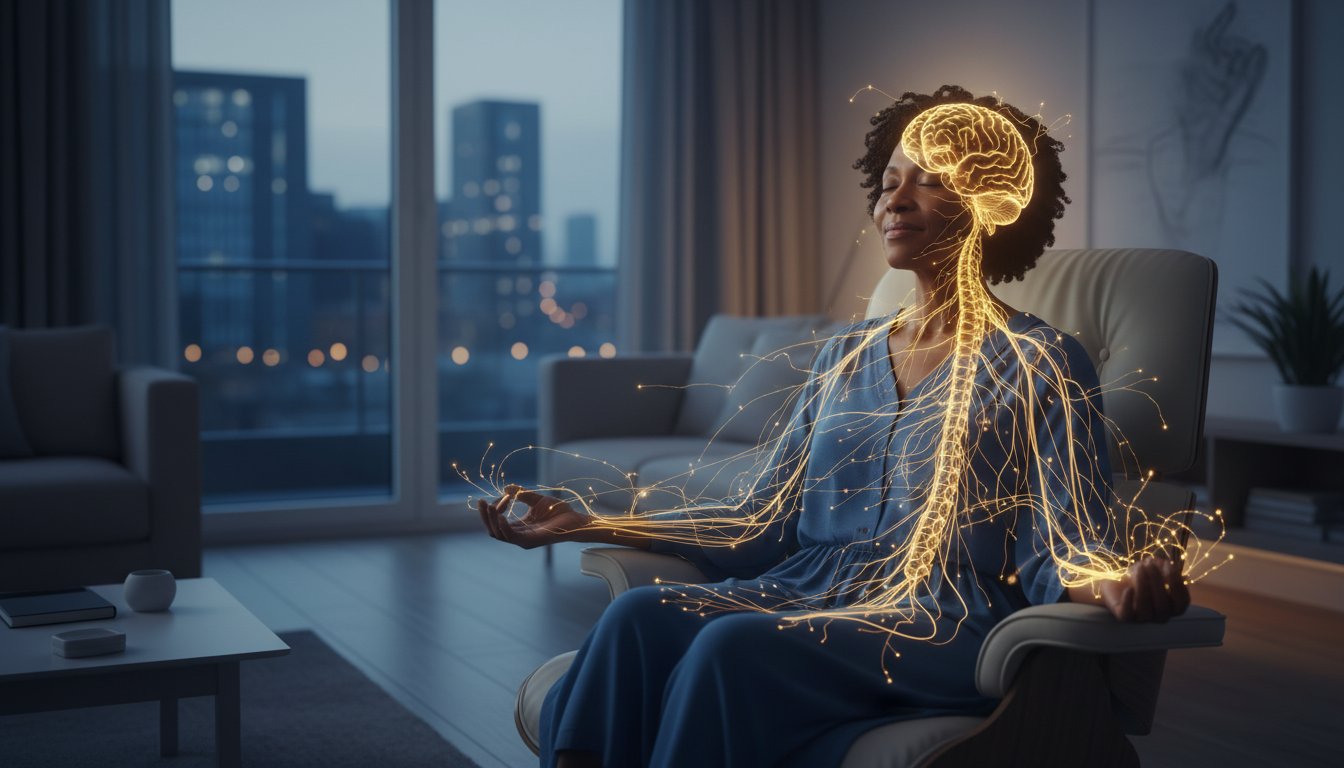
What if the reason your pain persists isn't because your body is broken, but because your nervous system is trapped in a protective loop? You have likely endured a cycle of normal test results and inconclusive scans, leaving you caught between the reality of your suffering and the silence of your clinical reports. It is a lonely space to inhabit, especially when you feel dismissed by a system that prioritises structural damage over human experience. You aren't imagining your symptoms, and you aren't out of options; you are simply looking for answers in a model that is too narrow to see the whole picture.
The biopsychosocial approach to chronic pain provides the scientific validation you have been seeking by addressing the intricate connection between your biology, your mind, and your environment. Whilst traditional medicine often focuses solely on the physical, this modern framework recognises that recovery requires a more integrated perspective. This article serves as your clinical guide, moving from the identification of systemic triggers to the presentation of a clear recovery framework. You will discover practical tools to manage your symptoms daily, shifting your focus from mere survival to genuine, evidence-based progress.
Key Takeaways
- Move beyond the outdated biomedical model to understand how the biopsychosocial approach to chronic pain views symptoms as a systemic behaviour rather than simple tissue damage.
- Discover the mechanism of central sensitisation and how your nervous system can "learn" to maintain persistent pain through the process of neuroplasticity.
- Reframe the role of the mind by understanding how the brain’s threat detection centre amplifies physical signals without the pain being "all in your head".
- Learn how to organise a recovery strategy that focuses on desensitising a high-volume nervous system through practical self-regulation and clinical insight.
- Understand why education is the essential first step in rewiring the brain-body connection and reclaiming a sense of physical agency.
The Biopsychosocial Approach: A Shift from Tissue Damage to System Behaviour
Modern pain science has undergone a quiet but profound revolution. We have moved away from the simplistic view that pain is merely a symptom of a broken body. Today, the biopsychosocial approach to chronic pain is recognised globally as the gold standard for clinical recovery. This framework shifts our focus from searching for a single "faulty part" to understanding the behaviour of a complex, living system.
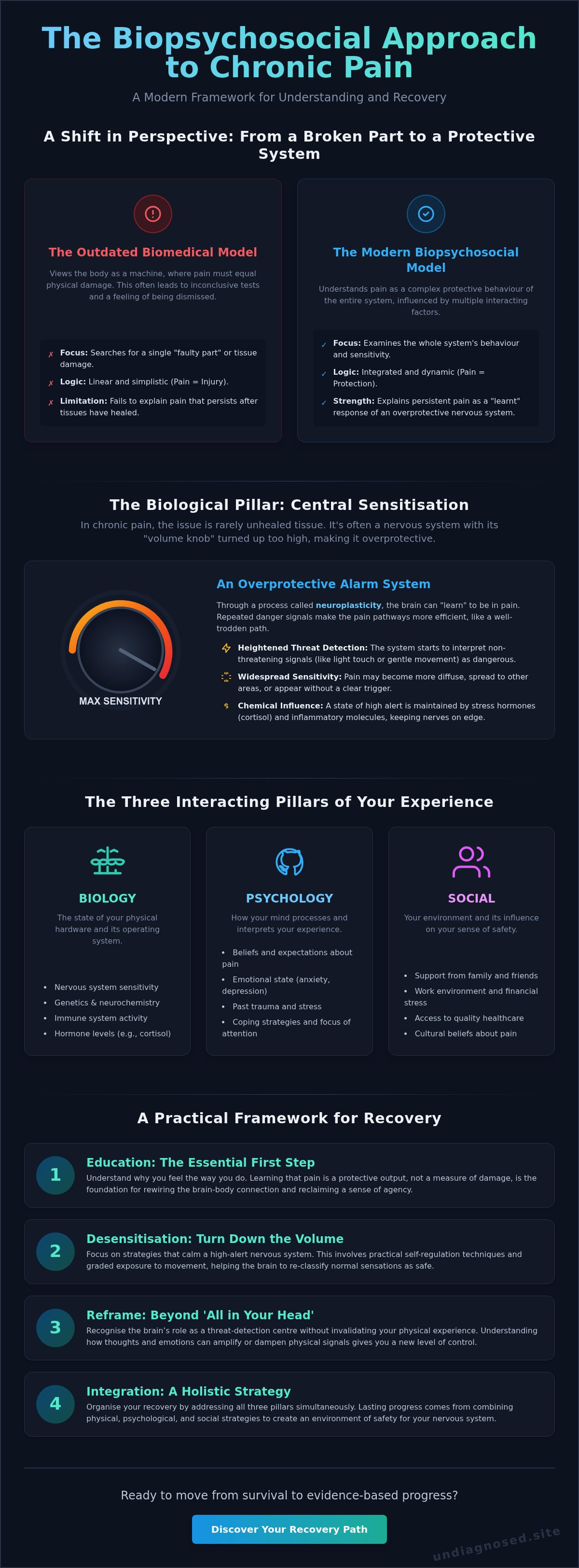
For decades, the biomedical model treated the human body like a machine. The logic was linear; if there was noise, there must be a loose screw. If there was pain, there must be tissue damage. This outdated perspective fails millions of people. You might have been told your scans are "normal" or "clear", yet your daily experience is one of genuine physical suffering. This discrepancy doesn't mean your pain is imaginary. It means the tools used to measure it are looking for structural faults whilst ignoring systemic sensitivity.
Pain is not a direct measurement of damage; it is a protective output. Think of your nervous system as a sophisticated home security alarm. Sometimes, the alarm continues to blare long after the intruder has left. In chronic conditions, the system becomes overprotective. It produces pain to keep you safe, even when the tissues have healed. Recognising this shift from "damage indicator" to "protective mechanism" is the foundation of the biopsychosocial approach to chronic pain.
Moving Beyond the Biomedical Myth
The "body-as-a-machine" metaphor is fundamentally flawed for chronic conditions. Tissues heal; most physical injuries resolve within a few months. When pain persists beyond this window, it is often because the nervous system has remained in a state of high alert. This "medically unexplained" pain is a biological reality, not a psychological failing. It occurs when the brain continues to perceive a threat based on a variety of inputs, long after the original injury is gone.
The Three Pillars of the Biopsychosocial Model
To find a clear path to recovery, we must examine the three intersecting forces defined by The Biopsychosocial Model:
- Biology: This includes your genetics, neurochemistry, and the current physical state of your nervous system’s sensitivity.
- Psychology: This covers your beliefs about pain, your emotional state, and how your brain processes previous trauma or stress.
- Social: Your support systems, work environment, and cultural influences all play a role in how your system perceives safety.
The Biological Pillar: Understanding Central Sensitisation and the Nervous System
Whilst traditional medicine often stops at the level of bones and muscles, the biopsychosocial approach to chronic pain recognises that the biological pillar is far more expansive. It encompasses the entire nervous system, the endocrine system, and the immune response. In chronic conditions, the primary issue is rarely a structural defect that hasn't healed. Instead, it is often a state of central sensitisation. You can think of this as the "volume knob" of your nervous system being turned up and stuck in a high-intensity position.
This biological shift occurs through neuroplasticity, the brain's ability to reorganise itself based on experience. Just as you might learn a new language through repetition, your brain can "learn" to be in pain. When danger signals are sent repeatedly, the neural pathways responsible for processing those signals become more efficient and more sensitive. Over time, the system begins to produce pain in response to non-threatening stimuli, such as a light touch or gentle movement. This is not a sign of weakness; it is a sign of a highly adaptive system that has become over-protective.
Your biology is also influenced by the chemical environment of your body. Chronic pain is frequently maintained by a heightened immune response and an overactive endocrine system. When your system perceives a constant threat, it releases a steady stream of cortisol and pro-inflammatory cytokines. This chemical bath keeps your nerves on high alert, creating a feedback loop that sustains the very symptoms you are trying to escape. Understanding these mechanisms is a core part of learning to regulate your internal environment.
The Neuroscience of Persistent Pain
There is a critical distinction between acute nociception, which is the immediate signal of potential tissue damage, and chronic functional pain. In the latter, the "danger sensing" system has become hypersensitive. This transition is explored deeply in the neuroscience of MUS, which explains how the brain creates genuine physical symptoms as a protective strategy. Your pain is a real biological event, even when it is driven by neural processing rather than a fresh injury.
Lifestyle Factors as Biological Drivers
Biological sensitivity is not static; it is influenced by your daily habits. Poor sleep quality and inadequate nutrition can significantly lower your pain threshold, making your system more reactive. Chronic stress acts as a primary driver for inflammation, whilst a lack of movement can reinforce the brain's fear of activity. Recovery involves addressing these Psychosocial Factors in Chronic Pain that manifest as biological triggers, allowing you to retrain your brain through safe, gradual exposure to movement.
The Psychological and Social Pillars: Beyond the 'All in Your Head' Myth
For many, the mention of "psychology" in a medical consultation feels like an accusation. It suggests that if no structural damage is visible on a scan, the suffering must be fabricated. This is a profound misunderstanding of the biopsychosocial approach to chronic pain. In this framework, psychological factors are not synonymous with "imaginary"; they are recognised as "influential" biological drivers. Your brain's threat detection centre, the amygdala, acts as a primary modulator of physical signals. When your system perceives a threat, whether that threat is emotional stress or physical strain, the amygdala amplifies the signals. It turns a whisper of discomfort into a scream of pain.
Recent Scientific Advances in the Biopsychosocial Approach demonstrate that emotional processing and physical pain share overlapping neural circuits. This means that your internal state is not separate from your physical reality; it is the lens through which your brain interprets every sensation from your body. When we address the psychological pillar, we aren't questioning the validity of your pain. We are identifying the factors that keep your nervous system in a state of high alert.
How Emotions and Beliefs Shape Physical Reality
The "Fear-Avoidance" model is a primary example of how beliefs dictate physical outcomes. If you believe that movement will cause further damage, your brain will produce pain as a protective barrier to stop you from moving. This creates a cycle of deconditioning and increased sensitivity. Catastrophising, or the tendency to anticipate the worst possible outcome, acts as high-octane fuel for your nervous system's alarm. Recognising the mind and body connection is not a matter of "positive thinking"; it is a clinical necessity for lowering the system's baseline threat level.
The Social Context of Chronic Pain
Your environment and relationships are biological "inputs" that your brain constantly monitors for safety or danger. Isolation, workplace stress, and financial instability are not just life challenges; they are signals that tell your nervous system to stay vigilant. Amongst the most damaging social factors is the experience of being dismissed by medical professionals. This "clinical gaslighting" increases the sense of threat, as the individual feels both physically vulnerable and socially abandoned. Furthermore, cultural expectations of "soldiering on" often force individuals to ignore their system's signals, leading to a total collapse of the body's ability to self-regulate. Healing requires an environment that validates your experience whilst providing the safety needed for the system to settle.
Practical Application: How to Organise Your Recovery Strategy
Moving from theory to practice requires a fundamental shift in your role. You are no longer a passive recipient of medical intervention; you are the active architect of your own nervous system. The biopsychosocial approach to chronic pain isn't a treatment you receive, but a strategy you implement. This process is not about a quick fix that masks symptoms, but a structured discipline that changes the underlying behaviour of your body. Recovery is not a miracle; it is a methodology. It requires moving from a state of reactive fear to one of proactive regulation.
Consistency matters. Your brain needs repetitive signals of safety to override years of ingrained protective patterns. Whilst a single breathing session might provide temporary relief, it is the cumulative effect of daily practice that eventually recalibrates your internal volume knob. To begin, you must identify your personal triggers across the biological, psychological, and social pillars. This data allows you to create a recovery programme that is specific to your life rather than a generic protocol. If you are ready to move from confusion to clarity, you can begin the Mind and Body Connection online course today to structure your path forward.
Retraining the Nervous System
Desensitising a high-volume system involves the use of graded motor imagery and strategic pacing. Pacing is not about doing less; it's about doing enough to signal safety without triggering the alarm. By gradually increasing your activity levels in a controlled manner, you teach your brain that movement is safe rather than threatening. Utilising specific mind-body balance tools can help you stay within your "window of tolerance", ensuring that you are challenging the system without overwhelming it.
Daily Tools for Symptom Management
Daily management focuses on dampening central sensitisation through physiological shifts. Vagus nerve stimulation, achieved through specific diaphragmatic breathing exercises, sends an immediate signal of safety to the brain's threat detection centre. Similarly, prioritising sleep hygiene is essential; poor sleep acts as a biological "threat" that keeps the nervous system on high alert. For a more detailed breakdown of these techniques, you can explore this guide on medically unexplained symptoms self-help. These tools work by changing the chemical environment of your body, shifting you from a state of high-cortisol vigilance to one of restorative calm.
The Undiagnosed Philosophy: Bridging Neuroscience and Lived Experience
Dr. Csaba Dioszeghy’s work focuses on the exact intersection where clinical neuroscience meets the individual's lived experience. In a medical landscape that often fragments the person into isolated symptoms, this philosophy restores wholeness. It is a specific application of the biopsychosocial approach to chronic pain, designed specifically for those who've been left behind by traditional biomedical models. By looking past the "all in your head" dismissals, we find a complex system that's doing its best to protect you. Recovery is not just a destination you reach; it's a process of discovery where you learn to interpret the signals your body has been sending for years.
The framework established by Undiagnosed - The Mind and Body Connection doesn't treat you as a collection of faulty parts. It treats you as a dynamic system capable of change. This approach acknowledges that whilst your pain may not be visible on an MRI, its impact on your life is undeniable. By bridging the gap between what's happening in your neural pathways and what's happening in your daily environment, we create a path to recovery that's both intellectually rigorous and emotionally accessible. You're moving from a state of being "broken" to a state of being "sensitised", and that distinction changes everything.
Why Education is Medicine
Understanding the "why" behind your pain is more than an intellectual exercise; it's a biological intervention. When you learn that your symptoms are a protective output of a sensitised nervous system rather than a sign of ongoing structural decay, your brain’s threat detection centre begins to settle. Knowledge reduces the fear that fuels the alarm. A structured curriculum provides the map you need to navigate out of functional distress. If you're seeking a clear path through these complex symptoms, you can explore the functional neurological disorder recovery course to find the right support for your healing journey.
Taking the Next Step Toward Healing
The transition from confusion to clarity begins with a single shift in perspective. By adopting the biopsychosocial approach to chronic pain, you move away from the frustration of failed treatments and toward a logical framework for recovery. This isn't a miracle cure, but a methodical rewiring of the brain-body connection through education and practice. For a deeper, step-by-step exploration of these concepts, the book Undiagnosed - The Mind and Body Connection offers a comprehensive guide to reclaiming your health and understanding your system's unique language. Your pain is real, your scans are normal, and your recovery is possible.
Reclaiming Your Path to Functional Health
We have moved from the fear of structural damage to the understanding of systemic behaviour. By examining the intersecting forces of biology, psychology, and social context, you have gained a framework that validates your experience whilst offering a logical route to recovery. The biopsychosocial approach to chronic pain proves that your symptoms are not imaginary; they are the output of a nervous system that has remained in a state of high alert. This shift from searching for a structural "fix" to mastering systemic self-regulation is the foundation of long-term healing.
Founded by Consultant Physician Dr. Csaba Dioszeghy, our work utilises an evidence-based neuroscience approach to provide realistic, grounded optimism for patients who feel overlooked by traditional medicine. You don't have to navigate this complex journey alone. Discover the 'Undiagnosed' curriculum and start your recovery journey today. Your system possesses an inherent capacity for change. By applying these clinical insights with consistency and patience, you can begin to turn down the volume of your symptoms and reclaim your sense of physical safety.
Frequently Asked Questions
Is the biopsychosocial approach suggesting that my pain is all in my head?
No, this approach validates that your pain is a real biological event occurring within your nervous system. Whilst the brain processes all pain, this doesn't mean the symptoms are imaginary or "fake". Instead, it recognises that the brain's threat detection system can amplify physical signals based on various inputs, creating genuine suffering even when structural tissues appear normal on a scan.
How can social factors like my job or family actually affect my physical pain?
Social factors act as constant biological inputs that your brain monitors to determine your level of safety or danger. Workplace stress or strained family relationships signal "threat" to the nervous system, which keeps your body in a state of high vigilance. This state of alert maintains the chemical environment, such as elevated cortisol, that sustains and amplifies the physical experience of pain in your body.
Can the biopsychosocial model work if I have a diagnosed condition like arthritis?
Yes, the model is highly effective for diagnosed structural conditions because it addresses the nervous system's reaction to those conditions. Two people can have the same degree of joint wear in arthritis but experience vastly different levels of disability. By addressing the psychological and social pillars, you can lower the sensitivity of your nervous system, reducing the overall intensity of the pain associated with the physical diagnosis.
How long does it take to see results using a biopsychosocial approach to chronic pain?
Recovery is a gradual process of retraining the nervous system rather than an overnight cure. Most individuals begin to notice shifts in their symptom intensity or their emotional reaction to pain within a few weeks of consistent practice. However, long-term desensitisation of a "high-volume" system typically requires months of structured application to create lasting neural changes and sustainable functional improvement.
The biopsychosocial approach to chronic pain is a methodology of discovery. It requires patience as you move from a state of reactive fear to one of proactive regulation.
Why haven't my other doctors mentioned the biopsychosocial model before?
Most medical training is traditionally rooted in the biomedical model, which focuses on identifying and fixing structural damage. Whilst this is vital for acute injuries or infections, it often fails in the management of chronic conditions. The biopsychosocial approach to chronic pain requires more time and a different set of clinical tools than a standard consultation usually allows, leading many clinicians to stick to more familiar pharmaceutical paths.
What is the difference between the biomedical model and the biopsychosocial model?
The biomedical model views the body as a machine where pain always equals a broken part that needs repair. In contrast, the biopsychosocial model views the body as a complex, adaptive system. It recognises that pain is a protective output influenced by your biology, your internal emotional state, and your external environment. This shift moves the focus from "fixing a part" to "regulating the whole system".
Can breathing exercises really change how much pain I feel?
Specific breathing exercises directly influence the nervous system by stimulating the vagus nerve, which acts as a "brake" for the body's stress response. When you slow your breath, you send an immediate, physiological signal of safety to the brain. This can dampen the "threat" response, lowering the production of stress hormones and helping to reduce the intensity of the pain signals produced by a sensitised system.