
What if the "clear" test results from your GP aren't proof that nothing is wrong, but rather evidence that your nervous system is stuck in a state of high alert? According to the NHS, roughly 25% of patients in primary care experience persistent physical symptoms that lack a simple diagnostic label. It's incredibly isolating to feel the weight of chronic fatigue or pain whilst being told there's no clinical explanation. You deserve validation, not dismissal. Your sensations are a physical reality, not a psychological invention; understanding this biological mechanism is the first step toward recovery. This guide to medically unexplained symptoms self-help provides a grounded pathway to relief, focusing on science, not speculation.
You'll learn how to recalibrate your body's stress response and implement evidence-based strategies that reduce symptom intensity. We'll explore the practical tools needed to bridge the gap between your mind and body, moving you from a state of fear toward a life of predictable health and renewed quality of life.
Key Takeaways
- Validation, not dismissal: Understand that your symptoms are real physical sensations caused by functional changes in the nervous system rather than structural "hardware" damage.
- Explore the science of central sensitisation to learn how the brain’s alarm system can become overactive, perpetuating pain signals even when medical tests appear clear.
- Master practical medically unexplained symptoms self-help techniques, such as somatic tracking, to retrain your brain to observe physical sensations without an immediate emotional reaction.
- Move beyond the "pill for every ill" approach by adopting a biopsychosocial framework that addresses the biological, psychological, and social factors influencing your recovery.
- Shift your focus from seeking an elusive diagnosis to supporting your system, moving from a state of distress towards a path of functional regulation and long-term relief.
What are Medically Unexplained Symptoms? Validation, Not Dismissal
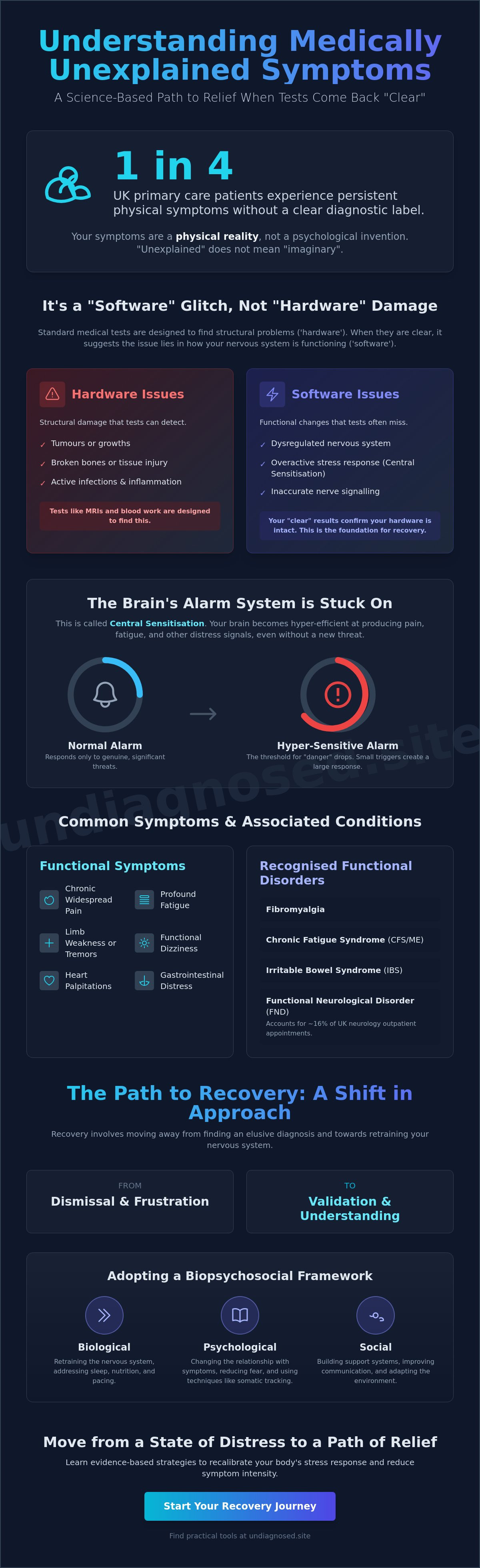
Medically unexplained symptoms (MUS) refer to persistent physical sensations that don't have an obvious structural cause. When you experience chronic pain, debilitating fatigue, or heart palpitations, your body is sending clear signals of distress. However, traditional diagnostic tools often fail to find a "hardware" issue like a broken bone or a tumour. This lack of a clear biological marker often leads to a devastating sense of isolation. It's vital to understand that "unexplained" does not mean imaginary. Your pain is real; the cause simply lies in how your systems function rather than how they're built.
In the United Kingdom, approximately 25% of all primary care consultations involve these types of issues. For many, seeking medically unexplained symptoms self-help begins with the realisation that their nervous system has become dysregulated. We categorise these as functional symptoms. This term reflects a shift in modern medicine: we're looking at the "software" of the body. Common manifestations include:
- Persistent limb weakness or tremors.
- Functional dizziness and balance issues.
- Chronic widespread pain.
- Gastrointestinal distress and bloating.
- Profound, unrefreshing fatigue.
The label of Medically unexplained physical symptoms often carries an unfair stigma. Patients frequently feel dismissed by clinicians who imply the problem is "all in the head." We advocate for a different perspective: validation, not dismissal. By acknowledging the reality of the physical experience, we can begin the work of recovery through evidence-based insights and practical tools.
The Paradox of Normal Test Results
Standard blood tests and MRIs are designed to detect structural damage. They're excellent at finding inflammation or injury but poor at measuring the speed and accuracy of nerve signals. Think of a computer with a perfect screen and keyboard that still crashes because of a software glitch. When a doctor says your results are "normal," they're confirming your hardware is intact. This is often frustrating whilst you're feeling unwell, yet it provides a vital foundation for medically unexplained symptoms self-help. It proves the body is capable of healthy function if we can retrain the nervous system.
Common Conditions Associated with MUS
Several recognised conditions fall under the umbrella of functional disorders. Fibromyalgia, Chronic Fatigue Syndrome (CFS/ME), and Irritable Bowel Syndrome (IBS) are the most frequent. Functional Neurological Disorder (FND) is another key example, often representing the second most common reason for outpatient neurology appointments in the UK, accounting for roughly 16% of cases. These conditions frequently overlap amongst patients. A person with IBS is statistically more likely to experience chronic migraine or pelvic pain, suggesting a shared underlying mechanism of systemic sensitivity rather than isolated organ failure.
The Neuroscience of Persistent Symptoms: Why Your Brain Stays on High Alert
The human nervous system functions as a sophisticated, 24-hour surveillance network. Its primary objective is your survival, acting as the body's internal alarm system. When you experience Medically unexplained symptoms, this alarm system has often become stuck in a state of high reactivity. The brain is not necessarily responding to active tissue damage or a current infection; instead, it is responding to a perceived threat that it no longer knows how to switch off.
This state is clinically recognised as central sensitisation. It occurs when the brain becomes exceptionally efficient at producing pain, fatigue, or dizziness signals. Through a process of biological "wind-up," the threshold for what the brain considers "dangerous" drops significantly. Neural pathways that transmit distress are reinforced through repetition, making the brain more sensitive to internal and external stimuli. In the context of medically unexplained symptoms self-help, understanding that your brain has become an over-achiever at protection is the first step toward relief.
To visualise this, imagine a hyper-sensitive car alarm. Initially, the alarm was designed to sound if a thief shattered a window. However, the system has become so sensitive that it now screams if a leaf touches the bonnet or a light breeze passes by. The car’s engine is sound, the tyres are inflated, and the chassis is intact. There is no structural defect with the vehicle, yet the alarm continues to wail because the sensors are tuned too tightly. Recovery involves recalibrating these sensors rather than trying to repair a "broken" engine that doesn't exist.
The Impact of Stress and Emotions on Physical Health
The fight or flight response creates immediate, measurable shifts in your physiology. When the brain perceives a threat, adrenaline surges and heart rates climb. Muscles brace for impact, often leading to chronic tension in the neck, shoulders, and back. Your amygdala, the brain's dedicated threat-detection centre, scans for hazards without pause. It does not distinguish between a looming work deadline and a physical injury; both are processed as "danger." The mind-body connection is a bidirectional biological feedback loop.
Neuroplasticity: The Key to Recovery
Neuroplasticity is the brain's inherent ability to reorganise its structure and functions. If the brain can "learn" to produce a symptom through persistent stress or trauma, it possesses the equal capacity to "unlearn" that pattern. Recovery focuses on retuning the nervous system rather than attempting to fix a specific body part that has already healed from any initial insult. You can explore the mechanics of this process in The Mind and Body Connection: A Clinical Guide to Functional Health. By consistently utilising neurological retraining tools, you can teach your brain to recognise safety, eventually silencing the false alarms that have dictated your daily life.
A Biopsychosocial Framework for Self-Help
Recovery from functional symptoms requires a fundamental shift in perspective. The traditional "pill for every ill" model often fails because it treats the body as a collection of isolated parts rather than an integrated system. Effective medically unexplained symptoms self-help relies on the biopsychosocial framework: a model that addresses biological, psychological, and social factors simultaneously. This approach provides hope, not hype. It acknowledges that recovery is a process of consistent practice rather than a sudden cure. By using this framework, you can organise your recovery journey logically, moving from confusion to a structured plan of action.
The Biological Pillar: Calming the Physical Body
Biology is the foundation of your recovery. Sleep hygiene is a primary tool; clinical research indicates that even a single night of disrupted sleep can increase pain sensitivity by 25%. Instead of the "boom and bust" cycle, where you overexert on good days only to crash later, adopt a strategy of pacing. This involves breaking tasks into manageable segments to keep your nervous system stable. Nutrition also plays a role. Supporting gut-brain health can reduce systemic inflammation, which often exacerbates physical distress. Understanding Medically Unexplained Symptoms helps clarify how these physical factors interact with your overall health and well-being.
The Psychological Pillar: Addressing the Internal Dialogue
Your internal dialogue acts as a volume knob for your symptoms. Catastrophising, or fearing the worst, sends "danger" signals to the brain that actually amplify physical pain signals. To break this cycle, use medically unexplained symptoms self-help techniques like neutral symptom tracking. This allows you to identify specific triggers without becoming obsessed with the sensation itself. Aim for curiosity over fear. When a flare-up occurs, treat it as data to be analysed rather than a sign of permanent damage. This cognitive shift helps downregulate a hyper-vigilant nervous system by reducing the perceived threat.
The Social Pillar: Environment and Connection
Humans are social creatures, and our environment dictates our internal sense of safety. Social isolation or high-conflict relationships keep the body in a state of "high alert," which directly worsens physical symptoms. Setting clear boundaries is essential for protecting your energy levels whilst you recover. Validation also plays a critical role. When you feel heard and understood by those around you, the brain's "threat" response naturally diminishes. Building a supportive social circle ensures that your recovery isn't a solitary struggle but a shared path toward wellness. It's about connection, not isolation.
Practical Self-Help Strategies for Symptom Management
Recovery is a process of retraining, not just resting. Effective medically unexplained symptoms self-help begins with five foundational steps designed to recalibrate a sensitised nervous system. First, education provides the evidence that your body is not broken. It is stuck in a state of high alert. Understanding that symptoms are signals of a protective brain, not structural damage, lowers your internal threat level. This is about safety, not suppression.
Second, somatic tracking teaches you to observe sensations with curiosity rather than fear. You learn to watch the pulse or the ache without the immediate emotional reaction that usually follows. Third, vagus nerve regulation switches off the internal alarm through physical cues. Fourth, graded motor imagery uses mental rehearsal and gentle movement to redraw the brain's map of the body, which often becomes blurred during chronic illness. Finally, emotional processing addresses the physiological impact of suppressed stress. Research suggests that addressing repressed emotions can lead to a 50% reduction in symptom intensity for many patients.
Breathing Techniques for Immediate Relief
Slow exhalations are the fastest way to signal safety to the brain. When you extend your breath out, you stimulate the vagus nerve. This lowers your heart rate and blood pressure instantly. The 4-7-8 technique is a powerful tool for down-regulating a spiked nervous system. It provides physiological feedback that the "danger" has passed.
Try this two-minute exercise now. Inhale through your nose for 4 seconds. Hold that breath for 7 seconds. Exhale slowly through pursed lips for a count of 8. Repeat this cycle four times. This specific rhythm forces the body out of "fight or flight" and into a state of "rest and digest." It is a biological override for anxiety.
Sleep Strategies to Reduce Sensitivity
Deep sleep allows the glymphatic system to clear metabolic waste from the brain. Without this nightly "clean," neurochemical sensitivity increases, making pain and fatigue feel more intense. To protect your recovery, adopt these three non-negotiable habits. Keep your bedroom at a cool 18 degrees Celsius. Stop using screens 60 minutes before bed to protect melatonin production. Stick to a consistent wake-up time every day, including weekends.
For those with sensory processing issues, a weighted blanket provides "deep pressure touch" that can ground the nervous system. White noise machines help by masking sudden sounds that might trigger a startle response during the night. You may also find it helpful to explore EMF and Geopathic Stress Protection Products as a way to further reduce environmental triggers. These tools create a predictable, safe environment for the brain to finally let go of its defensive posture.
Consistency is the bridge between distress and relief. Explore our comprehensive mind-body recovery tools to start your structured journey today.
Moving Beyond the 'Undiagnosed' State: Your Path to Long-Term Relief
The absence of a clinical label isn't a failure of your body; it's an opportunity to pivot toward functional recovery. When tests come back clear whilst your symptoms remain, the focus must shift from "Why is this happening?" to "How can I support my system?". This transition marks the move from passive patient to active participant. It's about agency, not abandonment. By embracing medically unexplained symptoms self-help strategies, you begin to address the physiological dysregulation that standard blood tests often miss. This is science, not guesswork.
When to Seek Professional Support
Self-help serves as a powerful companion to clinical guidance, not a replacement for it. You should always maintain an open dialogue with your GP. A biopsychosocially-informed clinician understands that your pain is real, even without a visible biomarker. They provide the safety net that allows you to explore mind-body recovery with confidence. You must consult a medical professional immediately if you experience "red flag" symptoms, such as:
- Unexplained weight loss of more than 5% of body weight over six months.
- Persistent night sweats or unexplained fever.
- New, localised lumps or swellings.
- Blood in stool, urine, or phlegm.
- Sudden, severe neurological changes like loss of vision or coordination.
The Power of Structured Learning
Recovery requires a roadmap. The "Undiagnosed" book and online course provide exactly that: tools, not just talk. This programme moves beyond vague advice, offering evidence-based guidance to help you recalibrate your nervous system. You'll learn how to identify triggers and implement daily practices that foster physiological safety. Because recovery isn't always linear, the course includes lifetime access to the curriculum. This ensures you have the resources to manage future flare-ups and maintain your progress over the long term. This is about hope, not hype.
You are the primary expert on your own body. You know the nuances of your sensations and the reality of your lived experience better than any diagnostic machine. However, you don't have to navigate this complex terrain alone. Effective medically unexplained symptoms self-help is about partnership; it's about combining your internal wisdom with external, scientific expertise. This is about recovery, not just coping.
Reclaim Your Life Through Evidence-Based Action
Recovery begins when you shift your focus from the frustration of being undiagnosed to the practical application of mind-body science. You've seen how a sensitised nervous system keeps the body on high alert and why a biopsychosocial framework is essential for sustainable relief. This journey is about progress, not perfection; it's about finding tools, not just answers. By utilising medically unexplained symptoms self-help strategies, you can begin to retune your nervous system and reduce the impact of persistent physical sensations on your daily life.
You don't have to navigate this complex path alone. Dr Csaba Dioszeghy, a Consultant Physician, created a structured programme to bridge the gap between clinical evidence and your personal experience. This evidence-based curriculum focuses on practical tools for symptom management, providing a clear roadmap for those who feel overlooked by traditional medical models. It's time to choose hope, not hype; start building a foundation for long-term health today.
Begin your journey to recovery with the Undiagnosed Online Course
Your path to relief is waiting, and the first step is within your reach.
Frequently Asked Questions
Is it possible that my doctor has missed something serious?
It is a common concern, but clinical data shows that for patients with persistent symptoms, a serious underlying pathology is missed in fewer than 0.5% of cases after initial diagnostic tests. NHS doctors follow strict NICE guidelines to rule out red flags before categorising symptoms as medically unexplained. You deserve thorough investigation, not dismissal. Once organic disease is excluded, we focus on the nervous system's function rather than structural failure.
Can stress really cause physical symptoms like dizziness and numbness?
Stress triggers the autonomic nervous system, which can create genuine physical sensations like dizziness or numbness without any tissue damage. This is a physiological response, not an imaginary one. When your brain perceives a threat, it alters blood flow and nerve signalling. In the UK, approximately 25% of GP consultations involve these functional symptoms. Understanding this mind and body connection is the first step toward lasting relief.
How long does it take to see results from mind-body self-help?
Most individuals begin to notice shifts in their symptom intensity within 4 to 8 weeks of consistent practice. Recovery is a gradual process of retraining the nervous system, not a quick fix. Data from clinical trials on neuroplasticity suggests that significant neural pathway changes require at least 60 days of daily engagement with medically unexplained symptoms self-help tools. Progress follows a path of persistence, not perfection.
Do I need to see a psychiatrist for medically unexplained symptoms?
You don't necessarily need a psychiatrist, as these symptoms are often managed by GPs, physiotherapists, or specialised clinicians. Whilst psychiatrists can help if there's co-occurring clinical depression, many people find relief through physiological regulation. It's about function, not mental illness. We provide tools for biological recovery, not just psychological support. It's evidence-based guidance for a physical reality that requires a practical, body-based approach.
What is the difference between psychosomatic and "all in your head"?
Psychosomatic refers to real physical symptoms caused or aggravated by internal nervous system processes, whereas "all in your head" is a dismissive myth. Your pain is a biological fact, not a figment of your imagination. The distinction lies in the origin of the signal, not the reality of the sensation. We advocate for validation, not gaslighting. Every symptom you feel has a basis in your nervous system's activity and deserves professional attention.
Can children or teenagers experience medically unexplained symptoms?
Children and adolescents frequently experience functional symptoms, with studies indicating that up to 10% of school-aged children suffer from unexplained abdominal pain or headaches. Their nervous systems are highly sensitive to environmental and emotional shifts. Early intervention using medically unexplained symptoms self-help techniques can prevent these patterns from becoming chronic. It's about providing resources, not just reassurance, for the younger generation to help them regain their physical confidence.
How do I explain my condition to family and friends who don’t understand?
Use the analogy of a "software issue" rather than a "hardware issue" to explain that your body's wiring is overactive. Tell them your nervous system is stuck in a high-alert state, creating real pain without a broken part. This creates clarity, not confusion. Explain that you're following a structured recovery plan based on clinical science. It helps them move from skepticism to support once they understand the biological basis of your experience.
Is it safe to exercise when I am in pain but have no diagnosis?
Exercise is generally safe and recommended once a clinician has ruled out structural damage or acute injury. Start with low-impact movement, like a 5-minute walk, to signal safety to your brain. Research suggests that graded motor imagery and gentle movement reduce central sensitisation. It's about movement, not strain. Listen to your body's rhythm whilst maintaining a steady pace of activity to rebuild your physical resilience safely.