
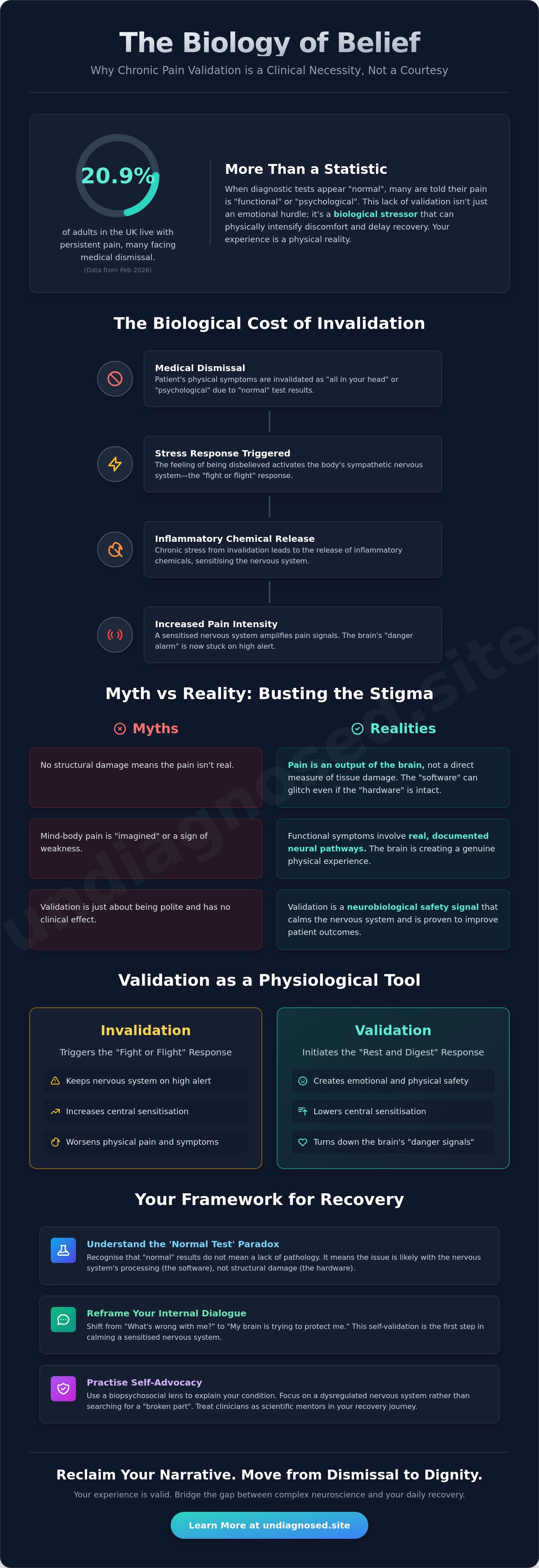
What if the most powerful tool for calming your nervous system isn't found in a pharmacy, but in the simple act of being believed? You've likely sat in sterile consulting rooms whilst a professional suggests your pain is "functional" or "psychological" simply because your MRI appears normal. This lack of chronic pain validation is not just an emotional hurdle; it's a biological stressor that physically intensifies your discomfort. Data from February 2026 indicates that 20.9% of adults live with these persistent symptoms, yet many are left to face the "all in your head" stigma without support.
We believe that your experience is a physical reality, not a mental fabrication. In this guide, you'll discover why clinical validation is a biological necessity for recovery and how to manage the undiagnosed journey with scientific dignity. We provide a clear framework for explaining your condition to others whilst exploring the evidence-based connection between the mind and body. This is about finding relief, not rhetoric; it's about providing hope, not hype, as you reclaim your narrative through education and insight.
Key Takeaways
- Understand why chronic pain validation is a biological requirement for calming a sensitised nervous system and reducing physical intensity.
- Learn why "normal" diagnostic results don't equate to a lack of pathology; the brain is capable of creating physical symptoms without structural damage.
- Discover the chemical link between medical dismissal and increased pain, specifically how the stress of being disbelieved triggers inflammatory responses.
- Access practical tools to reframe your internal dialogue and regulate your nervous system when faced with social or medical invalidation.
- Explore the Undiagnosed - The Mind and Body Connection philosophy to bridge the gap between complex neuroscience and your daily recovery journey.
Table of Contents
The Reality of Medically Unexplained Pain: Why Validation is Essential
Validation isn't a luxury or a polite social gesture; it's the clinical recognition of your physical experience as legitimate and worthy of support. Within the UK, where approximately 20.9% of adults live with persistent symptoms, this recognition often serves as the primary gateway to effective management. Without chronic pain validation, the journey toward health becomes a double burden, where you're forced to battle both the sensations in your body and a system that suggests they don't exist. This recognition provides the necessary foundation for trust, allowing you to move from a state of defensive searching to one of active recovery.
The "Normal Test Paradox" is a frequent source of distress for those with medically unexplained symptoms. You might have undergone numerous blood tests or MRI scans that return "perfect" results, yet your daily life remains severely restricted by physical suffering. These clear results don't indicate a lack of pathology; they simply confirm that the source of your chronic pain isn't structural. We advocate for a shift in perspective: diagnosis, not dismissal. This involves moving away from the hunt for a "broken part" and toward an understanding of a dysregulated nervous system. In this model, the clinician's role is to act as a witness to your suffering, functioning as a scientific mentor rather than just a technician of the body.
The Emotional Weight of Being Undiagnosed
The trauma of medical gaslighting is a physical stressor in itself. When you're told your pain is "functional" without a clear explanation of what that means, it often triggers a cycle of shame and social withdrawal. It's vital to recognise that "medically unexplained" is a reflection of the limitations of 2026 medical technology, not a lack of reality in your symptoms. By adopting a biopsychosocial lens, you can transition from the confusion of the unknown to a place of clinical clarity, where your experience is treated with the dignity it deserves.
Validation as a Physiological Tool
Science confirms that the feeling of being "heard" initiates a parasympathetic response, which is the body's natural "rest and digest" state. This shift is essential for healing, as it counteracts the high-stress "fight or flight" mode that keeps the nervous system in a state of high alert. Chronic pain validation creates the emotional safety required to lower central sensitisation, effectively turning down the volume on your brain's danger signals. Ultimately, pain validation acts as a neurobiological safety signal that tells your brain it no longer needs to produce such intense protection.
Myth vs Reality: Busting the 'All in Your Head' Stigma
The "all in your head" label is a relic of outdated medicine that causes genuine harm to those seeking relief. When patients seek chronic pain validation, they're often met with a dismissive shrug because a scan didn't show a slipped disc or a torn ligament. This dismissal ignores the fundamental reality of modern neuroscience: the brain creates 100% of the pain you feel. Whether the stimulus is a broken bone or a sensitised neural pathway, the experience is identical in the nervous system. Diagnosis, not dismissal, is the only path forward for those with functional symptoms.
Let's dismantle the common misconceptions that perpetuate this stigma:
- Myth: No structural damage means the pain isn't real. Reality: Pain is an output of the brain, not a direct measurement of tissue damage.
- Myth: Mind-body pain is "imagined." Reality: Functional symptoms involve documented neural pathways; the software is glitching, but the output is physical.
- Myth: Stress only causes minor tension. Reality: The endocrine system modulates "pain gates" in the spinal cord, directly increasing or decreasing pain signals.
- Myth: Validation is just about being polite. Reality: Research into the importance of pain validation shows it is a clinical intervention that improves patient outcomes.
Deconstructing the False Binary of Health
The divide between "physical" and "mental" health is based on 17th-century Cartesian dualism. This outdated concept suggests the mind and body are separate entities, yet modern science proves they're a single, unified system. When you understand the mind and body connection, you stop looking for a "hardware" fix for what is often a "software" issue. Our comprehensive online course helps you navigate this shift from structural thinking to systemic understanding, providing tools for long-term recovery.
Why Your Brain Creates Real Pain
The anterior cingulate cortex processes both physical injury and emotional distress. It doesn't distinguish between the two when generating a pain response. Your brain's danger detection system can become over-sensitised whilst scans remain clear, leading to high-impact chronic pain, which affects 6.9% of adults according to February 2026 data. This sensitisation is a biological fact, not a character flaw. Chronic pain validation acknowledges that real pain is defined by the experience, not the imaging.
The Biological Cost of Invalidation: How Dismissal Worsens Pain
Dismissal is more than an emotional slight. It is a physiological event that directly alters your internal chemistry. When a clinician or a loved one suggests your symptoms aren't real, your brain perceives a profound loss of safety. This "Stress of Social Exclusion" triggers a primal survival threat, activating the same neural regions responsible for physical injury. Providing chronic pain validation isn't just about good bedside manner; it's a clinical necessity to prevent the worsening of physical symptoms.
The chemical pathway from invalidation to increased pain is well-documented. Medical dismissal activates the Hypothalamic-Pituitary-Adrenal (HPA) axis, causing a spike in cortisol. Whilst cortisol is intended to manage short-term stress, chronic elevation leads to a pro-inflammatory state. These inflammatory cytokines increase the sensitivity of your nerves, effectively lowering your pain threshold. This creates a destructive feedback loop: invalidation leads to stress, which causes sensitisation, resulting in more pain and, eventually, further invalidation from others who don't understand the "invisible" nature of the condition.
Neuroscience of the Stress-Pain Link
The HPA axis reacts to medical gaslighting as if it were a physical attack. When patients are repeatedly told there is "nothing wrong" despite their agony, they often develop learned helplessness. This psychological state is not just a feeling; it's a biological configuration where the brain prioritises pain signals because it feels the environment is unsafe. Breaking this cycle requires chronic pain validation to signal to the brain that the threat has been recognised and the "danger detection" system can begin to de-escalate.
The Impact of Chronic Invalidation amongst Family and Friends
The trauma of invisible illness is often compounded by the secondary loss of social support. Data from February 2026 shows that the risk of suicide is doubled in individuals with chronic pain, a statistic heavily influenced by social isolation and the stress of being disbelieved. What others perceive as "pain behaviour" is often a desperate, subconscious plea for the validation the nervous system requires to regulate itself. You can begin to reclaim your health by recognising when your social environment is contributing to your symptom flare-ups. Moving away from invalidating spaces is often as crucial to recovery as any physical therapy or mind-body tool.
Practical Strategies for Self-Validation and Advocacy
When the medical system fails to provide answers, you must become your own grounded advocate. External chronic pain validation is often slow to arrive, so creating a stable internal environment is your first priority. This process begins with reframing your internal dialogue. Move away from the belief that your body is "broken" and instead recognise that your nervous system is in a "protective" state. You aren't faulty; you're sensitised. This shift in perspective signals safety to the brain, which is the first step in lowering symptom intensity.
To support this internal shift, utilise mind-body balance tools to regulate your nervous system when others dismiss your experience. Regulation is a skill you can develop through consistent practice. Alongside these tools, start documenting your symptoms through a biopsychosocial lens. Instead of only recording pain levels, note your stress, sleep quality, and emotional state. This comprehensive data provides a clearer picture of your health than a standard pain diary and helps you identify patterns that scans cannot detect.
Preparing for medical appointments requires a strategic approach. Use evidence-based language about functional symptoms to guide the conversation. When seeking support online, look for communities that offer "Hope, not hype." Avoid groups that focus exclusively on shared despair; instead, find spaces that prioritise evidence-based validation and practical recovery steps.
Navigating the UK Healthcare System
In your next GP appointment, ask for a "biopsychosocial assessment" to ensure your care plan considers your environment and history, not just your biology. Within the NHS, the "medically unexplained symptoms" label is often treated as a dead end. You should treat it as a starting point for exploring nervous system health. It's helpful to distinguish between a clinician who is "stumped" by your case and one who is "dismissive" of your suffering. One is a limitation of their current knowledge; the other is a lack of professional empathy.
Self-Validation Techniques for Daily Relief
Somatic tracking allows you to observe physical sensations without the secondary layer of fear. By noticing pain with neutral curiosity, you teach your brain that these signals aren't dangerous. Pair this with "Affirmative Inquiry"-the practice of acknowledging your pain's reality whilst remaining open to the possibility of recovery. To track your progress, keep a "Validation Journal" to record small wins in your mind-body connection. For a structured programme to help you master these techniques, join our Mind and Body Connection Online Course.
Moving Beyond Dismissal: The Mind and Body Connection
The Undiagnosed philosophy exists to bridge the gap between complex neuroscience and the lived experience of persistent symptoms. Whilst traditional medicine often stops at the limits of a scan, we provide the chronic pain validation required to move beyond a state of perpetual searching. By understanding that your symptoms are a protective output of a sensitised system, you stop being a passive recipient of care. You begin the transition from a frustrated patient to a knowledgeable expert in your own recovery.
Education is the most effective tool for re-training a nervous system that has become stuck in a loop of danger signals. As of January 2026, clinical trends show a 15% increase in the adoption of multidisciplinary pain strategies that prioritise patient education over pharmaceutical-only interventions. When you learn how neural pathways operate, you gain the power to influence them. This isn't about "thinking away" the pain; it's about providing the biological safety your brain needs to dial down its sensitivity. Our resources serve as the authoritative guide that the traditional healthcare system often lacks, offering a structured methodology for long-term health.
A New Path to Recovery
Dr. Csaba Dioszeghy’s evidence-based approach focuses on the reality of functional symptoms through a clinical lens. We provide "Hope, not hype," ensuring that every strategy is grounded in current science rather than empty promises. Understanding the "why" behind your pain, specifically the triggers and patterns of your unique nervous system, is the fundamental key to changing the "how" of your physical experience. This insight allows you to move from fear-based reactions to calm, informed responses.
Your Journey Starts with Recognition
Your pain is real, your symptoms are valid, and recovery is a biological possibility. You don't have to navigate the undiagnosed journey in isolation or confusion. By accessing our digital curriculum and structured resources, you join a community dedicated to patient dignity and scientific rigor. This level of chronic pain validation is the missing piece in many standard treatment plans. Explore the Undiagnosed book and start your mind-body recovery today to begin reclaiming your narrative and your health.
Reclaim Your Recovery Through Scientific Insight
Your journey toward wellness doesn't end with a clear scan; it begins with the recognition of your physical reality. We've explored how chronic pain validation serves as a biological signal of safety, effectively lowering the inflammatory markers that intensify your discomfort. Data from February 2026 shows that 20.9% of adults live with these persistent symptoms, making the need for a mind-body approach more urgent than ever. This isn't a psychological workaround; it's a physiological recalibration based on the latest neuroscience.
You don't have to navigate this transition from "undiagnosed" to "empowered" alone. Founded by Consultant Physician Dr. Csaba Dioszeghy, our approach prioritises diagnosis, not dismissal, through an evidence-based biopsychosocial curriculum. It's time to move beyond the stigma of invisible illness and embrace a methodology that offers hope, not hype. Discover the 'Undiagnosed' approach to mind-body recovery and take the first step toward retraining your system. Your experience is valid, your pain is real, and a life beyond constant distress is within your reach.
Frequently Asked Questions
Is chronic pain validation just about being nice to patients?
No, validation is a clinical intervention that produces measurable biological changes in the nervous system. Research indicates that when a patient feels understood, the brain's "danger detection" system reduces the production of pro-inflammatory cytokines. This shift lowers the physiological stress response, making it a necessary component of any evidence-based recovery plan rather than a mere social nicety.
Can my brain really create physical pain without any injury?
Yes, the brain is responsible for generating 100% of the pain sensations you experience, regardless of whether a structural injury is present. In chronic conditions, the nervous system can become over-sensitised, meaning it continues to produce pain signals as a protective mechanism. This is a physical "software" glitch in the neural pathways that remains real and debilitating even when scans are clear.
What should I do if my GP says my symptoms are 'just stress'?
Ask your GP to explain the specific biological mechanism of how stress is affecting your nervous system. You should request a biopsychosocial assessment, which looks at the interaction between your physical health, your environment, and your emotional state. Stress isn't a "made-up" cause; it's a physical trigger that modulates the pain gates in your spinal cord, directly increasing symptom intensity.
How does validation actually help reduce physical pain intensity?
Validation initiates a parasympathetic "rest and digest" response, which is the biological opposite of the "fight or flight" state. By receiving chronic pain validation, the brain receives a signal of safety that allows it to dial down the volume of pain signals. This process reduces central sensitisation, effectively lowering the physical intensity of the pain you feel on a daily basis.
Why do my medical tests keep coming back normal when I feel so unwell?
Standard NHS tests like MRIs and blood panels are designed to find structural damage or acute disease, not functional dysregulation of the nervous system. Your symptoms are often the result of how your system is functioning rather than how it is built. It's a limitation of 2026 diagnostic technology that we cannot yet "see" the sensitised neural pathways that cause your genuine physical distress.
What is the difference between psychosomatic pain and 'imaginary' pain?
Psychosomatic pain involves real, measurable physical symptoms driven by the mind-body connection, whilst "imaginary" pain is a myth used to dismiss patients. Psychosomatic symptoms are not under your conscious control; they are produced by the autonomic nervous system. These sensations are just as physical and valid as pain from a broken bone, involving the same neural architecture in the brain.
Can chronic pain validation help with Functional Neurological Disorder (FND)?
Yes, chronic pain validation is a fundamental part of managing FND, which is a condition where the brain's "signalling" system is faulty. Because FND symptoms are often triggered or worsened by a lack of safety, being believed helps stabilise the nervous system. This stability is essential for the long-term work of re-training neural pathways and reducing the frequency of functional seizures or motor issues.
How can I explain my medically unexplained symptoms to my family?
Use the "software vs. hardware" analogy to clarify that your structure is intact but your signalling is faulty. Explain that your nervous system has become over-protective, sending pain signals even though there is no "hardware" damage to show on a scan. Framing your experience as a biological dysregulation helps your family understand that your symptoms are a physical reality, not a choice or a mood.