
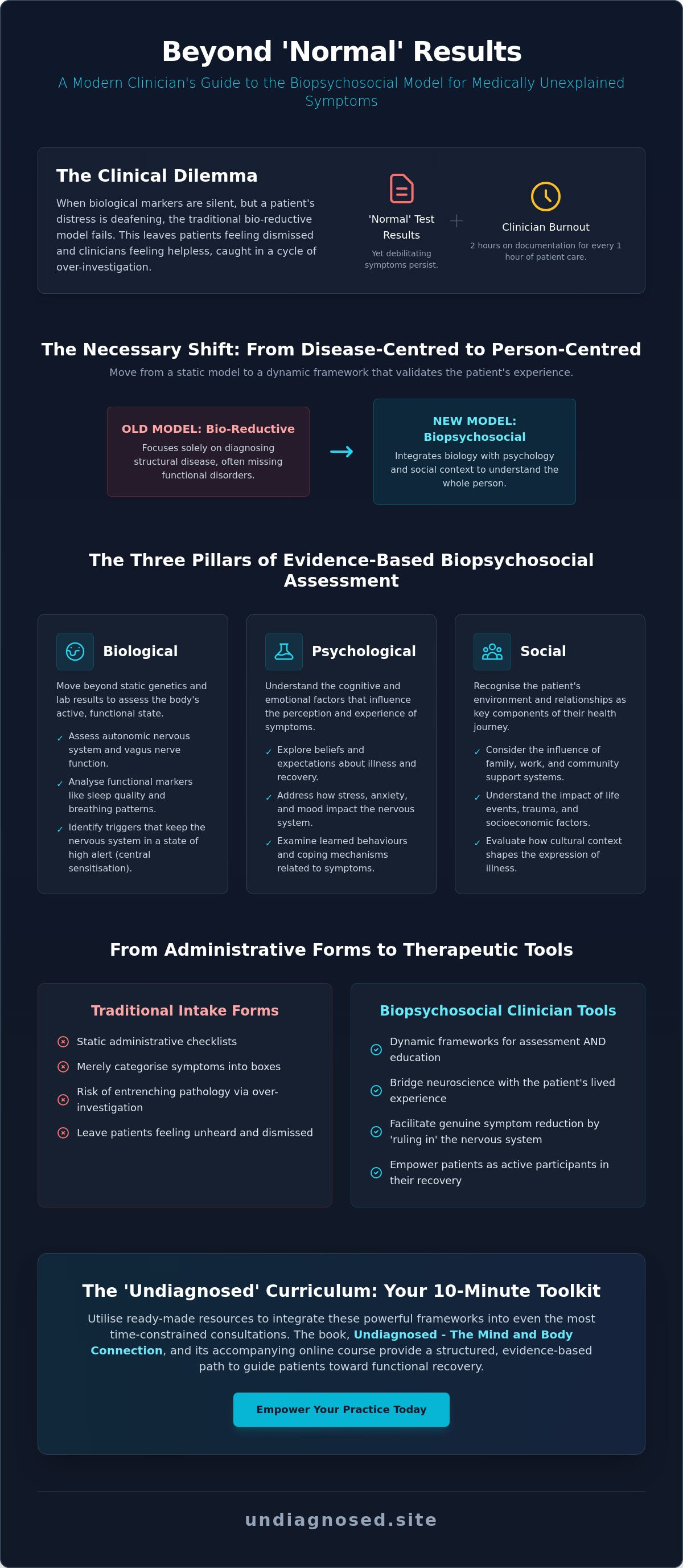
What if the 'normal' test results sitting on your desk aren't a sign that nothing is wrong, but a signal that you're using the wrong map for the journey? You've likely felt the tension of a consultation where the biological markers are silent, yet the patient's distress is deafening. It's an exhausting reality; with clinicians now spending nearly two hours on documentation for every one hour of patient care, the space to implement effective biopsychosocial clinician tools is vanishing. You need a way to validate the person in front of you without over-medicalising the problem, yet traditional templates often fail to capture the complex intersection of mind and body.
This guide demonstrates how to bridge the gap between neuroscience and tangible patient recovery. We'll explore how to move beyond static intake forms towards dynamic educational frameworks that reorganise a patient's understanding of their own nervous system. You will discover evidence-based structures to explain medically unexplained symptoms (MUS) whilst saving valuable time in your practice. By integrating resources like the book Undiagnosed - The Mind and Body Connection, we are moving away from clinical uncertainty towards a structured, compassionate path that honours both scientific rigour and human experience.
Key Takeaways
- Shift your clinical focus from merely diagnosing a disease to understanding the person through frameworks that bridge the gap between assessment and education.
- Deepen your insight into the biological pillar of health by moving beyond static genetics to address active nervous system dysregulation.
- Identify the critical difference between administrative forms and therapeutic biopsychosocial clinician tools that facilitate genuine symptom reduction.
- Master the art of the ten-minute toolkit to integrate evidence-based biopsychosocial frameworks into even the most time-constrained consultations.
- Utilise ready-made resources like the "Undiagnosed" book and online course to provide patients with a structured, evidence-based path toward functional recovery.
Beyond the Intake Form: Why Modern Clinicians Need Biopsychosocial Tools
Modern clinical practice is at a crossroads. For decades, the intake form has served as a static boundary, a way to categorise symptoms into neat biological boxes. However, true biopsychosocial clinician tools are not merely administrative checklists; they are dynamic frameworks designed to facilitate both assessment and patient education. In 2026, the focus of medicine is shifting from the narrow pursuit of diagnosing the disease to the broader necessity of understanding the person. This transition requires tools that do more than record data. They must bridge the chasm between clinical observation and the patient's lived experience.
The Failure of the Bio-Reductive Model
The UK healthcare system is currently grappling with a silent crisis: the prevalence of medically unexplained symptoms (MUS). When a patient presents with debilitating fatigue or chronic pain, yet their blood tests and scans return as "normal," the traditional bio-reductive model reaches its limit. This failure often leaves patients feeling dismissed and clinicians feeling helpless. Within the biopsychosocial model, we recognise that physical symptoms can exist without structural damage. Central sensitisation, where the nervous system remains in a state of high alert, creates genuine physical suffering that no MRI can detect. Without the right biopsychosocial clinician tools, practitioners are often forced into a cycle of over-investigation, which only serves to increase patient anxiety and entrench the pathology.
Tools as a Bridge Between Neuroscience and Clinical Practice
Effective clinician tools act as a translator. They take complex concepts like the neuroscience of MUS and turn them into therapeutic interventions. Instead of just ruling out pathology, these frameworks allow you to rule in the nervous system. This is the core philosophy behind Undiagnosed - The Mind and Body Connection: education is not a secondary thought; it is the first step of the intervention. By using structured resources like the book or the accompanying online course, clinicians can validate a patient's pain whilst shifting the narrative toward recovery. These tools provide a logical, organised methodology that empowers the patient through insight. It transforms them from a passive recipient of care into an active participant in their own healing journey.
The Three Pillars of Evidence-Based Biopsychosocial Assessment
Effective clinical assessment is not a linear collection of data points. It's a three-dimensional mapping of a patient's reality. To move beyond the limitations of bio-reductivism, we must employ biopsychosocial clinician tools that examine the biological, psychological, and social domains as an integrated system rather than isolated silos. This holistic approach ensures that no part of the patient's experience is dismissed as irrelevant. It allows for a sophisticated understanding of how internal physiology reacts to external pressures, providing a roadmap for recovery that traditional diagnostics often miss.
Biological Tools: Assessing the Nervous System
The biological pillar is often misunderstood as merely a review of genetics or medical history. In modern practice, we must look at functional biology. This involves assessing the autonomic nervous system and the vagus nerve, as dysregulation in these areas often explains why symptoms persist despite clear scans. Research into the Principles, Practice, and Scientific Inquiry of this model highlights that biological markers like sleep quality and breathing patterns are critical indicators of a system under stress. Understanding the mind and body connection allows clinicians to identify specific triggers that keep the nervous system in a state of high alert. By identifying these functional markers, you can provide patients with a tangible explanation for their physical sensations, moving the conversation away from 'all in your head' towards 'it's in your nervous system'.
Psychological and Social Tools: Mapping the Environment
Mapping the psychological and social environment requires looking for internal 'rules' and external stressors. We must distinguish between precipitating factors, which initially trigger an episode, and perpetuating factors, which maintain the chronic cycle. Psychological tools shouldn't just look for 'mental illness' but for cognitive patterns and emotional processing styles that influence physical health. Social tools examine the support systems and environmental pressures that either aid or hinder recovery. When clinicians use these biopsychosocial clinician tools collaboratively with the patient, they build a shared case formulation. This transparency fosters trust and provides a clear roadmap for intervention. For those looking to organise this collaborative process into a manageable format, the Undiagnosed online course offers a structured framework to guide patients through these complex domains. It helps patients realise that their environment and their internal reactions are not separate from their physical health, but are instead the very keys to their recovery.
Comparing Clinical Documentation vs Patient Education Tools
Documentation is a necessity; education is a therapy. Most practitioners remain tethered to administrative tools designed for insurance compliance rather than patient recovery. Whilst these templates satisfy the requirement to document medical necessity, they rarely contribute to symptom reduction. True biopsychosocial clinician tools must transcend the limitations of the electronic health record. They are not just records of what has happened; they are instruments of change that reorganise the patient's perspective. We must distinguish between administrative forms that capture data and therapeutic curriculums that facilitate healing. One records the problem; the other initiates the solution.
The Limitations of Standard Intake Templates
Standard templates often rely on a checkboxes-only approach. This rigid structure fails to capture the nuanced reality of functional neurological disorders or complex mind-body symptoms. When we force a patient's experience into a binary psychological assessment, we risk pathologising normal human responses to chronic stress. Administrative tools view the patient as a passive subject; therapeutic tools view them as an active partner. The "Undiagnosed" approach differs by shifting the focus from "what is wrong with you" to "how your mind-body mechanism is functioning." It prioritises understanding the process of the symptom over the mere labelling of the distress. By moving away from static forms, you avoid the trap of reducing a complex human life to a set of diagnostic codes.
Why Educational Tools are the Future of MUS Management
Research consistently supports Pain Neuroscience Education (PNE) as a primary tool for recovery. When a patient understands why their brain creates real physical symptoms, the threat level of the nervous system begins to drop. This is why modern practice relies heavily on biopsychosocial resources that extend care beyond the consultation room. Books and online courses act as "extended clinicians." They provide support at the very moment symptoms flare up, reinforcing therapeutic concepts when the practitioner isn't present. Prescribing the best mind-body books or digital curriculums turns the patient's home into a space for active rehabilitation. This shift from passive documentation to active education is a clinical necessity for managing medically unexplained symptoms effectively. It bridges the gap between the clinic and the living room, ensuring that recovery isn't limited to a twenty-minute appointment window.
How to Integrate Biopsychosocial Frameworks into Time-Constrained Consultations
Clinicians often cite time as the primary barrier to holistic care. When you're managing a ten-minute consultation window, a deep dive into complex social history feels like an impossible luxury. However, failing to utilise effective biopsychosocial clinician tools actually increases your long-term workload. It creates the 'revolving door' patient who returns repeatedly because their underlying nervous system dysregulation remains unaddressed. The goal is not to find more time, but to use the time we have differently. By shifting from reactive symptom suppression to proactive education, you reduce the administrative burden of chronic, unexplained illness.
The 'Flipped Consultation' Strategy
The 'flipped classroom' model, borrowed from modern education, is a powerful efficiency tool for the medical setting. Instead of spending your precious consultation time explaining the basics of mind-body health, you provide the educational materials before or between appointments. Recommending the book Undiagnosed - The Mind and Body Connection allows the patient to arrive with a foundational understanding of their physiology. Your role then shifts from lecturer to guide. You can focus on specific follow-up questions and collaborative case formulation, making the ten-minute window significantly more impactful. This structured approach ensures the patient is doing the work of recovery whilst you provide clinical oversight.
Communication Tools for Validating Patients
Validation is the most effective time-saving tool in your kit. A patient who feels unheard will continue to seek new investigations, consuming more resources and increasing their own anxiety. You can teach your patients specific frameworks for talking to doctors about MUS so they can communicate their experience with clarity. Replace the dismissive 'it's not in your head' with the scientifically accurate 'it is in your nervous system.' Use visual metaphors, such as a car alarm that has become too sensitive, to simplify complex neuroscience. This clarity reduces clinical friction and builds the trust necessary for a recovery-focused partnership.
Integrating these strategies into your practice doesn't require a total overhaul of your workflow. You simply need the right resources to support the patient's journey outside the clinic. To provide your patients with a comprehensive, evidence-based path to recovery, you can direct them to the Mind and Body Connection online course. It offers the structured curriculum needed to bridge the gap between your consultations and their daily lives.
The Undiagnosed Curriculum: A Specialist Tool for Functional Recovery
The transition from clinical assessment to therapeutic recovery is often where the most significant gaps in care occur. Whilst traditional intake forms end at the point of diagnosis, effective biopsychosocial clinician tools must extend into the active phase of rehabilitation. The Undiagnosed curriculum serves as this missing link. By providing a ready-made structure, it addresses the biological, psychological, and social domains simultaneously, ensuring that no aspect of the patient’s experience is left to chance. This isn't just about managing symptoms; it’s about providing a logical, evidence-based path toward functional health that empowers both the practitioner and the individual.
What is Included in the Clinician Toolbox?
The clinician toolbox consists of two primary components designed to work in tandem: the Undiagnosed: The Mind and Body Connection book and the comprehensive online course. The course modules guide patients through the foundational neuroscience of their symptoms before moving into practical, daily applications. This structured programme includes:
- Neuroscience Education: Modules that explain the mechanics of central sensitisation and nervous system dysregulation.
- Practical Intervention: Evidence-based techniques for breathing, relaxation, and emotional processing.
- Downloadable Resources: Specific sleep hygiene strategies, symptom trackers, and guided exercises that patients can use at home.
By providing these biopsychosocial clinician tools, you ensure that the patient has a consistent reference point that aligns with your clinical advice. The book serves as a permanent reference guide, whilst the course provides the interactive, step-by-step support needed to facilitate long-term behaviour change.
Transforming Your Practice with the Biopsychosocial Lens
Adopting this lens transforms your professional identity and your daily clinical experience. You move away from the frustration of being a mere prescriber of pharmaceuticals and become a scientific mentor. This role allows you to provide compassionate validation backed by rigorous evidence. It significantly reduces the burnout associated with treating complex, chronic conditions, as you finally have a structured solution to offer patients who have previously felt "undiagnosable." You aren't just treating a patient; you are joining a growing community of clinicians dedicated to the integrity of the mind-body connection and the dignity of the individual.
Empower your patients to move beyond the limitations of their symptoms and rediscover their functional potential. By integrating these frameworks into your practice, you provide the clarity and hope necessary for genuine recovery. It’s time to bridge the gap between medical science and human experience. Explore the Undiagnosed Clinician Tools and Course to begin this transformation in your practice today.
Transforming Clinical Uncertainty into Functional Recovery
Modern medicine requires more than just ruling out disease; it demands the active restoration of health. We have explored how shifting from static documentation to dynamic education allows you to validate patient suffering whilst providing a clear map for recovery. By addressing the biological, psychological, and social pillars as an integrated system, you move beyond the limitations of the bio-reductive model and toward a more complete understanding of the individual.
Implementing effective biopsychosocial clinician tools doesn't have to be a burden on your schedule. It is about utilising ready-made frameworks that bridge the gap between your expertise and the patient's daily reality. Developed by Dr. Csaba Dioszeghy, a Consultant Physician, the Undiagnosed curriculum provides an evidence-based neuroscience approach that clinicians already use to manage complex MUS cases with confidence and clarity. You have the power to transform the "revolving door" consultation into a journey of discovery and progress.
Empower your clinical practice with the Undiagnosed Mind-Body Curriculum
The path to recovery begins with the right map. Start providing the answers your patients have been searching for today.
Frequently Asked Questions
What are the essential components of a biopsychosocial clinician tool?
Essential components of biopsychosocial clinician tools include functional biological markers, cognitive processing patterns, and social stressors. They must operate as an integrated system rather than isolated checkboxes. A robust tool moves beyond data collection to provide a framework for patient education. It translates scientific concepts into a shared language that both clinician and patient can use to navigate the recovery process.
How do biopsychosocial tools improve patient outcomes in chronic pain?
These tools improve chronic pain outcomes by addressing the mechanism of central sensitisation. When patients understand that their pain is a protective output of the nervous system rather than a sign of ongoing tissue damage, their threat level decreases. This cognitive shift facilitates physiological changes, such as improved sleep and reduced muscle tension. It moves the patient from a state of fear-driven avoidance to a state of evidence-based recovery.
Can these tools be used for Functional Neurological Disorder (FND)?
Biopsychosocial frameworks are ideally suited for Functional Neurological Disorder (FND) because they address the "software" of the nervous system. Since FND involves real physical symptoms without structural damage, these tools help explain how the brain's predictive processing has become dysregulated. They provide a logical narrative that validates the patient's experience whilst offering practical strategies for retraining the nervous system and restoring functional movement or sensation.
How do I integrate these tools into a 10-minute GP consultation?
GPs can integrate these frameworks into a ten-minute consultation by adopting a "flipped consultation" model. Instead of explaining neuroscience in the room, prescribe specific educational resources like the Undiagnosed book for the patient to study at home. This allows you to spend your limited appointment time focusing on collaborative problem-solving and follow-up. It shifts the burden of education to the resource, making the consultation more efficient and focused.
What is the difference between a psychosocial assessment and a biopsychosocial tool?
A psychosocial assessment is primarily a data-gathering event, whilst a biopsychosocial tool is a therapeutic intervention. Assessments often stop at the identification of risk factors or social stressors. In contrast, biopsychosocial clinician tools provide an ongoing framework for education and recovery. One records the patient's history; the other reorganises their understanding of their own physiology to facilitate a change in their health status.
Are there digital biopsychosocial tools available for UK clinicians?
UK clinicians have access to various digital resources, including practice management platforms and specialised online curriculums. The Mind and Body Connection Online Course is a prime example of a digital tool designed to bridge the gap between clinical theory and patient application. These platforms allow for the delivery of evidence-based education outside the clinic, providing patients with 24/7 support whilst ensuring clinicians can track progress through structured modules.
How does the "Undiagnosed" curriculum help with medically unexplained symptoms?
The Undiagnosed curriculum addresses medically unexplained symptoms by providing a clear, scientific explanation for functional distress. It guides patients through the biological, psychological, and social domains that contribute to their condition. By offering a logical narrative for symptoms that scans fail to detect, it reduces the anxiety of the "unknown." This structured approach helps patients reorganise their nervous system responses and move toward functional recovery.
Is education considered a clinical tool for functional recovery?
Education is a primary clinical tool for functional recovery, specifically through Pain Neuroscience Education (PNE). Research shows that when patients are educated about the mechanics of their symptoms, their clinical outcomes improve significantly. This is not "just talking"; it is a targeted intervention that changes how the brain processes sensory information. It empowers the patient to manage their own health, reducing the reliance on pharmaceutical prescriptions and frequent consultations.