
What if the most effective clinical intervention for your chronic symptoms isn't a pharmaceutical prescription, but a targeted reading list? Clinical trials have confirmed that bibliotherapy can produce symptom reductions equivalent to medication for certain conditions; yet, tens of millions of people still face dismissal when their lab results return "normal." You likely know the frustration of feeling gaslit by a medical system that treats the mind and body as separate entities. It's exhausting to live with physical pain whilst being told it's simply a product of stress. If you are searching for the best mind-body books to validate your experience, you are in the right place.
This curated guide provides the evidence-based guidance you deserve. We'll move beyond the "all in your head" narrative to explore essential 2026 releases, including Jodi Taub’s 19 March publication, More Than a Patient, and Emily Mendenhall’s January history of invisible illness. You'll discover how to bridge the gap between neuroscience and your physical experience, gaining practical tools to lower your nervous system's threat levels. We are looking at recovery, not just management; validation, not just observation.
Key Takeaways
- Understand why bibliotherapy serves as a clinical intervention to lower your brain's danger signals whilst establishing a sense of biological safety.
- Discover the best mind-body books that bridge the gap between repressed emotions and physical manifestations to help you move beyond medical dismissal.
- Gain access to tactical tools from modern neuroscience that allow you to rewire your neural pathways and reduce the impact of central sensitisation.
- Learn how to organise a structured recovery plan using practical workbooks focused on somatic tracking and expressive writing techniques.
- Explore a comprehensive biopsychosocial framework that synthesises classic pain psychology with contemporary research for evidence-based relief.
Bibliotherapy: Why Reading is a Clinical Tool for Recovery
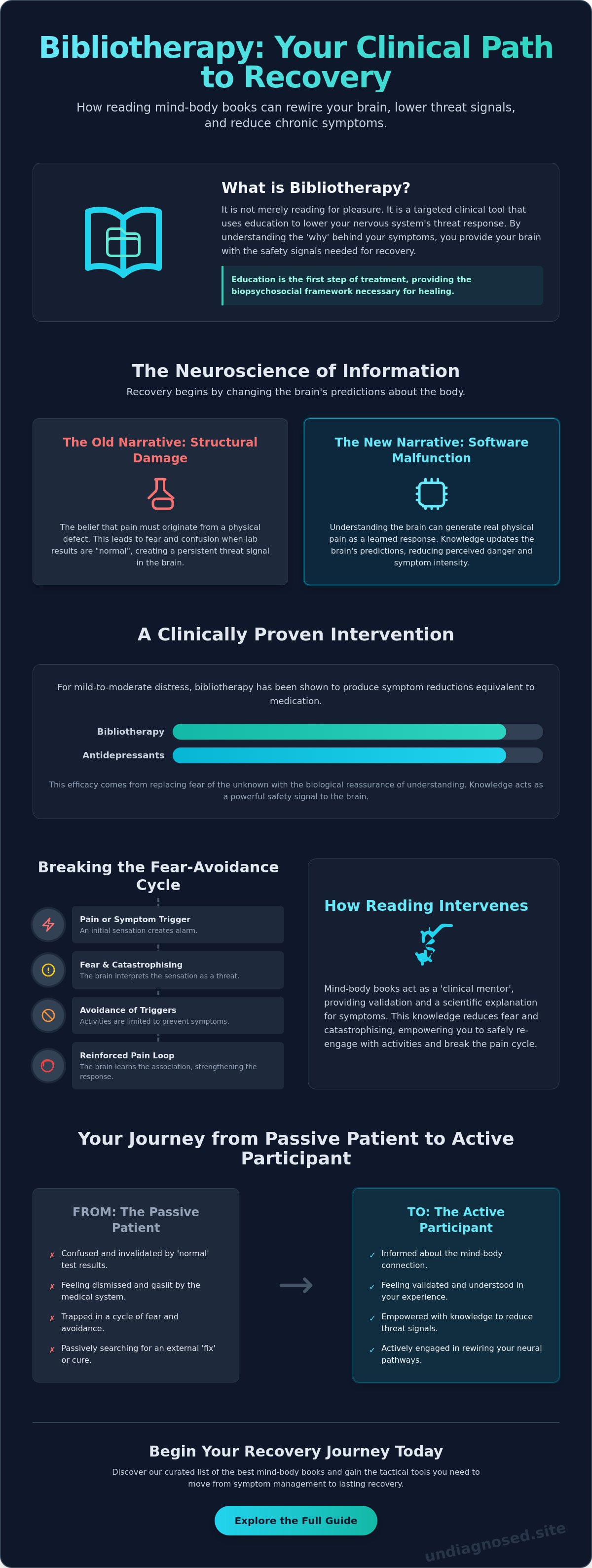
Recovery often begins with a shift in perspective. Whilst traditional medicine frequently focuses on pharmaceutical or surgical interventions, a growing body of evidence supports the use of Bibliotherapy as a structured educational approach to symptom management. This isn't merely reading for pleasure; it's a targeted clinical tool designed to lower the nervous system's threat response. By engaging with the best mind-body books, patients can move from a state of confusion to one of informed agency. Education is the first step of treatment; it provides the biopsychosocial framework necessary to understand why physical symptoms persist even when tests appear normal.
Multiple independent clinical trials have confirmed that bibliotherapy as a standalone intervention can produce significant results. In cases of mild-to-moderate distress, the reductions in symptoms are often equivalent to antidepressant medication. This efficacy stems from the brain's need for safety. When we lack a logical explanation for our pain, the brain perceives a persistent threat. Knowledge acts as a safety signal, replacing fear with understanding and "danger signals" with biological reassurance. Understanding the "why" behind your symptoms is often half the battle in achieving functional recovery.
The Neuroscience of Information
Modern neuroscience reveals that the brain operates through "predictive processing." It doesn't just react to the world; it makes constant guesses about what is happening inside the body. When you understand the mechanism of chronic symptoms, you provide the brain with new data to update its predictions. Normal test results cease to be a source of dismissal; they become an opportunity for a new narrative. You begin to view your condition as a software malfunction rather than structural damage. This shift in thinking is essential for recovery, as it changes how the brain interprets sensory input and reduces the intensity of physical sensations.
Education as a Safety Signal
The "fear-avoidance" cycle is a primary driver of chronic conditions. When movement or stress triggers pain, the brain learns to avoid those triggers, which reinforces the pain loop. Reading the best mind-body books helps break this cycle by providing a "clinical mentor" in written form. These texts validate your experience whilst offering a path forward based on hope, not hype. This type of validation is a powerful neurobiological signal that reduces the system's overall threat level. It's about finding a partner who is both a researcher and a confidant, helping you transition from being a passive patient to an active participant in your own healing journey.
The Foundational Classics: Understanding the Psychology of Pain
Long-term recovery from chronic symptoms requires looking beyond the results of an MRI scan. Before modern neuroimaging confirmed the brain's ability to "learn" pain, two pioneering clinicians challenged the mechanical view of the human body. Their work shifted the medical narrative from a purely structural focus to a biopsychosocial lens. This transition was essential for patients who felt dismissed by a system that couldn't find a physical "break" to fix. By exploring these foundational texts, you begin to see your symptoms not as a sign of a broken body, but as a complex communication from your nervous system. These works remain amongst the best mind-body books for anyone needing to validate their physical experience through the lens of psychological history.
The clinical community now recognises that Mind and Body Practices are not merely "alternative" options but are central to managing functional disorders. These classic texts provided the first evidence-based guidance for patients who were told their pain was "all in their head." They proved that whilst the pain is generated by the brain, the physical sensations are 100 per cent real. Understanding this distinction is often the first moment of relief for those who have spent years in a cycle of fear and medical gaslighting.
The Sarno Legacy: Mind over Back Pain
Dr John E. Sarno’s 1998 publication, The Mindbody Prescription, introduced the concept of Tension Myositis Syndrome (TMS). Sarno argued that the brain uses physical pain as a protective distraction to keep repressed emotions, particularly unconscious rage, from reaching conscious awareness. From a 2026 perspective, our understanding has evolved from "repressed rage" toward "neuroplastic pain" and nervous system dysregulation. However, his core thesis remains a vital clinical tool. TMS is a functional, not structural, condition where the nervous system produces physical symptoms in the absence of tissue pathology. If you are struggling to bridge this gap, our Mind and Body Connection Online Course provides a structured way to apply these concepts to your daily life.
Gabor Maté and the Cost of Hidden Stress
In his 2003 work, When the Body Says No, Dr Gabor Maté explores the link between personality patterns and the immune system. He identifies how specific behaviours, such as a compulsive need to care for others or the inability to express anger, create physiological stress. This hidden stress can manifest as autoimmune conditions or chronic fatigue. Maté’s work helps you identify the "stress-illness" connection by examining your life history. It encourages a shift from the victimhood of "Why me?" to the curiosity of "What is my body telling me?". This insight is a cornerstone of the best mind-body books, as it empowers the reader to address the root causes of their physiological distress.
Modern Neuroscience: Rewiring the Brain for Safety
Whilst early pioneers focused on the "why" of physical symptoms, modern neuroscience has provided the "how." We no longer need to rely on theory alone; we can now observe the Neuroscience of Pain through advanced neuroimaging. This research confirms that chronic symptoms are often the result of "neural circuit pain" or central sensitisation, where the brain remains in a high-alert state long after a physical injury has healed. This shift from a psychological to a neurological framework is a cornerstone of recovery. It moves the conversation away from "it's all in your head" and toward "your brain has learned a protective response that we can now unlearn."
To navigate this field effectively, you must distinguish between trauma-focused literature and brain-retraining resources. Trauma-focused books help you understand the historical reasons your nervous system became sensitised. Brain-retraining or Pain Reprocessing Therapy (PRT) texts provide the tactical tools to turn the pain signal off in the present moment. Both are essential, but they serve different clinical functions. Understanding this distinction is what separates a general interest reader from someone successfully using the best mind-body books as a roadmap for functional recovery.
Trauma and the Nervous System
Bessel van der Kolk’s The Body Keeps the Score remains a definitive text for understanding how the physiology of the body changes after stress. He advocates for a "bottom-up" approach to healing, focusing on the vagus nerve and the brain's emotional centres rather than just talk therapy. It's vital to distinguish between psychological trauma and physiological nervous system dysregulation. Your symptoms might be a biological "stuck" state in the nervous system, even if you don't feel "traumatised" in the traditional sense. This book validates that your physical sensations are a legitimate biological record of your lived experience.
Unlearning the Pain Response
Dr Howard Schubiner’s Unlearn Your Pain represents the cutting edge of evidence-based guidance. Schubiner uses neuroscience to prove that whilst pain is 100 per cent real, it is often generated by neural circuits rather than structural damage. This is particularly relevant for those with clear MRI scans who still experience debilitating symptoms. The engine for recovery is neuroplasticity; the brain's ability to reorganise itself by forming new neural connections. These are amongst the best mind-body books because they offer a clear, logical path out of chronic pain. New 2026 releases, such as Majid Fotuhi’s The Invincible Brain, published in March 2026, further expand on this by showing how we can improve cognitive function and physical resilience through targeted brain-health habits.
Practical Workbooks: How to Organise Your Recovery Journey
Moving from understanding the neuroscience of pain to changing your physical experience requires a transition from passive reading to active participation. Whilst the foundational texts provide the necessary clinical framework, workbooks serve as the bridge to functional recovery. They allow you to build a personalised toolkit for managing symptom flares in real time. By engaging with these resources, you move beyond the role of a student and become an active participant in your own healing. These practical guides are essential additions to any list of the best mind-body books because they transform abstract theories into daily, actionable protocols.
Clinical data suggests that structured interventions, such as those found in evidence-based workbooks, help ground the nervous system when it is in a high-threat state. For instance, Nicole Sachs’ work in The Meaning of Truth provides a roadmap for "JournalSpeak," a specific method of emotional release. Similarly, Vanessa Blackstone’s The Pain Reprocessing Therapy Workbook offers tactical exercises for somatic tracking. These tools are designed to provide a stabilizing influence when the confusion of chronic symptoms feels overwhelming. They offer a logical and organized methodology to navigate the complexities of the mind and body connection.
Step-by-Step Somatic Tracking
Somatic tracking is the clinical practice of observing physical sensations with curiosity rather than fear. When the brain is stuck in a chronic pain loop, it interprets every sensation as a sign of danger. Workbooks provide the necessary structure to break this cycle. By following a guided process, you learn to sit with your symptoms whilst maintaining a sense of biological safety. Consistency is the engine of this change. Repeatedly showing your brain that these sensations are safe eventually reorganises its response to physical stimuli, turning down the volume on the pain signal. If you find the structure of a workbook helpful but prefer a guided, interactive format, you can explore these tools in depth through The Mind and Body Connection Online Course.
Emotional Regulation and Journaling
The science behind expressive writing is well-documented; externalising emotions on paper significantly lowers physiological arousal in the amygdala. Amongst the top-rated mind-body workbooks, techniques vary from timed writing sessions to the "unsent letter" method. Each approach aims to reduce the load on the nervous system by processing "hidden" stressors that contribute to physical tension. The primary goal of emotional journaling in a clinical context is to provide a safe outlet for the nervous system to discharge accumulated stress without triggering a physical flare. This practice helps you identify the specific behaviour patterns and stressors that precede your symptoms, providing a clear path to long-term relief.
Undiagnosed: Bridging the Gap Between Science and Self-Healing
Whilst the foundational classics and modern neuroscience provide the "why" and "how" of recovery, many patients find themselves with a library of knowledge but no clear path forward. Undiagnosed: The Mind and Body Connection by Dr Csaba Dioszeghy serves as the vital synthesis of these disciplines. It brings together the emotional insights of Maté, the functional theories of Sarno, and the neuroplasticity of modern clinicians into one cohesive roadmap. If you've spent years searching for the best mind-body books only to feel that your specific case remains a mystery, this text is designed to move you from confusion to a structured recovery plan.
The core philosophy of the Undiagnosed platform is "Diagnosis, not dismissal." We recognise that tens of millions of people are currently living with debilitating symptoms that the conventional biomedical model fails to explain. This book doesn't offer empty promises or "quick fixes." Instead, it provides a sense of grounded optimism. It functions as a scientific mentor, helping you translate complex medical concepts into a personal strategy for relief. It's the logical next step for those who understand the theory but need a partner to help them navigate the practicalities of healing.
A Biopsychosocial Lens for Modern Patients
Dr Dioszeghy’s work centres on the patient-clinician partnership, specifically addressing Medically Unexplained Symptoms (MUS). In a system where approximately 30 to 50 per cent of primary care consultations involve symptoms that lack a clear structural cause, a new model is required. This approach provides a necessary Mind and Body Connection: A Clinical Guide to Functional Health, ensuring that your physical experience is validated through a rigorous scientific lens. By focusing on functional health, the book helps you understand that your body isn't broken; it's simply operating in a protective, high-alert state that can be recalibrated.
From Knowledge to Action
True recovery requires more than just insight; it requires the consistent application of practical tools. The Undiagnosed book is designed to integrate seamlessly with The Mind and Body Connection Online Course, creating a comprehensive recovery experience. This isn't just about reading; it's about doing. The focus remains on evidence-based guidance for sleep strategies, breathing techniques, and nervous system regulation. You can explore these specific techniques in our Mind-Body Balance Tools: A Roundup for Functional Symptom Recovery. This structured methodology provides the stabilizing influence needed to lower stress levels and foster long-term well-being through hope, not hype.
Your Roadmap to Lasting Physical Relief
Recovery is a process of moving from medical dismissal to clinical validation. You've explored how emotional history shapes physical health and seen how modern neuroscience proves the brain can unlearn pain through neuroplasticity. Selecting from the best mind-body books is more than an educational exercise; it's a targeted intervention to lower your system's threat levels. You now have the structural knowledge to transition from passive observation to active participation in your healing journey.
If you're ready to synthesise these insights into a clear, actionable plan, explore "Undiagnosed: The Mind and Body Connection". Written by Consultant Physician Dr Csaba Dioszeghy, this text provides an evidence-based biopsychosocial approach specifically designed for medically unexplained symptoms. It bridges the gap between scientific research and your lived experience; it offers a path toward functional recovery that values truth and patient dignity. You don't have to navigate the confusion of chronic symptoms alone. Your body has the capacity to find balance, and with the right tools, you can begin to send the signals of safety it needs to heal.
Frequently Asked Questions
Are mind-body books suggesting my symptoms are all in my head?
No, these books validate that your physical sensations are 100 per cent real and biologically generated by the nervous system. The focus is on how the brain processes "danger signals," not on suggesting your pain is imaginary. This approach provides diagnosis, not dismissal. It explains the software malfunction of the body rather than structural damage, ensuring you feel heard and understood by the clinical community.
Can reading a book actually reduce my physical pain or dizziness?
Yes, clinical trials have confirmed that bibliotherapy can produce symptom reductions equivalent to medication in mild-to-moderate cases. By reading the best mind-body books, you provide your brain with "safety signals" that update its predictive processing. This knowledge helps de-sensitise the nervous system, which can directly lower the intensity of physical sensations like dizziness or chronic pain as the brain's perceived threat level decreases.
Which mind-body book should I start with if I am a beginner?
You should start with a text that provides a comprehensive clinical roadmap, such as Undiagnosed: The Mind and Body Connection. Whilst classics like John E. Sarno’s work are foundational, a modern synthesis helps bridge the gap between 1980s theory and 2026 neuroscience. This ensures you have a clear biopsychosocial framework before moving into more tactical workbooks or specific trauma-focused literature.
How do these books differ from standard "self-help" or "positive thinking" books?
These texts provide evidence-based guidance rooted in neuroscience rather than anecdotal "positive thinking." They focus on the biological mechanisms of the nervous system and the vagus nerve. Unlike standard self-help, they offer a structured methodology for recovery based on clinical observations of functional health. The goal is realistic optimism and practical tools, adhering to the philosophy of hope, not hype.
Is there scientific evidence that bibliotherapy works for functional symptoms?
There is significant scientific evidence; for example, independent clinical trials have shown that reading can be as effective as antidepressant medication for certain functional disorders. These results are achieved by breaking the "fear-avoidance" cycle and providing the brain with new data. By using the best mind-body books as a clinical tool, patients can achieve a reduction in symptom severity by up to 50 per cent in structured programmes.
What happens if I read these books and my symptoms do not improve?
If symptoms persist, it often indicates that the "passive reading" stage needs to transition into active participation. Some individuals require the interactive structure of an online course or more specific somatic workbooks to apply the concepts effectively. Recovery is a steady, methodical process; it isn't a "quick-fix." It's important to continue working with your clinicians to rule out other factors whilst refining your mind-body toolkit.
Can I use these books alongside my current medical treatment?
Yes, these resources are designed to complement your current medical care rather than replace it. They provide a biopsychosocial layer that most standard treatments lack, helping you understand the "why" behind your symptoms whilst you follow your doctor's advice. This integrated approach ensures you are addressing both the physical symptoms and the underlying nervous system dysregulation for a more comprehensive recovery experience.
Why do doctors not recommend these books more often in the UK?
The UK healthcare system has traditionally focused on a biomedical model that prioritises structural damage over functional health. However, with the rise of conditions like Long COVID, there is an increasing shift towards the biopsychosocial model. Recent publications like Emily Mendenhall's January 2026 history of invisible illness highlight this change. Many clinicians are now beginning to recognise the mind and body connection as a primary pillar of modern treatment.