What if the "normal" results on your medical scans aren't a sign that nothing is wrong, but rather a signal that your doctor is only looking at one third of the map? This gap in understanding is where the biopsychosocial model provides essential clarity. With record numbers of adults reporting chronic pain; reaching 24.3 per cent in 2023; it is clear that the traditional biomedical approach often misses something vital. It is deeply frustrating to experience persistent symptoms only to be told that everything looks fine on paper. You know your body is struggling, yet you're often left feeling dismissed whilst your pain remains very real.
You deserve a more complete answer. This guide validates your physical reality by examining the complex, scientific interplay between your biology, your mind, and your social environment. It operates in the vital space where medical science meets human experience. By understanding this connection, you can move past the confusion of unexplained symptoms and find a clear, evidence-based roadmap for recovery. We will examine how your nervous system processes your life experiences and provide practical strategies to help you begin your journey toward lasting wellness.
Key Takeaways
- Move beyond the limitations of the biomedical model to understand how biological factors, psychological states, and social environments interact to maintain chronic symptoms.
- Discover the science of central sensitisation and how your brain, acting as a central processor, can become over-protective in response to persistent stress.
- Learn why the biopsychosocial model provides the necessary map for navigating the territory between unexplained pain and measurable health.
- Understand the role of therapeutic education as a practical tool for rewiring the nervous system and organising a structured recovery plan.
- Explore how bridging the gap between clinical evidence and human experience allows for a recovery that is both scientifically rigorous and deeply personal.
Beyond the Biomedical: Why the Biopsychosocial Model Matters
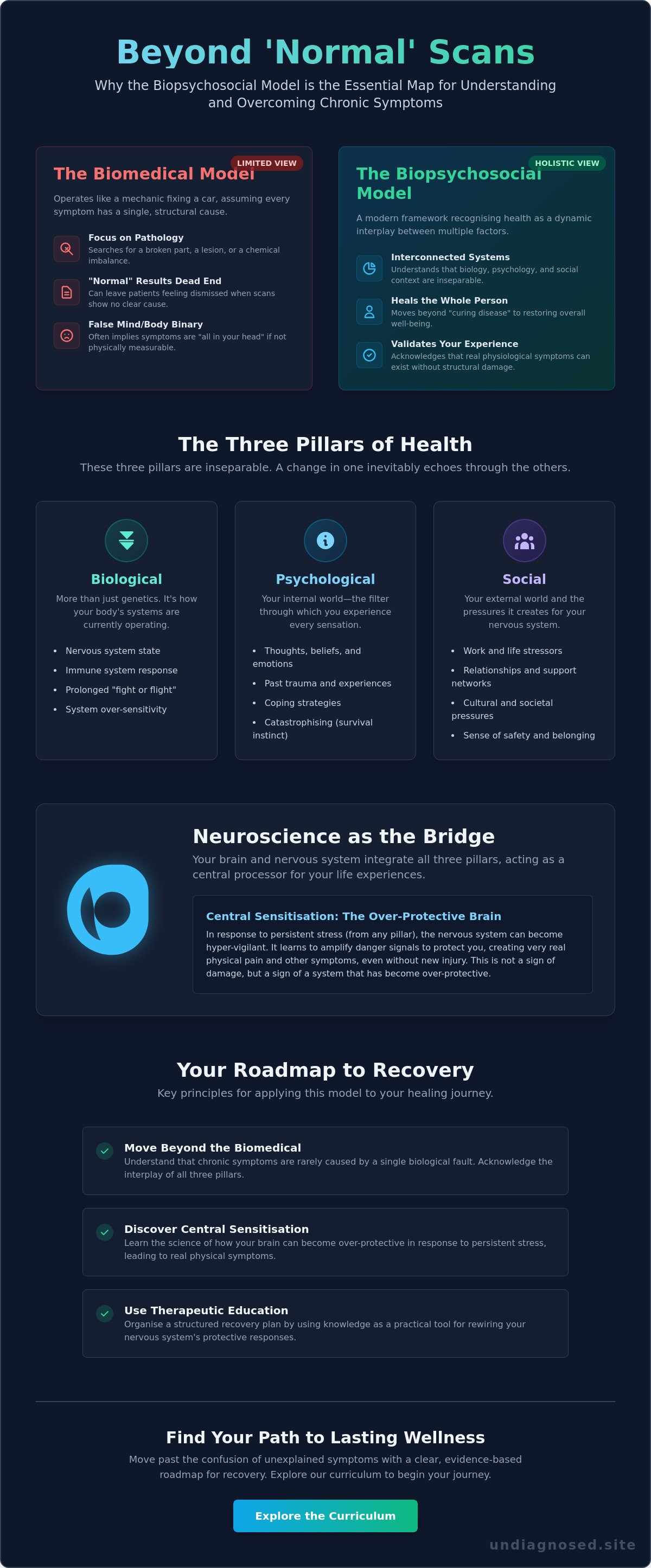
For decades, the traditional medical approach has operated like a mechanic fixing a car. This biomedical model assumes that every physical symptom must stem from a structural defect, a broken part, or a chemical imbalance. Whilst this works well for a broken leg or an acute infection, it fails spectacularly when applied to chronic, complex conditions. When your scans come back clear but your pain persists, the biomedical model reaches a clinical dead end. It leaves you with "normal" results that feel like a denial of your reality.
The biopsychosocial model offers a necessary departure from this narrow view. It is a holistic framework that recognises health as a sophisticated interplay between your biology, your internal psychological state, and your external social environment. This model restores dignity to patients by acknowledging that "medically unexplained" does not mean "imaginary." It provides a scientific basis for the symptoms that traditional tests miss, moving the conversation from what is wrong with your parts to what is happening in your life.
The Evolution from Biomedical to Biopsychosocial
In 1977, psychiatrist George Engel proposed a radical paradigm shift. He argued that to truly help a patient, a clinician must look beyond the microscope. You can explore a comprehensive overview of the biopsychosocial model to see how this philosophy has matured over the decades. The core difference lies in the objective. The biomedical model seeks to cure a disease; the biopsychosocial model seeks to heal a person. Modern healthcare is increasingly adopting this integrated approach because it accounts for the stress, history, and environment that shape our physical well-being.
Validating the "Undiagnosed" Experience
Few things are as isolating as the "all in your head" stigma that often follows a clear medical report. If your doctor cannot find a physical lesion, they may suggest your symptoms are purely psychological. This creates a false binary: either the problem is in the body or it is in the mind. The biopsychosocial model destroys this wall. It proves that your nervous system can produce very real physical pain without structural damage. It validates the "undiagnosed" experience by showing that symptoms are the output of a unified system. Your pain is not a fabrication; it is a physiological response to a complex set of inputs that your brain is struggling to process.
The Three Pillars of Health: Biological, Psychological, and Social Interplay
To understand the biopsychosocial model, we must stop viewing the human body as a collection of isolated systems. Health is not a static state of "not being ill" but a dynamic equilibrium. Imagine three gears turning in unison. When one slows, the others must work harder to compensate. These pillars; biological, psychological, and social; are inseparable. A change in one inevitably echoes through the others, creating a feedback loop that can either facilitate healing or entrench illness.
Biological and Physiological Factors
Biology is often the first place we look, yet it is frequently the most misunderstood. It encompasses more than just inherited genetics or structural damage. It includes the intricate dance of your nervous system and immune response. When you are under prolonged pressure, your body maintains a persistent "fight or flight" state. This isn't just a feeling; it is a physiological reality where cortisol levels remain high and the immune system becomes hyper-vigilant. Understanding modern research paradigms and clinical implications helps us see that pathology is rarely the whole story. Your physical symptoms are real, but they are often the result of a system that has become over-sensitive rather than one that is simply broken.
Psychological and Emotional Influences
Our internal world acts as a filter for every physical sensation. Thoughts, beliefs, and past traumas don't just exist in the mind; they shape our physical reality. If you believe a movement is dangerous, your brain will amplify the pain signal to protect you. This process, often called catastrophising, isn't a sign of weakness. It is a survival mechanism gone awry. Coping strategies that once kept you safe, such as hyper-vigilance or total rest, can inadvertently prolong your symptoms by keeping the nervous system on high alert. If you're ready to explore these connections further, our online course on the mind and body connection provides a structured way to begin.
Social and Environmental Determinants
The final pillar is your environment. We don't live in vacuums. Work stress, family dynamics, and financial security act as constant inputs to our biological systems. A social stressor, like a looming deadline or a difficult relationship, can trigger a biological response that manifests as physical tension or digestive distress. This creates a "vicious cycle" where:
- Social stress triggers a physiological "fight or flight" response.
- Biological changes lead to increased physical pain or fatigue.
- Psychological distress arises from the frustration of these symptoms, which then feeds back into the social and biological pillars.
Your environment isn't just a backdrop; it is a vital component of your clinical picture. By viewing these three pillars as a unified system, we can begin to identify the specific levers that will allow you to regain control over your health.
Neuroscience as the Bridge: How the Brain Integrates the Model
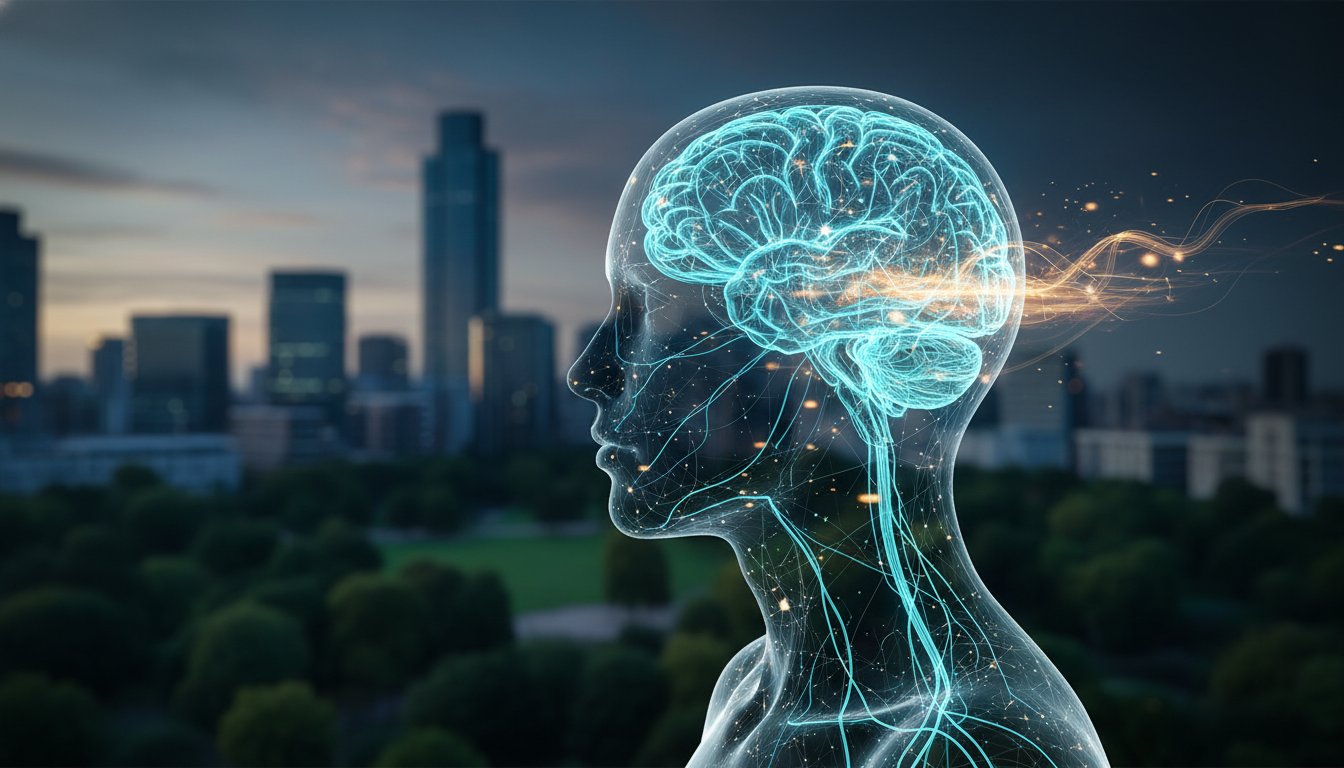
If the three pillars of health are the raw ingredients of your experience, your brain is the master chef that combines them. It functions as a central processing unit, constantly receiving data from your organs, your thoughts, and your environment. The biopsychosocial model is not merely a philosophical concept; it is a description of how your nervous system actually operates. Every social interaction and every internal belief is translated into electrical signals that the brain must interpret. When these signals suggest a threat, the brain produces a physical response to protect you.
This protective mechanism can sometimes become too efficient, leading to a state known as central sensitisation. In this state, the nervous system becomes "wound up" and hyper-vigilant. It begins to amplify signals that would normally be ignored, much like a faulty car alarm that triggers at the slightest breeze. This isn't a sign of a broken body, but of a brain that has become over-protective. Understanding the Biopsychosocial Model of Health allows us to see that recovery involves calming this alarm system rather than just searching for structural damage that isn't there.
The "Predictive Brain" and Physical Symptoms
Your brain doesn't just react to the world; it predicts it. Based on your past experiences and current stress levels, your brain anticipates what a movement or situation should feel like. If you have experienced pain in the past, your brain may "turn up the volume" on sensory input to ensure you pay attention. This predictive processing explains why symptoms like dizziness or chronic fatigue can persist even after an initial injury has healed. Neuroplasticity is the brain's ability to reorganise its neural pathways, providing the biological foundation for mind-body recovery.
Addressing the "All in My Head" Objection
One of the greatest hurdles in recovery is the fear that symptoms are "psychogenic" or made up. Neuroscience provides a definitive answer: physical pain and emotional distress share the same neural pathways in the brain. When you feel the sting of social rejection or the weight of chronic stress, your brain processes this using much of the same circuitry it uses for a physical burn. This is why we often refer to functional neurological disorders as a "software" issue rather than a "hardware" one. Your nerves and muscles (the hardware) are perfectly healthy, but the way the brain sends and receives signals (the software) has become distorted. By using the biopsychosocial model, we can begin to debug this software and restore normal function.
Applying the Model to Recovery: From Theory to Daily Practice
Moving from understanding to action requires a decisive shift in perspective. The biopsychosocial model provides the structure needed to organise your recovery programme. Instead of remaining a passive patient waiting for an external fix, you become an active participant in your own healing. This transition is not about ignoring medical advice; it is about expanding it to include every factor that influences your well-being. By taking an active role, you move from a state of uncertainty to one of agency.
Education is your first and most powerful intervention. When you understand that your symptoms are the result of a sensitive nervous system rather than structural damage, the brain's "threat" signal begins to quieten. You can start to map your own bio-psycho-social triggers. This involves identifying biological factors like poor sleep, psychological factors like high self-expectations, and social factors like a stressful work environment. Once these triggers are identified, they no longer feel like random attacks; they become manageable data points.
Practical Tools for Symptom Management
Recovery involves implementing daily habits that communicate safety to your brain. You can use specific relaxation techniques for physical health to lower the baseline arousal of your nervous system. Similarly, establishing consistent sleep strategies for chronic pain provides the biological restoration your body needs to heal. Simple breathing exercises are also effective. By slowing your exhale, you modulate the vagus nerve and reduce the physical arousal that often drives unexplained symptoms.
Changing the Narrative of Your Health
The language you use to describe your condition matters. If you view your body as "broken," your brain will remain in a state of high alert. Reframing your symptoms as a "protective response" helps reduce the intensity of the signals. It is also vital to build a social support network that understands the mind-body connection. Surrounding yourself with people who validate your experience without encouraging fear is a key component of the biopsychosocial model. Focus on functional recovery, such as returning to a hobby or walking a certain distance, rather than an immediate "cure." This approach builds confidence and creates a positive feedback loop.
If you are ready to move from confusion to clarity, our Mind and Body Connection Online Course offers the structured guidance you need to apply these principles today.
Navigating the Path Forward with the Undiagnosed Curriculum
The transition from understanding a theory to experiencing a recovery requires more than just clinical data. It demands a philosophy that marries scientific rigor with deep, human compassion. Our "Undiagnosed" framework is built upon this exact intersection. We recognise that whilst the biopsychosocial model provides the map, you still need the tools to walk the path. By translating complex neurological concepts into actionable steps, we help you bridge the gap between feeling stuck in a cycle of "normal" test results and reclaiming your functional health.
Empowerment begins with language. When you possess a firm grasp of how your biology and environment interact, your relationship with the medical community changes. You move away from the frustration of being misunderstood and toward a collaborative dialogue with your healthcare providers. Instead of feeling dismissed by clear scans, you can use your knowledge of the biopsychosocial model to advocate for a more integrated approach to your care. This shift in perspective turns you from a seeker of answers into a master of your own recovery process.
Evidence-Based Resources for Your Journey
Recovery is rarely a linear event; it is a skill that must be practiced and refined. Utilising structured functional neurological disorder tools allows you to manage daily symptoms with confidence rather than fear. For those seeking a deeper dive into the mechanics of the mind-body link, our book, Undiagnosed: The Mind and Body Connection, offers a comprehensive exploration of the science behind your physical experience. This foundation is further supported by structured video lessons designed to help you rewire the neural pathways that maintain chronic arousal. These resources are self-paced and evidence-based, ensuring you have the support you need without the pressure of a clinical clock.
A New Perspective on Healing
The biopsychosocial model represents the future of medicine because it refuses to reduce a person to their pathology. It sees you as a whole being. If you have felt overlooked or told that your symptoms are "all in your head," please know that your experience is scientifically valid. Your pain is real, your fatigue is documented, and your nervous system is simply doing its best to protect you. Recovery is not a matter of luck; it is a matter of education and application. By changing the inputs to your system, you can change the outputs of your body.
You don't have to navigate this complex territory alone. If you are ready to apply these principles and move toward a life defined by function rather than limitation, explore our online course and begin your recovery today.
Empowering Your Path to Functional Wellness
The journey from unexplained physical pain to meaningful recovery begins with a decisive change in perspective. You have seen how the biopsychosocial model provides a scientific framework for the symptoms that traditional scans often miss. By understanding that your brain acts as a central processor for biological, psychological, and social inputs, you can begin to calm an over-protective nervous system. This evidence-based neuroscience approach moves beyond the frustration of "normal" results and toward a structured, actionable methodology.
Founded by Consultant Physician Dr. Csaba Dioszeghy, our curriculum utilises rhythmic parallelism in its recovery steps to help you organise your healing. You don't have to remain stuck in a cycle of uncertainty. With the right education and practical tools, you can rewire your brain-body link and regain control over your life. Begin your journey to recovery with the Undiagnosed Online Course and move from a state of distress to a place of grounded optimism. Recovery is possible when you have the right map. Take the first step today and trust in your body's capacity to find its way back to balance.
Frequently Asked Questions
Is the biopsychosocial model the same as saying my symptoms are psychosomatic?
No, this model does not suggest that your symptoms are "imaginary" or purely psychological. It acknowledges that your physical sensations are real and biological, but they are influenced by your mind and environment. This approach removes the stigma of psychosomatic labels by showing how your nervous system processes stress into tangible physical pain. It is a validation of your physical reality, not a dismissal of it.
How can social factors like my job actually cause physical pain?
Social factors like workplace stress trigger a biological "fight or flight" response in your body. When you face constant deadlines or a difficult manager, your brain perceives a threat and maintains high levels of cortisol and muscle tension. Over time, this persistent physiological arousal leads to real physical pain, such as headaches or back tension. Your social environment acts as a constant input that your biology must react to every day.
Does the biopsychosocial model ignore biological causes of disease?
No, the "biological" component is a foundational pillar of this framework. The model includes genetics, infections, and physical injuries as essential parts of your clinical picture. It simply argues that biology alone rarely explains the full experience of chronic illness. By including psychological and social factors, the model provides a more complete understanding of why two people with the same injury can have very different recovery outcomes.
Can the biopsychosocial model help if my doctor hasn’t found a diagnosis yet?
Yes, the biopsychosocial model is specifically designed to explain symptoms that traditional scans and tests often miss. It focuses on the function of your nervous system rather than just the structure of your organs. If your results are "normal" but you are still in pain, this model provides the scientific roadmap to understand how your system has become over-sensitive. It offers a path forward when traditional diagnostics reach a dead end.
What is the difference between the biomedical model and the biopsychosocial model?
The biomedical model views the body as a machine with parts that need fixing, focusing strictly on physical pathology. In contrast, the biopsychosocial approach views the body as a complex system influenced by your thoughts, emotions, and surroundings. Whilst the biomedical model is excellent for acute trauma, it often fails in chronic cases. This newer model offers a more sophisticated lens that accounts for the human experience behind the symptoms.
How long does it take to see results using a biopsychosocial approach to recovery?
Recovery times vary depending on the individual, as rewiring the nervous system is a gradual process rather than an overnight fix. Many people begin to feel a shift in their symptoms once they truly understand the science behind their pain, which reduces the brain's threat signal. Consistent application of these principles typically leads to functional improvements over several months. It requires patience and persistent practice to see lasting changes in your physical well-being.
Do I need a therapist to use the biopsychosocial model for my health?
No, you do not necessarily need a therapist to benefit from this approach. Much of the work involves self-education and changing your daily habits to calm your nervous system. Resources like our "Undiagnosed" book and online course are designed to empower you with these tools independently. However, some individuals find that working with a professional can help them identify specific psychological or social triggers more quickly during their recovery.
Is there scientific evidence that the biopsychosocial model works for chronic pain?
Yes, extensive research confirms that the biopsychosocial model is the gold standard for managing chronic pain. Modern neuroscience has proven that pain is a multi-dimensional experience produced by the brain. Studies consistently show that integrated treatments addressing physical, emotional, and social factors are more effective than purely medical interventions. This evidence-based approach is now the foundation for leading pain management programmes worldwide, offering hope for those with long-term symptoms.