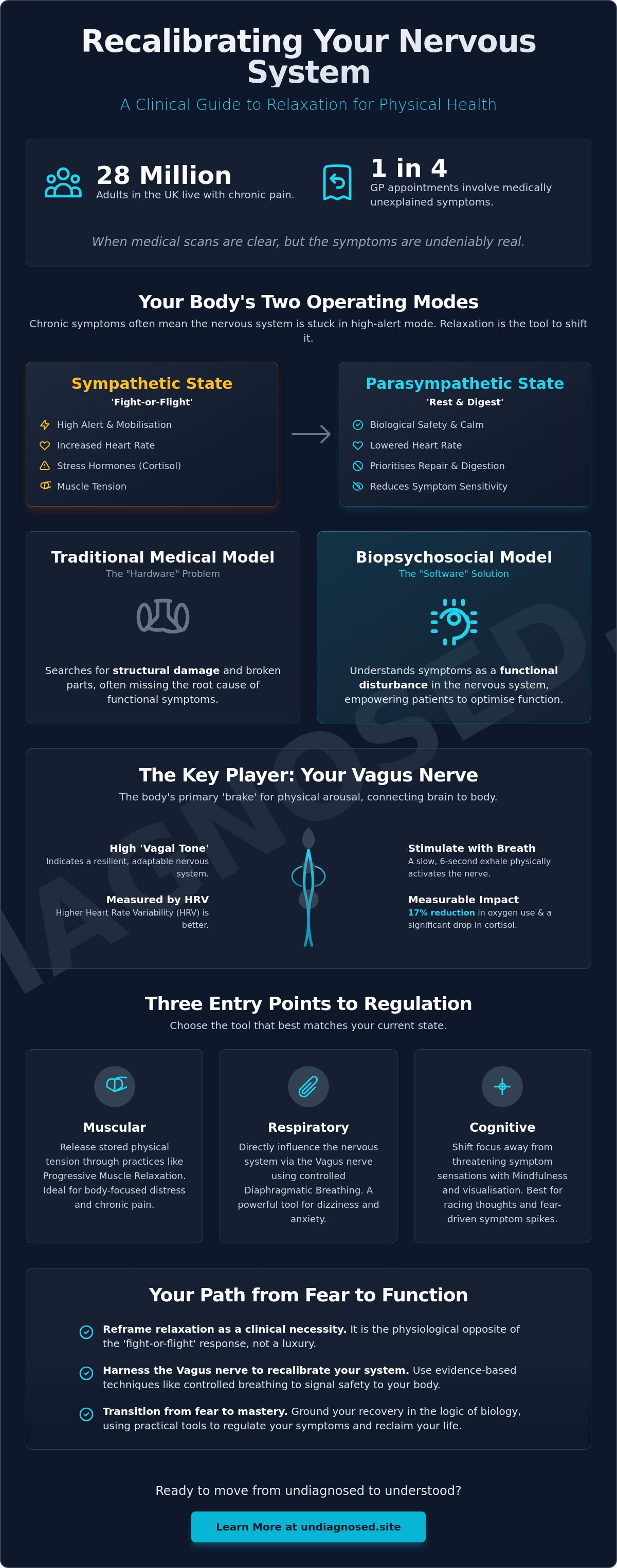
What if the physical pain you feel isn't a sign of permanent damage, but a signal of a nervous system that's lost its ability to reset? It's a question many of the 28 million adults in the UK living with chronic pain face when traditional medical scans come back clear. You've likely been told your symptoms are "all in your head," yet the dizziness and exhaustion you feel are undeniably real. Understanding relaxation techniques for physical health isn't about "just de-stressing"; it's about recalibrating a biological system that's stuck in a state of high alert.
You're right to feel frustrated when clinicians dismiss your experience, especially since 1 in 4 GP appointments in the UK now involves medically unexplained symptoms. We believe in validation, not dismissal. This guide provides a scientific framework to help you move from fear to function. You'll discover how evidence-based relaxation techniques recalibrate your nervous system to manage chronic pain and dizziness effectively. We'll explore the biopsychosocial model and provide three practical tools you can use today to lower symptom intensity and reclaim your life.
Key Takeaways
- Reframe relaxation as a clinical necessity rather than a luxury, understanding how it serves as the physiological opposite to the 'fight-or-flight' response.
- Harness the power of the Vagus nerve by implementing evidence-based relaxation techniques for physical health designed to recalibrate a dysregulated nervous system.
- Learn to select the most effective 'entry point' for your recovery, matching specific muscular, respiratory, or cognitive tools to symptoms like chronic pain or dizziness.
- Navigate the complexities of the stress-symptom loop with a practical five-step framework for maintaining a practice, even whilst experiencing peak physical distress.
- Transition from fearing undiagnosed symptoms to mastering the biological tools that regulate them, grounding your recovery in logic and hope, not hype.
Beyond the Spa: Why Relaxation is a Clinical Tool for Physical Health
In a clinical context, relaxation is far more than a luxury or a temporary escape from a busy schedule. It represents the physiological counter-manoeuvre to the sympathetic nervous system's fight-or-flight response. When you engage in a structured relaxation technique, you're actively down-regulating stress hormones and activating the parasympathetic branch. This isn't just a mood boost; it's a measurable biological shift that lowers heart rate, reduces cortisol, and stabilises blood pressure. It's about physiology, not just feelings.
We must distinguish between passive and active states to understand the true impact of these tools. Passive relaxation, such as watching television or scrolling through a phone, often fails to trigger the necessary neurological changes. Active relaxation involves the intentional elicitation of the 'relaxation response', a term pioneered by Dr Herbert Benson of Harvard Medical School in 1975. For those managing persistent or undiagnosed symptoms, using relaxation techniques for physical health serves as a form of neuroplasticity training. It's a method of rewiring the nervous system's habitual patterns, shifting it from a state of constant high alert to one of regulated safety. It's a practice, not just a break.
The Biopsychosocial Model of Symptom Management
The biopsychosocial model views the brain and body as a single, integrated system rather than separate entities. Social stressors and psychological pressures aren't just 'in your head'; they manifest as tangible physical symptoms through the autonomic nervous system. Clinicians now recognise that 'medically unexplained' symptoms are real, documented experiences rather than imaginary complaints. By providing the brain with a 'safety signal', relaxation helps the nervous system understand that the body is no longer under threat. This signal is essential for dampening the over-sensitised neural pathways that contribute to chronic pain and fatigue.
The Limitations of the Traditional Medical Model
Traditional diagnostics often fall short because they prioritise structural damage over functional disturbance. MRI scans and blood tests are designed to find broken parts, yet they frequently miss the subtle, functional changes in how the nervous system communicates. Functional symptoms are a software issue in the body's hardware. Instead of focusing solely on finding damage that may not exist, we shift the focus to optimising function. This approach moves the patient from a cycle of dismissal to a path of practical empowerment, using relaxation techniques for physical health to recalibrate the system. We prioritise function, not just findings.
The Neuroscience of the Relaxation Response
The human nervous system functions through a delicate equilibrium of activation and recovery. This balance is governed by the Autonomic Nervous System (ANS), which operates through two distinct branches: the sympathetic and the parasympathetic. Whilst the sympathetic branch prepares the body for action, the parasympathetic branch facilitates restoration. For many individuals experiencing persistent symptoms, this system becomes skewed. The body remains trapped in a state of high alert, prioritising survival over repair. Science, not superstition, shows us that we can intentionally shift this balance. By utilizing evidence-based techniques, it's possible to signal to the brain that the perceived threat has passed, allowing the body to exit a state of physiological debt.
The Vagus Nerve and Physical Regulation
The Vagus nerve acts as the body's primary internal 'brake' for physical arousal. As the longest nerve of the ANS, it connects the brainstem to the heart, lungs, and digestive tract. A high 'Vagal Tone' is essential for health; it's measured by Heart Rate Variability (HRV), where higher variability indicates a resilient system. Research from 2010 suggests that specific diaphragmatic breathing patterns, such as a six-second exhale, physically stimulate the Vagus nerve. This stimulation triggers a 17% reduction in oxygen consumption and a significant drop in cortisol levels. According to Polyvagal Theory, the body must feel biologically 'safe' before it can prioritise digestion or cellular repair. Without this safety signal, the body remains in a defensive posture that exacerbates physical pain.
Central Sensitisation and the Pain Loop
When stress is chronic, the brain undergoes a process called central sensitisation. The nervous system becomes hyper-vigilant, effectively lowering the pain threshold. In this state, the brain becomes too efficient at producing pain signals, even in the absence of new tissue damage. This involves 'neuro-tagging', a process where the brain mistakenly associates neutral movements or thoughts with danger. If a specific activity once caused a flare, the brain 'tags' that activity as a threat. Relaxation techniques for physical health work by introducing calm during these flares, which helps to 'un-tag' these associations. This isn't about 'thinking away' the pain; it's about using physiological tools to re-train a hyper-vigilant brain.
Consistent practice is the key to lasting change. Repetitive relaxation doesn't just provide temporary relief; it down-regulates the entire system over time. This creates a foundation for long-term recovery. If you're looking to explore practical tools for your own health journey, understanding these neural pathways is the first step toward reclaiming control. By moving from a state of high-alert to one of regulated calm, you provide your body with the environment it needs to function optimally.
Evidence-Based Techniques for Specific Physical Symptoms
Effective relaxation techniques for physical health work through specific biological pathways. We categorise these by their primary entry point: muscular, respiratory, or cognitive. Selecting the right tool requires precision, not guesswork. A patient experiencing persistent dizziness requires a different physiological entry than one struggling with lower back pain. Success depends on the dose-response relationship. Clinical research, such as studies from the Benson-Henry Institute, indicates that 10 minutes of daily practice produces more sustainable neurological change than a two-hour session once a week. This consistency builds interoception. It's the skill of monitoring internal body signals with objective awareness, not anxious hyper-vigilance. It allows you to listen to your body without the reflex of fear.
- Muscular mechanisms: Targeting the peripheral nervous system to reduce physical guarding.
- Respiratory mechanisms: Balancing blood gases to stabilise the autonomic nervous system.
- Cognitive mechanisms: Using the brain's executive functions to override stress signals.
Techniques for Chronic Pain and Muscle Tension
Muscular tension often becomes a self-perpetuating cycle where the body remains in a state of "bracing." Progressive Muscle Relaxation (PMR) addresses this by systematically tensing and releasing specific muscle groups. This process resets the baseline tension levels in the body, making you aware of what true relaxation feels like. Autogenic Training takes a cognitive-muscular approach. You use self-suggestion to perceive warmth and heaviness in the limbs, which triggers peripheral vasodilation and eases the "fight or flight" response. When performing a body scan, the goal is curiosity, not judgement. We observe the pain without the emotional overlay of "good" or "bad." This shift in perspective can reduce the perceived intensity of chronic pain by up to 30% in controlled clinical settings.
Techniques for Dizziness and Functional Neurological Symptoms
Dizziness and lightheadedness often stem from subtle respiratory shifts that we don't notice. Diaphragmatic breathing is essential here. It's about stabilising carbon dioxide levels in the blood, which prevents the cerebral vasoconstriction that causes a sense of unsteadiness. For those with Functional Neurological Disorder (FND) or dissociative symptoms, grounding techniques provide a vital "circuit breaker." By engaging the five senses to focus on the immediate environment, the brain is pulled out of a dizzy or disconnected state and back into the present moment. Guided imagery uses the visual cortex to simulate physical ease and balance. By imagining a state of physical stability, you prime the motor systems to mirror that ease. It's about retraining the brain, not just distracting the mind.
- Stabilisation, not suppression: Techniques should aim to balance the system, not just mask the symptom.
- Sensory focus: Using external anchors like touch or sound to resolve internal vertigo.
- Visual priming: Using the brain's plasticity to "re-map" a sense of physical balance.
Overcoming the Stress-Symptom Loop: A Practical Implementation Guide
Attempting to relax whilst in significant physical pain often feels like an impossible task. For many, stillness acts as a megaphone for their symptoms, making the discomfort feel louder and more intrusive. This phenomenon is known as relaxation-induced anxiety. It affects approximately 15% to 30% of people according to clinical observations. It isn't a failure of character; it's a neurological response where the brain interprets a drop in external stimulation as a period of vulnerability. Understanding this allows you to move toward relief without the guilt of "failing" at mindfulness.
When your symptoms are at their peak, use this 5-step framework to ground your nervous system:
- Acknowledge the sensation: Briefly name the pain without judging it.
- Find a neutral zone: Shift your focus to a part of the body that feels neutral, such as an earlobe or a single toe.
- Soft exhales: Breathe out for longer than you breathe in to signal safety to the vagus nerve.
- Micro-release: Drop your shoulders or uncurl your toes by just ten percent.
- Sensory tethering: Touch a physical object, like a cold glass or a textured fabric, to return to the present moment.
Adopting a mindset of practice, not perfection, is essential. If you spend ten minutes trying to calm your mind and fail, you've still performed the neurological "reps" required to build resilience. The goal isn't a silent mind; it's the consistent return to the attempt.
Managing the Relaxation-Induced Anxiety Spike
Silence can feel threatening when the body is in a state of high alert. If sitting still triggers a spike in heart rate or panic, stop forcing traditional meditation. You can titrate your relaxation techniques for physical health by starting with two-minute bursts rather than long sessions. For those who find stillness too distressing, active relaxation is a superior entry point. Mindful walking or gentle rhythmic movements allow the body to discharge excess energy whilst still engaging the parasympathetic nervous system.
Building a Sustainable Daily Routine
Consistency relies on habit stacking rather than willpower. Attach your practice to existing cues in your British working day, such as practising a breathing reset whilst the kettle boils or during a train commute. Designate a specific corner of your home as a "recovery centre" with specific lighting or scents to signal safety to your brain. The window of tolerance is the physiological zone where a person can effectively process physical and emotional sensations without becoming overwhelmed or shutting down. By staying within this zone, you ensure your relaxation techniques for physical health lead to genuine recovery rather than further stress.
Success is found in consistency, not intensity. Explore our evidence-based tools to help you navigate the complexities of symptom management.
Moving from Undiagnosed to Understood: The Mind-Body Connection
Transitioning from the fear of unexplained symptoms to the mastery of your own physiology is a profound shift. It marks the moment you stop being a victim of your body and start becoming its most informed advocate. This process is built on a foundation of "Hope, not hype." Recovery isn't a miracle or a stroke of luck. It's a logical, biological outcome of consistent nervous system regulation. When you apply relaxation techniques for physical health, you aren't just "calming down"; you're actively engaging with the neurobiology of your survival response.
The journey from feeling overlooked by the medical system to feeling understood is often long. However, the science of neuroplasticity proves that change is always possible. Your symptoms are genuine and your pain is real, but your nervous system is plastic. It can be retrained. By mastering the tools that regulate your internal environment, you move from a state of constant high alert back to a state of safety and repair.
The Power of Education in Recovery
Understanding the neuroscience behind your condition is the first step in the relaxation process. Knowledge acts as a safety signal to the brain, reducing the perceived threat of physical sensations. Whilst many clinicians miss the broader framework of the mind-body connection during a standard consultation, the Undiagnosed - The Mind and Body Connection book provides the evidence-based guidance needed to fill those gaps. It offers a clear, clinical perspective on how stress manifests as physical illness.
For those who require a more structured approach, the Undiagnosed - The Mind and Body Connection online course offers a step-by-step programme. It moves beyond theory, providing the practical tools required to organise your recovery in a way that feels manageable and grounded in science. This education allows you to interpret your body's signals without the panic that usually follows, creating a stable foundation for long-term health.
Final Steps Towards Reclaiming Your Health
The path forward requires a fundamental change in perspective. You must stop searching for a single, elusive "silver bullet" cure and start building a recovery environment. This means creating the biological conditions where your body can return to a state of homeostasis. Using relaxation techniques for physical health isn't a temporary fix; it's a way of life that signals to your brain that the danger has passed.
Your nervous system possesses the innate ability to change and adapt. By retraining your neural pathways through consistent practice and education, you can finally move away from the "undiagnosed" state and towards a life of clarity. You have the capacity to heal, provided you have the right framework to guide you.
Your journey towards understanding doesn't have to be solitary or confusing. You can access the resources specifically designed to bridge the gap between clinical science and your lived experience right now. Explore the Undiagnosed - The Mind and Body Connection course and book to begin your recovery journey today.
Moving from Dismissal to Clinical Relief
Understanding the neuroscience of the relaxation response is the first step toward breaking the cycle of persistent physical symptoms. It's about moving from being undiagnosed to being understood. By prioritising evidence-based relaxation techniques for physical health, you're not just seeking a temporary escape; you're engaging a clinical tool that alters your body's physiological state. This biopsychosocial approach ensures that your recovery is grounded in medical science, not just sentiment.
Dr. Csaba Dioszeghy, a Consultant Physician, founded this methodology to provide patients with practical tools for real-world symptom management. It's time to choose recovery, not just rest. You can access these structured resources to bridge the gap between your physical symptoms and the relief you've been seeking for far too long. These methods focus on tangible results; they give you the power to manage your health with confidence and precision. You deserve a roadmap that prioritises your dignity and your recovery.
Start your journey to recovery with the 'Undiagnosed' book and online course today
Your path to health is built on clarity and evidence. You aren't alone in this process.
Frequently Asked Questions
Can relaxation techniques really cure chronic physical pain?
Relaxation techniques offer management, not miracles. While they don't cure structural damage, a 2022 study in The Lancet showed that mind-body interventions can reduce pain interference by 30 per cent. These tools work by lowering cortisol levels and dampening the central nervous system's alarm response. It's about regulation, not eradication. By shifting the body out of a "fight or flight" state, you change how your brain processes pain signals.
How long does it take to see physical health improvements from relaxation?
You'll notice physiological shifts immediately, but sustainable change takes consistency. Research from Harvard Medical School indicates that regular practice of relaxation techniques for physical health triggers gene expression changes related to inflammation within 8 weeks. Most patients report a measurable reduction in heart rate and muscle tension during their first 20 minute session. Persistence is key. Think of it as training a muscle; the strength builds through daily repetition rather than occasional effort.
What if I find it impossible to relax because my symptoms are too intense?
Intensity doesn't preclude progress; it necessitates a modified approach. If symptoms are overwhelming, don't aim for total calm. Instead, focus on "pacing, not pushing." Data from the NHS suggests that even 3 minutes of diaphragmatic breathing can begin to stabilise the autonomic nervous system. You aren't failing if you feel pain whilst practising. You're simply teaching your body that it can be safe even when symptoms are present.
Is there a specific time of day that is best for practising these techniques?
The best time is the one you can stick to consistently. However, a 2021 sleep study found that practising 15 minutes before bed improved sleep efficiency by 12 per cent. Morning sessions help set a lower baseline for stress throughout the day. Choose a window where you won't be interrupted. Routine creates reliability. Whether it's 7:00 am or 10:00 pm, the physiological benefit comes from the ritual itself.
Are these relaxation techniques different from just 'thinking positively'?
These techniques involve biological regulation, not just positive thinking. It's science, not sentiment. While "thinking positively" is a cognitive exercise, relaxation techniques for physical health actively engage the vagus nerve to lower blood pressure. A 2019 clinical review confirmed that these practices physically alter the amygdala's grey matter density. We focus on evidence-based physiological shifts that create a calmer internal environment, regardless of your current mood or outlook.
Can relaxation help with symptoms like dizziness and heart palpitations?
Relaxation helps stabilise the autonomic nervous system, which often drives dizziness and palpitations. When the body stays in a state of high arousal, the heart rate can fluctuate unnecessarily. Clinical trials have shown that slow-paced breathing at 6 breaths per minute can reduce palpitations in 65 per cent of patients with anxiety-related cardiac awareness. It provides a biological anchor. By slowing your breath, you send a direct signal to your heart to find a steady rhythm.
Do I need a doctor's supervision to start these relaxation exercises?
Most relaxation exercises are safe to start independently, though consulting a GP is sensible if you have severe cardiovascular issues. It's about safety, not restriction. For 90 per cent of individuals, techniques like progressive muscle relaxation or box breathing carry no risk. If you experience fainting or acute chest pain, seek professional medical advice before continuing. These tools are designed to complement your existing medical care, providing a bridge between clinical treatment and self-management.
What is the most effective relaxation technique for someone with a busy schedule?
Box breathing is the most efficient tool for those with limited time. It takes exactly 4 minutes and is used by elite performers to manage high-pressure environments. You inhale for 4 seconds, hold for 4, exhale for 4, and hold for 4. This specific ratio has been shown to lower heart rate variability within 120 seconds. It's a practical tool that fits into a lunch break or a commute, proving that relief doesn't require hours of silence.