
What if the most effective way to quiet your tremors or seizures isn't a miracle cure, but a commitment to retraining the communication lines between your brain and your body? For the 30% of neurology outpatients who receive an FND diagnosis according to a 2020 report in the Journal of Neurology, Neurosurgery & Psychiatry, the path forward often feels like a series of dead ends. You've likely experienced the exhaustion of medical dismissal or the fear of unpredictable physical symptoms that seem to strike without warning. It's a state of being overlooked, not understood.
We believe in validation, not dismissal. This guide introduces a structured biopsychosocial framework and practical functional neurological disorder tools designed to help you reclaim control over your mind-body connection. You'll discover how to organise a daily routine that prioritises long-term stability over temporary fixes. We will examine the specific evidence-based strategies that reduce symptom frequency and explain exactly why these tools work to stabilise your nervous system.
Key Takeaways
- Understand the distinction between "software" and "hardware" neurological issues to focus your recovery on retraining faulty brain signals rather than searching for structural damage.
- Discover how to leverage neural plasticity using evidence-based functional neurological disorder tools that help you rewire the communication pathways between your mind and body.
- Explore the three essential pillars of symptom management—Regulatory, Cognitive, and Environmental—to identify the specific strategies you can perform with consistency.
- Learn a practical two-step method for recovery by identifying your unique early warning signs and selecting the most effective tools to stabilise your nervous system.
- Access a structured, video-led curriculum designed to provide a clear roadmap for reclaiming control over your physical health and emotional well-being.
Beyond Diagnosis: Why You Need Functional Neurological Disorder Tools
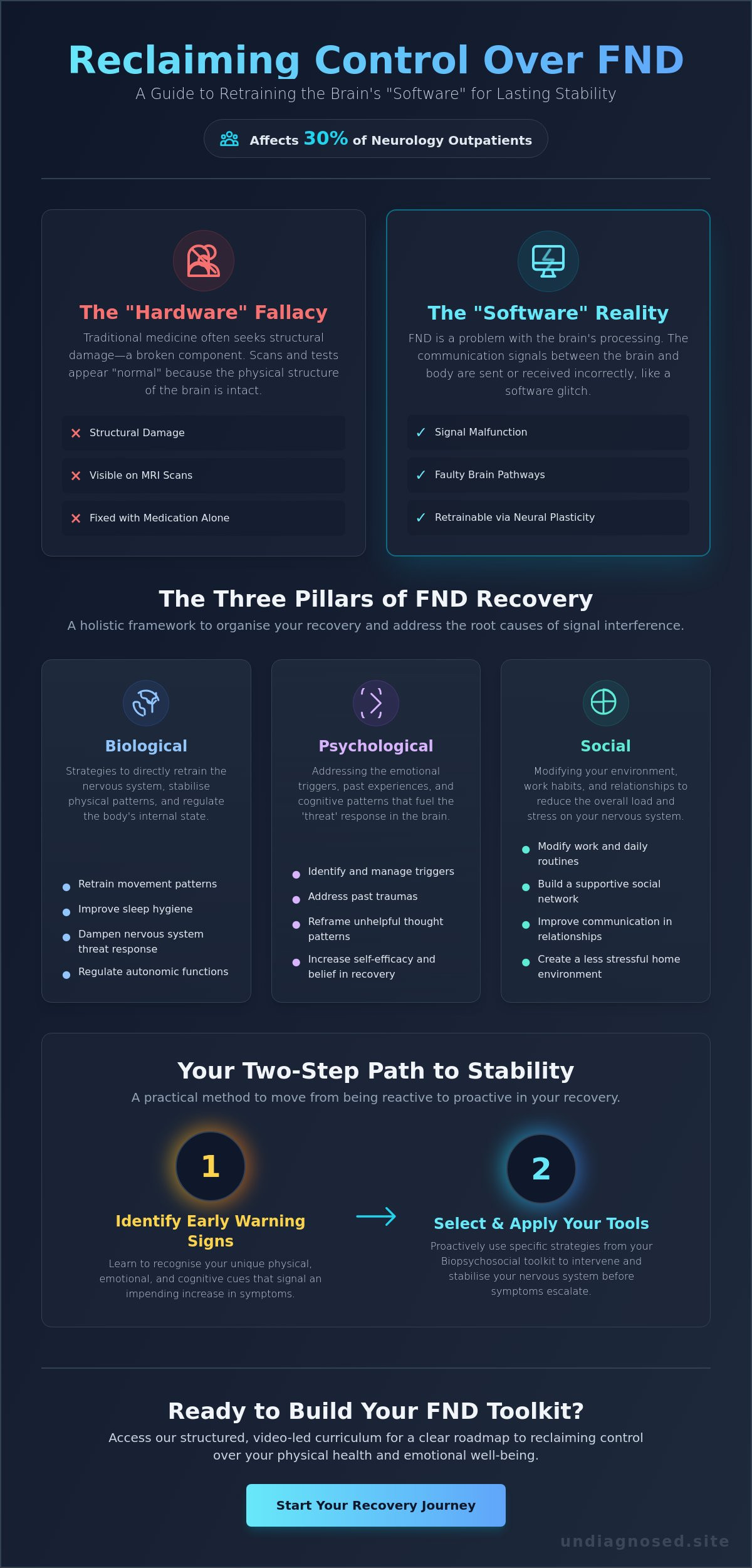
Receiving a diagnosis of Functional Neurological Symptom Disorder often brings a confusing mix of relief and frustration. For many, the road to this point involved months of "normal" MRI scans and blood tests that failed to explain why their legs collapsed or why their hands wouldn't stop shaking. Traditional medical tools often fail because they look for structural damage; they look for a broken "hardware" issue. FND is different. It's a "software" issue where the brain's signals are sent or received incorrectly. This is why you need specific functional neurological disorder tools designed to retrain these faulty pathways through evidence-based practice.
We operate on a philosophy of "Diagnosis, not dismissal." A clear label isn't the end of the journey; it's the essential foundation for recovery. Without it, patients often remain trapped in a cycle of expensive, unnecessary testing that only increases anxiety. Once the diagnosis is accepted, we shift to "Hope, not hype." Recovery isn't an overnight miracle or a "quick fix" found in a supplement bottle. It's a methodical process of using clinical guidance to restore function over weeks and months. We prioritise realistic progress over sensationalist promises.
The Shift from Passive Patient to Active Manager
Waiting for a clinician to "fix" a functional condition often leads to stagnation. In FND, the patient must move from a passive recipient of care to an active manager of their nervous system. Research indicates that increasing self-efficacy, the belief in one's ability to influence their health, can significantly reduce the frequency of functional seizures and tremors. This shift is powered by understanding the mind and body connection. This connection acts as the operating system for your recovery. When you understand how your thoughts, physical sensations, and autonomic nervous system interact, you can begin to use functional neurological disorder tools to interrupt symptom loops before they escalate.
The Biopsychosocial Lens: A Better Way to Organise Recovery
Full remission rarely comes from focusing on just one area of health. If you only attend physical therapy but ignore chronic stress or an unsupportive environment, the nervous system remains in a state of high alert. A biopsychosocial framework allows you to categorise your recovery into three distinct pillars:
- Biological: Strategies to retrain the nervous system, improve sleep hygiene, and stabilise physical movement patterns.
- Psychological: Addressing the emotional triggers, past traumas, and cognitive patterns that fuel the "threat" response in the brain.
- Social: Modifying your environment, work habits, and relationships to reduce the overall load on your system.
By using this structured lens, you can ensure that no part of your experience is overlooked. It allows you to build a toolkit that addresses the root causes of signal interference rather than just chasing individual symptoms as they appear.
Understanding the Mechanism: How FND Tools Retrain the Brain
To understand how functional neurological disorder tools work, we must first understand neural plasticity. This is the brain's inherent ability to reorganise its structure and functions by forming new neural connections throughout life. In FND, the brain has "learned" an incorrect response to internal or external stimuli. It's a software malfunction rather than structural damage. Because the brain is plastic, it can be retrained to send the correct signals once more. Research highlighted in Functional Neurologic Disorder treatment guidelines confirms that this retraining is the cornerstone of modern recovery.
The autonomic nervous system (ANS) drives these functional symptoms. When the brain's threat detection centre, the amygdala, perceives a state of "danger," it can trigger physical symptoms like tremors or seizures as a protective mechanism. This is often a subconscious process. By consistently using specific functional neurological disorder tools, we dampen this threat response. We aren't just managing symptoms; we are physically and neurologically signalling safety to the brain. This gradual process reduces the system's reactivity over time.
The Science of Central Sensitisation
Central sensitisation is the nervous system remaining in a persistent state of high alert. In this state, the brain becomes over-sensitive to stimuli that it would normally ignore. A 2020 report in The Lancet Psychiatry suggests that this hypersensitivity is a primary driver of chronic functional symptoms. Grounding and distraction tools interrupt this cycle. They shift the brain's focus from internal "malfunctions" to neutral, external information. This breaks the internal loop of symptom monitoring, which otherwise strengthens faulty neural pathways.
Bridging the Gap Between Neuroscience and Clinical Practice
Dr. Csaba Dioszeghy’s methodology focuses on translating these neurobiological concepts into practical daily exercises. We categorise these into "bottom-up" and "top-down" strategies. Bottom-up tools use physical sensations to calm the brain, whilst top-down tools use cognitive reframing to regulate the body. Education serves as a primary therapeutic tool. When you understand the mechanism behind your tremors or seizures, the brain's "danger" signal naturally decreases because the unknown becomes manageable. For those seeking to apply these concepts, exploring a structured curriculum offers a clear path toward reclaiming your mind-body connection.
The Essential Categories of Functional Neurological Disorder Tools
Effective recovery requires a diverse inventory of strategies. We organise functional neurological disorder tools into three primary pillars: Regulatory, Cognitive, and Environmental. The "best" tool isn't the most complex one; it's the one you can perform with absolute consistency. Within these categories, we distinguish between "acute" tools, which you use mid-symptom to break an episode, and "preventative" tools used for daily nervous system maintenance. Integrating relaxation techniques for physical health serves as the core pillar that provides the baseline stability your body needs to respond to other interventions.
A collaborative approach often starts with a clear clinical pathway. As noted in the Mayo Clinic's guidance on FND diagnosis and treatment, a multidisciplinary strategy is most effective for long-term success. This means your personal toolkit should be balanced. Relying only on physical exercises whilst ignoring cognitive patterns often leads to a plateau in progress.
Regulatory Tools: Calming the Nervous System
Regulatory tools focus on the "bottom-up" approach of using the body to influence the brain. Breathing techniques are foundational, specifically those that emphasise a long, slow exhale. This simple action activates the vagus nerve, which signals the parasympathetic nervous system to lower your heart rate and reduce the "threat" response. Grounding exercises, such as the 5-4-3-2-1 method, anchor the brain during a functional episode by forcing it to process neutral sensory data: five things you see, four you can touch, three you hear, two you smell, and one you can taste. For more intense episodes, temperature-based regulation like splashing cold water on the face can "reset" sensory input and interrupt a mounting seizure or tremor loop.
Cognitive and Educational Tools
Cognitive strategies focus on the "top-down" path of using the mind to regulate the body. Symptom tracking is a vital functional neurological disorder tools component, but it must be done correctly. We move from "fearful monitoring," where you obsess over every twitch, to "analytical observation," where you objectively note triggers and patterns. This data allows for effective reframing. Instead of thinking "my body is broken," you learn to tell yourself "my brain is sending a false alarm." This reduces the emotional charge of the symptom. Finally, sleep hygiene is non-negotiable. Research from the Sleep Foundation suggests that even one night of poor sleep can increase nervous system reactivity by 30%, making it a primary preventative tool for reducing nocturnal triggers.
How to Organise Your Personalised FND Recovery Plan
Transitioning from understanding the mechanism to applying it requires a structured curriculum. You cannot master every strategy at once. Start by identifying your "early warning signs." These are the subtle sensory changes, such as a specific tingling in the limbs, a metallic taste, or a slight change in peripheral vision, that precede a full episode. Recognising these auras gives you a window of opportunity to intervene. Once identified, select exactly one regulatory tool and one cognitive tool to master. Trying to use ten different functional neurological disorder tools simultaneously creates a high cognitive load, which can actually trigger symptoms. Master the basics before expanding your repertoire.
Environment and rhythm provide the safety your brain needs to rewire. Create a "low-arousal" environment by reducing sensory triggers like harsh fluorescent lighting or constant background noise. This involves auditing your space for 15 minutes each morning to identify hidden stressors. Establish a consistent daily rhythm. The brain thrives on predictability. When you eat, sleep, and practice your exercises at the same times each day, you reduce the autonomic nervous system's need to be on high alert. Review your progress weekly. Look for patterns in symptom frequency and intensity rather than judging your success on the outcome of a single "bad" day.
Prioritising the Vagus Nerve and Sleep
Sleep is the master regulator of functional symptoms. A 2021 study in the journal Sleep Medicine indicated that fragmented sleep can increase pain sensitivity and motor dysfunction in FND patients by up to 40%. Integrate micro-breaks of relaxation throughout your day to prevent the "boom and bust" cycle. This cycle occurs when patients overexert themselves on high-energy days, leading to a prolonged crash. The vagus nerve acts as the primary brake for the body’s stress response. By stimulating it regularly through the breathing techniques we have explored, you manually override the "fight or flight" mode. To build these habits into a sustainable daily structure, enrol in our structured mind-body curriculum for professional guidance.
Managing Setbacks and "Flare-ups"
Recovery is rarely linear. A temporary increase in symptoms is not a sign of "failure" or evidence that the functional neurological disorder tools are ineffective. It's often a sign that your nervous system is processing a temporary increase in physiological or emotional load. Prepare a "Flare-up Toolkit" in advance. This is a written list of pre-planned actions, such as specific grounding exercises or environmental changes, that you can follow when your cognitive function is low. Use self-compassion as a clinical tool. Research confirms that self-criticism spikes cortisol levels, whilst self-compassion lowers them, directly calming the brain's threat detection centre.
The "Undiagnosed" Curriculum: A Structured Path to Mind-Body Connection
The journey from medical confusion to functional recovery requires more than just a list of techniques; it requires a roadmap. Whilst individual functional neurological disorder tools offer immediate relief during episodes, long-term stability is built through a comprehensive understanding of the system. The book, "Undiagnosed: The Mind and Body Connection," serves as the primary reference for this journey. It provides the scientific depth needed to move beyond the "undiagnosed" state and into a life of managed health. For those who prefer a more interactive experience, our Online Course offers a structured, video-led curriculum with lifetime access. This isn't just about reading; it's about retraining the brain's software through a biopsychosocial approach developed by a Consultant Physician.
This platform acts as a bridge. It connects the frustration of being overlooked by traditional systems with the practical reality of reclaiming your mind-body connection. By following a curriculum designed by clinical experts, you move from a state of passive suffering to active management. We prioritise "Hope, not hype," ensuring that every tool you learn is grounded in clinical authority rather than empty promises.
Why a Structured Course Surpasses Random Online Research
The internet is often a source of "information overload," which paradoxically increases the brain's threat levels. When you encounter conflicting advice or catastrophic stories on social media, your nervous system remains in a state of high alert. This constant scanning for danger is the opposite of what an FND patient needs. A curated, evidence-based path designed by Dr. Csaba Dioszeghy removes this uncertainty. By following a logical progression, you ensure that you aren't just trying random things in a state of panic. Structured exercises lead to better long-term outcomes because they build upon each other. They create a cumulative effect on neural plasticity that sporadic self-help cannot match. It's about "Education, not just exercises."
Final Steps: Joining the Mind and Body Community
Recovery is a transition from "learning" to "doing." It's the daily application of functional neurological disorder tools that creates lasting change in your neural pathways. We stand by our promise: recovery is a journey of education and practice, not a quick fix. You don't have to navigate this transition alone. By joining our community, you move amongst others who value truth and patient dignity. It's time to stop searching for a miracle and start practicing the science of recovery. Take the final step in your journey and explore the Mind and Body Connection Online Course today.
Reclaim Your Mind-Body Connection
Recovery from FND is a process of education and consistent practice. We've explored how the brain's software can be retrained through neural plasticity and why a biopsychosocial framework is essential for long-term stability. By moving away from the "boom and bust" cycle and mastering specific functional neurological disorder tools, you transition from feeling gaslit by the medical system to becoming an active manager of your own health. It's a shift from fear to analytical observation.
You don't have to navigate this journey in isolation. Our curriculum, developed by Consultant Physician Dr. Csaba Dioszeghy, provides an evidence-based path designed to lower the nervous system's threat levels. With lifetime access to this structured digital curriculum, you gain a permanent resource for managing your symptoms and understanding the complex interaction between your mind and body. This is "Hope, not hype." It's the beginning of a life where you are in control, not your symptoms.
Begin your recovery journey with the Mind and Body Connection Course today and start building the foundation for a more predictable, stable future.
Frequently Asked Questions
What are the most effective functional neurological disorder tools for beginners?
Grounding techniques and diaphragmatic breathing exercises are the most effective starting points for those new to recovery. Specifically, the 5-4-3-2-1 method provides immediate sensory redirection that can stabilise the nervous system. These functional neurological disorder tools help beginners build a foundation of safety before they move on to more complex cognitive reframing or physical retraining exercises.
Can I use these FND tools alongside my current medical treatment?
Yes, these strategies are designed to complement, not replace, your existing clinical care. Most neurologists advocate for a multidisciplinary approach that combines medical oversight with active self-management. According to a 2020 consensus statement in the Journal of Neurology, Neurosurgery & Psychiatry, integrated care models lead to better patient outcomes than isolated medical treatments. Always keep your clinical team informed of the self-regulation exercises you practice.
How long does it take for these mind-body tools to show results?
Initial shifts in nervous system reactivity often become noticeable within 4 to 6 weeks of daily practice. However, retraining established neural pathways usually requires 3 to 6 months of consistent application to see a significant reduction in symptom frequency. We prioritise "Hope, not hype," focusing on the realistic timeline of neuroplasticity rather than promising overnight cures that don't last.
Are functional neurological disorder tools the same as psychological therapy?
No, whilst there is some overlap, these functional neurological disorder tools focus specifically on the neurobiological "software" malfunction of the brain. Traditional psychological therapy often explores emotional history; in contrast, these tools target the immediate regulation of physical signals and the autonomic nervous system. This approach treats the mind-body connection as a single, integrated system that requires physiological retraining to stop tremors or seizures.
What should I do if my FND symptoms get worse while using these tools?
A temporary increase in symptoms is a common part of the recovery journey and usually indicates a state of over-stimulation. If this occurs, you should temporarily reduce the intensity of your practice and return to basic regulatory tools like slow exhales or cold water therapy. It's a signal to rest, not a sign of failure. Use your pre-planned "Flare-up Toolkit" to manage these periods with self-compassion.
Is there a specific tool for functional seizures or tremors?
Sensory distraction and "opposite movement" techniques are particularly effective for managing motor symptoms. For tremors, engaging in a different rhythmic task with an unaffected limb can often interrupt the brain's faulty signal loop. For functional seizures, identifying the 30 to 60 second "aura" window is critical. This allows you to use intense grounding exercises to signal safety to the brain before the episode escalates.
Can a book really help with physical neurological symptoms?
Yes, a book provides the essential educational foundation that reduces the brain's "danger" signals by explaining the "why" behind the "what." Research indicates that patients who understand the mechanism of their condition experience a 20% reduction in symptom-related anxiety. Understanding the science of FND is a clinical intervention in itself, as it transforms the unknown into a manageable set of biological processes.
Do I need a doctor’s referral to start the Undiagnosed course?
No, you do not require a formal referral from a GP or neurologist to begin the Mind and Body Connection curriculum. It is designed as an accessible, self-led educational resource to empower you between your clinical appointments. Whilst we recommend maintaining a relationship with your medical consultant for your primary diagnosis, these tools are available to anyone ready to move from a passive to an active recovery role.