
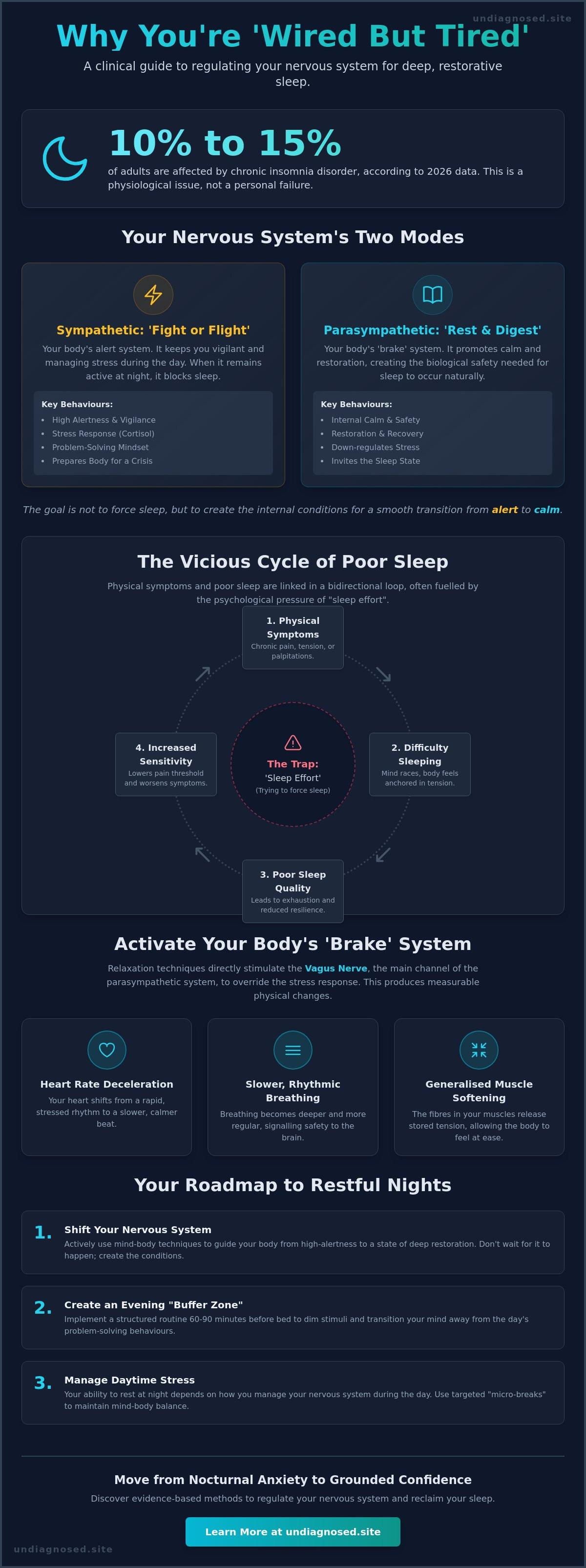
What if your inability to drift off isn't a failure of willpower, but a biological signal that your nervous system is stuck in the "on" position? You likely recognise the heavy frustration of lying awake at 2am, watching the clock whilst your mind races and your body remains anchored in tension. It's a lonely experience to feel "wired but tired," yet you aren't alone in this struggle. Recent 2026 data indicates that chronic insomnia disorder now affects between 10% and 15% of adults. Mastering relaxation for sleep isn't about forcing rest; it's about creating the physiological conditions where sleep becomes inevitable.
You deserve a reliable method to transition from high-alertness to deep restoration. In this guide, you'll discover how to use evidence-based mind-body techniques to lower physical tension and quiet the internal noise that keeps you awake. We'll examine the vital link between your physical symptoms and your sleep quality, providing you with a clear roadmap to regulate your nervous system. From understanding the latest 2026 AASM clinical guidelines to practical nervous system resets, you're about to move from a state of nocturnal anxiety to one of grounded confidence.
Key Takeaways
- Gain a clinical understanding of how to shift your autonomic nervous system from high-alertness to a physiological state of deep restoration.
- Break the bidirectional loop between physical symptoms and sleep quality by reducing the psychological pressure of "sleep effort."
- Master specific mind-body techniques for relaxation for sleep, choosing between active and passive methods based on your unique type of tension.
- Implement a structured "buffer zone" in your evening routine to dim environmental stimuli and transition your mind away from problem-solving behaviours.
- Discover why your nocturnal rest depends on how you manage your nervous system throughout the day using targeted micro-breaks for mind-body balance.
Understanding the Science of Relaxation for Sleep
Sleep isn't a task you perform; it's a physiological state you invite. To achieve effective relaxation for sleep, we must first understand the biological barrier standing in our way. Our autonomic nervous system operates on a binary of survival and rest. During the day, the sympathetic branch keeps us alert, scanning for problems and managing stress. This alertness is a vital survival mechanism, yet it must be deactivated for rest to occur. If the brain perceives the lingering tension of the day as a threat, it'll refuse to initiate the sleep cycle. You can't logic your way into rest whilst your body is prepared for a crisis. Instead, you must transition your nervous system from a state of vigilance to a state of ease.
True rest requires a sense of biological safety. This isn't just about the absence of physical danger, but the presence of internal calm. When your nervous system remains in a state of high-arousal, your brain prioritises alertness over recovery. This is why many people feel "wired but tired" at 2am; the body is exhausted, but the survival brain is still on duty. Moving toward sleep requires a deliberate shift in your internal chemistry, moving away from cortisol and towards the neurochemicals of restoration.
The Role of the Parasympathetic Nervous System
The vagus nerve acts as the body's internal "brake" system. It's the primary channel for the parasympathetic nervous system, responsible for down-regulating the heart and lungs. When you engage common relaxation techniques, you're essentially stimulating this nerve to override the stress response. The results are physical and measurable:
- Heart rate deceleration
- Slower, more rhythmic breathing
- Generalised softening of the muscle fibres
The relaxation response is a clinical term coined to describe the opposite of the fight-or-flight mechanism.
Why Traditional Sleep Hygiene Often Fails
Standard sleep advice often focuses on external factors like room temperature or light levels. Whilst these matter, they don't address the internal state of the nervous system. You can have a perfect bedroom and still lie awake because your internal physiology is still in "problem-solving" mode, triggering alert behaviours. Trying to force sleep creates a paradoxical stress response; the effort itself signals the brain to stay alert. Standard hygiene fails because it ignores the mind-body connection, which is the essential bridge for relaxation for sleep.
The Biopsychosocial Lens: Why Mind and Body Must Align
To understand why sleep remains elusive, we must look through a biopsychosocial lens. It isn't just about the caffeine you drank or the blue light from your phone. It's about how your biological state, your psychological pressure, and your social environment converge at midnight. Whilst the previous section examined the mechanics of the vagus nerve, true relaxation for sleep requires a profound alignment between your physical sensations and your psychological state. When these elements are out of sync, the brain remains on high alert, scanning for threats even in a locked room. Research into the body's relaxation response suggests that achieving deep rest requires more than just lying still; it requires the brain to perceive a state of absolute safety.
This perception is often blocked by a bidirectional loop. Physical symptoms like chronic pain, dizziness, or palpitations make it difficult to drift off. In turn, the resulting poor sleep lowers your pain threshold and increases sensitivity the following day. This cycle is fuelled by "sleep effort," the psychological pressure we put on ourselves to perform the act of resting. Sleep effort is a trap. It transforms a natural, passive process into a performance-based task, which the brain interprets as a stressor. The harder you try to sleep, the more your brain stays awake to monitor your progress.
Emotions and Physical Tension at Night
Physical restlessness at night is often the body's way of processing suppressed daily emotions. During the busy hours of the day, we can ignore subtle anxieties or frustrations. However, when the lights go out, these emotions manifest as physical tension or hypervigilance. You might find yourself startling at small noises or feeling a vague sense of dread. It's vital to recognise that your physical symptoms are real and valid. They aren't "in your head," but they are often exacerbated by a nervous system that has forgotten how to stand down. This state of constant scanning leads to fragmented, light sleep that leaves you feeling unrefreshed.
Rewiring the Brain for Rest
The path to better rest involves teaching the brain that it's safe to let go. Understanding the neuroscience of MUS helps explain why the brain stays "on" even when you're exhausted. When you learn that your symptoms are signals from an overprotective nervous system rather than signs of imminent danger, the threat response begins to fade. Cognitive reframing allows you to view wakefulness not as a health crisis, but as a temporary state of arousal that can be managed. If you're looking for a structured way to apply these insights, our book Undiagnosed - The Mind and Body Connection provides the tools to start this internal dialogue and reclaim your nights.
Comparing Effective Relaxation Techniques for Night-time
Choosing the right method for relaxation for sleep requires a diagnostic approach to your own tension. Some nights, the mind is a whirlwind of racing thoughts whilst the body feels leaden. Other nights, the body vibrates with restless energy despite a quiet mind. To navigate these states, you must distinguish between active relaxation, where you deliberately engage a physiological process, and passive relaxation, where you practice the art of letting go. Sensory-based interventions often work best for those prone to ruminative thoughts, whilst breath-based tools address the mechanical aspects of the stress response. Consistency in these practices outweighs the intensity of a single session; the goal is to train the nervous system over time rather than force an immediate result.
Breathing Exercises vs. Muscle Relaxation
If your primary barrier is a racing heart or shallow chest breathing, targeted breathing exercises for stress provide an immediate mechanical reset. Techniques like the 4-7-8 method or diaphragmatic breathing regulate CO2 levels and signal safety to the brainstem. Conversely, for those experiencing fibromyalgia-type symptoms or persistent physical rigidity, Progressive muscle relaxation (PMR) is often more effective. By systematically tensing and releasing muscle groups, you provide the brain with concrete sensory feedback that the "threat" is over. This physical engagement helps ground the individual in the body, moving focus away from abstract anxieties and into tangible sensations of release.
Visualization and Non-Sleep Deep Rest (NSDR)
Visualization serves as a sophisticated distraction technique for a brain prone to monitoring internal symptoms. Instead of scanning for pain or dizziness, you provide the mind with a complex, calming landscape to navigate. This shifts the brain's focus from internal monitoring to external imagination. For individuals with intense racing thoughts, guided practices like Yoga Nidra or Non-Sleep Deep Rest (NSDR) are superior to unguided meditation. These structured protocols provide a "scaffold" for the wandering mind, preventing it from slipping back into nocturnal problem-solving. NSDR, in particular, has gained clinical recognition in 2026 for its ability to lower baseline arousal levels. Matching your technique to your specific symptom profile transforms relaxation for sleep from a haphazard attempt into a precise clinical intervention.
A Step-by-Step Evening Routine for Nervous System Regulation
Sleep is an invitation, not a command. You cannot force your brain to switch off, but you can create the physiological conditions that make rest inevitable. This requires a "buffer zone," a dedicated sixty-minute window to transition from the high-velocity demands of the day to the stillness of the night. This period isn't about passive waiting; it's about active down-regulation. By following a structured sequence, you provide your brain with the concrete evidence it needs to feel safe. Effective relaxation for sleep is built on this chronological progression, moving methodically from the external environment to the internal state.
The transition begins with a shift in focus. You must move from a state of "doing" to a state of "being." This isn't a luxury; it's a biological necessity for those whose nervous systems have become sensitised by chronic stress or persistent physical symptoms. When you follow a predictable routine, you lower the cognitive load on your brain, reducing the need for nocturnal vigilance.
Step 1 & 2: Preparing the Body
Start by organising your surroundings to minimise sensory load. Dim the lights and initiate a "digital sunset" at least an hour before bed. This cessation of "problem-solving" activities—such as checking emails or planning the following day's schedule—is vital. Once your environment is calm, move into gentle somatic movement. Muscular bracing is a common, often unconscious response to stress, particularly for those managing dizziness at home or dealing with chronic physical tension. Soft, slow stretches release this physical armouring, signalling to the brainstem that the time for vigilance has passed and the time for restoration has begun.
Step 3 & 4: Calming the Mind
Once the body begins to soften, focus on the breath to rapidly lower arousal. The "physiological sigh," which involves a double inhalation through the nose followed by a long, audible exhalation, is a potent tool for resetting your baseline. This mechanical shift changes your heart rate variability within moments. After settling into bed, use a "body scan" to observe physical sensations. The key is to validate symptoms without reacting to them; you acknowledge the discomfort whilst remaining uncoupled from the alarm. Finally, establish a "mental anchor," such as a neutral visualisation, to prevent the mind from slipping into rumination. The goal of these steps is not to "force" sleep, but to remove the obstacles to it.
Mastering this internal dialogue is the first step toward long-term recovery. For a structured guide on rewiring your response to physical tension, explore our The Mind and Body Connection Online Course.
Beyond the Bedroom: Integrating Mind-Body Balance into Your Life
Whilst you might seek relaxation for sleep in the final hours of the day, your success is largely determined by how you navigate the sixteen hours preceding them. Sleep quality isn't a isolated event; it's a reflection of your cumulative nervous system state. If you spend your day in a cycle of high-pressure "doing" without moments of recovery, your brain will struggle to down-regulate when the lights go out. This phenomenon, often called stress stacking, ensures that your baseline arousal remains too high for the brain to initiate deep rest. True recovery requires a shift from trying to "fix" your sleep to understanding the internal signals your body sends throughout the day.
Adopting a biopsychosocial approach means recognising that your thoughts, physical sensations, and environment are constantly interacting. When you manage these interactions in real-time, you prevent the build-up of nocturnal tension. Integrating practical mind-body balance tools into your working day allows you to discharge stress as it occurs, rather than attempting to process it all at 2am. This proactive regulation is the foundation of long-term recovery from functional symptoms and persistent insomnia.
The Importance of Daytime Regulation
Nervous system regulation shouldn't be reserved for the bedroom. When you ignore physical tension or emotional triggers during the day, your brain maintains a state of hypervigilance that makes nighttime relaxation for sleep almost impossible. You can break this cycle by implementing "micro-breaks"—short periods dedicated to resetting your physiological baseline. These don't need to be long; even sixty seconds of focused breathing every few hours can prevent your system from reaching a state of "wired" exhaustion. Processing emotions as they arise, rather than suppressing them, ensures that your mind is clear and your body is soft by the time you reach your evening buffer zone.
Next Steps for Deep Recovery
Lasting change requires more than just temporary fixes; it requires a structured curriculum for the mind and body. Choosing a mind-body online course can provide the necessary framework to move beyond surface-level advice. Our methodology, rooted in Dr. Csaba Dioszeghy’s biopsychosocial approach, bridges the gap between clinical science and your personal experience of distress. By following a logical path of education and insight, you gain a sense of control over your nocturnal state. Remember that relaxation is a skill. It can be mastered with patience, consistency, and the right guidance. You aren't just learning to sleep; you're learning to inhabit your body with a sense of safety and ease.
Reclaiming Your Nights Through Mind-Body Insight
Transitioning from a state of nocturnal vigilance to one of physiological safety is a skill that requires both knowledge and practice. True relaxation for sleep isn't found in a single evening habit; it's the result of consistent nervous system regulation throughout your waking hours. By aligning your physical sensations with a sense of internal safety, you can finally break the cycle of sleep effort and hypervigilance that keeps you awake. You've moved from seeing sleep as a task to perform to understanding it as a state to invite.
Dr. Csaba Dioszeghy, a Consultant Physician, developed our evidence-based biopsychosocial curriculum to address the complexities of functional and medically unexplained symptoms. This structured methodology provides the clarity needed to move from a state of confusion to one of empowered recovery. Discover the 'Undiagnosed' approach to mind-body recovery and reclaim your sleep. You possess the inherent capacity to rewire your response to stress and rediscover the restorative rest you deserve.
Frequently Asked Questions
Is relaxation for sleep the same as meditation?
No, they are distinct yet complementary practices. Relaxation for sleep focuses specifically on inducing a physiological state of rest by dampening the autonomic nervous system's stress response. Meditation is a broader practice of awareness and observation. Whilst meditation can lead to relaxation, specific techniques like progressive muscle relaxation or breathing exercises are designed to mechanically reset the body to facilitate the transition into sleep.
How long does it take for relaxation techniques to start working for sleep?
You'll often feel immediate physiological shifts, such as a lowered heart rate, during your first session. However, retraining a sensitised nervous system typically requires several weeks of daily practice. Most individuals report a noticeable improvement in their ability to drift off and stay asleep after four to eight weeks of consistency. Patience is essential; the goal is to lower your baseline arousal over time rather than force an instant result.
Can relaxation help if I have chronic pain keeping me awake?
Yes, relaxation for sleep is highly effective for managing the bidirectional loop between pain and rest. Whilst it doesn't eliminate the underlying cause of pain, it lowers the brain's "threat volume," which reduces pain sensitivity and muscular bracing. By stimulating the parasympathetic nervous system, you create a physiological buffer that allows you to drift off despite physical discomfort, breaking the cycle of nocturnal distress.
What should I do if I feel more anxious whilst trying to relax for sleep?
This is known as relaxation-induced anxiety and occurs when the brain interprets the loss of vigilance as a threat. If you feel your heart rate rising or thoughts racing, stop the technique immediately. Shift your focus to a sensory grounding exercise, such as naming five objects in the room. Moving from internal monitoring to external observation helps reset your system without triggering further alarm or psychological pressure.
Does the 4-7-8 breathing technique actually help with insomnia?
The 4-7-8 technique acts as a mechanical reset for the brainstem by regulating carbon dioxide levels and stimulating the vagus nerve. It's a potent tool for lowering acute arousal, though it works best when integrated into a broader routine. It provides a reliable way to exit the "flight or fight" state, making it a valuable component of a nightly strategy to manage the physiological symptoms of insomnia.
Can I use relaxation techniques if I have a functional neurological disorder (FND)?
Relaxation techniques are a cornerstone of managing FND, as they focus on regulating the "software" of the nervous system. Since FND involves a glitch in how the brain sends and receives signals, mind-body tools help retrain these neural pathways. These methods empower you to communicate safety to your system, which can reduce the frequency and intensity of functional symptoms whilst improving your overall sleep quality.
What is the best way to relax my mind when it won't stop racing at night?
The most effective method for a racing mind is to use a structured "mental anchor" that requires mild cognitive effort, such as counting backwards in odd numbers. This occupies the brain's working memory, leaving less space for ruminative thoughts or problem-solving. Combining this with a guided protocol like Non-Sleep Deep Rest (NSDR) prevents the mind from returning to its habitual state of worry by providing a clear scaffold for focus.
How does the biopsychosocial model explain poor sleep?
This model views sleep as an outcome of biological predispositions, psychological habits, and social stressors. It suggests that poor sleep isn't just a physical failure, but a complex interaction between your nervous system's health, your internal beliefs about rest, and your external environment. Understanding this interplay allows for a more holistic approach to recovery that addresses the root causes of nocturnal arousal rather than just treating the surface symptoms.