
What if the reason your balance feels broken isn't because of a physical defect in your ears, but a communication error in your brain? For many, the struggle of managing dizziness at home becomes a frustrating cycle of "normal" scans and dismissive shrugs from clinicians. You feel the rocking sensation whilst sitting perfectly still; you sense the floor shifting beneath your feet. Yet, the tests say you're fine. This disconnect creates a unique kind of anxiety, leaving you trapped between a physical reality that feels dangerous and a medical verdict that offers no path forward.
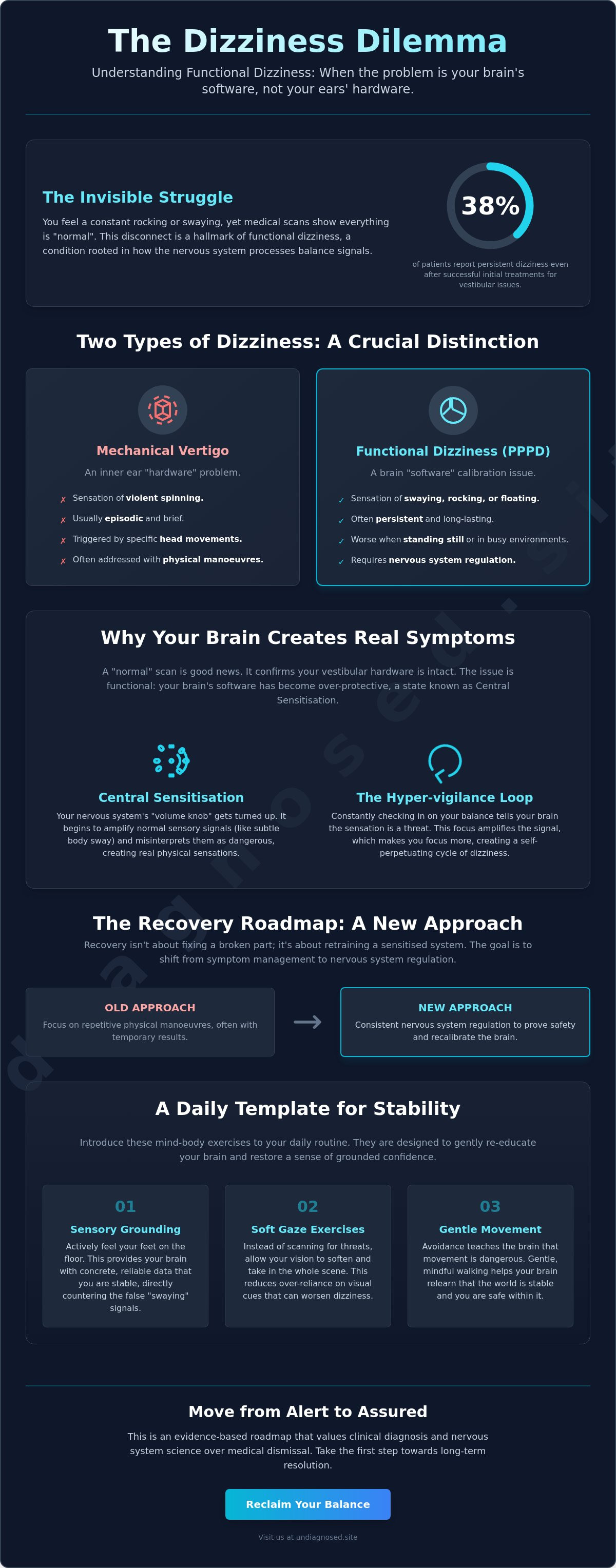
We understand that your symptoms are real even when they're invisible to an MRI. Data from 2026 suggests that nearly 38% of patients report persistent residual dizziness even after successful initial treatments for conditions like BPPV. This article provides a comprehensive, biopsychosocial approach to stabilising your balance by addressing the nervous system directly. You'll discover a structured daily routine designed to recalibrate your internal sensors and calm a hyper-aware brain. This is about evidence, not guesswork. It's about hope, not hype. We'll explore the practical tools you need to move from a state of constant alert to a place of grounded confidence.
Key Takeaways
- Distinguish between mechanical vertigo and functional dizziness to ensure you are utilising the correct recovery tools for your specific symptoms.
- Explore the neuroscience of central sensitisation and why a hyper-aware nervous system can create genuine sensations of rocking or swaying.
- Learn why managing dizziness at home requires a shift from repetitive physical maneuvers toward consistent nervous system regulation.
- Discover a structured mind-body template featuring sensory grounding and soft gaze exercises to restore a sense of safety and predictability.
- Move beyond temporary symptom management by following an evidence-based roadmap that values clinical diagnosis over medical dismissal.
Beyond the Spinning: Understanding Functional Dizziness at Home
Most medical advice for managing dizziness at home focuses almost exclusively on the inner ear. You're told about displaced crystals, viral infections, or inflammation. Whilst these are valid concerns for acute vertigo, they rarely explain the chronic, persistent swaying that lasts for months or years. If you feel like you're walking on a trampoline or standing on a boat in a calm harbour, you aren't experiencing a hardware failure in your ear. You're likely experiencing a software glitch in how your brain processes balance data.
Vertigo vs. Functional Dizziness
Vertigo is a specific, often violent sensation of spinning. It's usually episodic and linked to physical head movements. Functional dizziness is different. It's a persistent sense of unsteadiness, lightheadedness, or non-spinning swaying that often feels worse when you're standing still or in crowded environments. A key step in recovery is Understanding Functional Dizziness as a neurological state rather than a structural injury. Clinicians classify this as Persistent Postural-Perceptual Dizziness (PPPD). These symptoms are real physical experiences. They are not imaginary; they are the result of a nervous system that has become too loud, misinterpreting normal environmental signals as imminent threats.
Receiving a normal result from a neurologist or an ENT specialist can feel like a dismissal of your struggle. However, these results are a vital diagnostic marker. They confirm that your balance organs are healthy and intact. The issue lies in the calibration. Your brain has entered a state of hyper-vigilance. By constantly checking in on your balance, you're inadvertently telling your brain that the sensation is dangerous. This creates a feedback loop. The more you focus on the sway, the more the brain amplifies the signal to protect you from a perceived fall.
When the Brain Becomes Over-Protective
Your brain is a prediction engine. It uses a mix of visual data, inner ear signals, and sensations from your feet to keep you upright. When you experience an initial dizzy spell, the brain can become glitchy and start over-relying on visual cues. Many people try to cope by staying in bed or avoiding movement. This often backfires. Depriving your brain of movement data prevents it from relearning that the world is stable. Managing dizziness at home effectively requires you to gently reintroduce these signals to prove to your nervous system that you're safe. Recovery isn't about fixing a broken ear; it's about training the brain to stop over-protecting a healthy body.
The Neuroscience of Dizziness: Why Your Brain Creates Real Symptoms
Your brain is not a passive observer of your environment; it is an active architect of your physical reality. When standard medical tests fail to find a cause for your symptoms, it is often because the issue is not structural, but functional. Understanding the neuroscience of MUS (Medically Unexplained Symptoms) is the first step in reclaiming control. In the context of balance, this involves a process called central sensitisation. This is where your nervous system becomes "too loud," amplifying normal sensory input and misinterpreting subtle movements as signs of danger. Your brain has essentially turned up the volume on its internal balance monitors, making every minor shift feel like a seismic event.
For many, receiving an "all-clear" from a neurologist feels like the end of the road. In reality, it is the beginning of recovery. A normal MRI confirms that your vestibular hardware is intact, which allows us to focus entirely on the software. This is the biopsychosocial lens. It suggests that your dizziness is a convergence of biological signals, psychological state, and environmental triggers. Whilst mechanical issues might require The Home Epley Maneuver, functional symptoms require a strategy focused on nervous system regulation. Managing dizziness at home becomes a process of teaching the brain that these signals are safe, not threatening.
The Prediction Error Theory
The brain maintains balance by predicting what movement should feel like based on past experiences. If you suffered a past illness, such as a vestibular virus, your brain may have entered a state of high alert to protect you from falling. Even after the virus has cleared, the brain can remain "stuck" in this protective mode. It expects instability, so it creates the sensation of instability to keep you cautious. Recovery involves rewiring this connection by providing the brain with new, safe data through gentle movement. You are not repairing a broken ear; you are correcting a predictive error.
The Vagus Nerve and Balance
There is a profound connection between your autonomic nervous system and your vestibular nuclei. When you are in a "fight or flight" state, your brain prioritises survival over precision, which can significantly alter your perception of the ground beneath your feet. This explains why your dizziness often spikes during periods of high stress or in over-stimulating environments. To find lasting relief, you can explore our online course which details specific techniques for calming the nervous system. Within the biopsychosocial model, the vagus nerve acts as a critical modulator that determines how the vestibular nuclei interpret balance signals based on your current state of physiological safety or threat.
Comparing Home Treatments: Physical Maneuvers vs. Nervous System Regulation
When you begin managing dizziness at home, the most common advice involves mechanical fixes like the Epley or Brandt-Daroff maneuvers. These are designed to reposition displaced crystals within the inner ear. Whilst these techniques are highly effective for Benign Paroxysmal Positional Vertigo (BPPV), they offer little relief for functional dizziness. In fact, if your symptoms are driven by central sensitisation rather than ear crystals, repetitive maneuvers can lead to an "Epley hangover." This is a state of increased sensory distress and anxiety caused by over-stimulating a nervous system that is already on high alert. Recognising when to stop physical maneuvers is just as important as knowing when to start them.
Traditional home remedies for dizziness often focus on environmental safety, such as installing railings or improving lighting. These are vital for preventing falls, especially since May 2026 data shows that 18.9% of BPPV patients suffer a fall within seven years of their first episode. However, for long-term recovery from functional symptoms, you must address the brain's "gain control." This involves moving away from compensatory behaviours. When you grip furniture or stare at your feet whilst walking, you are sending a signal of danger to your brain. This prevents the brain from recalibrating its balance software and reinforces the sensation of instability.
Evaluating Mechanical Maneuvers
To determine if your symptoms require a physical or neurological approach, consider this checklist. Mechanical vertigo (BPPV) usually involves a violent spinning sensation triggered by specific head movements, such as rolling over in bed. It typically lasts less than a minute. Functional dizziness, conversely, feels like a constant rocking or swaying that worsens in supermarkets or when looking at screens. If maneuvers haven't provided relief after two or three attempts, it is time to consult a vestibular physiotherapist and pivot your strategy toward nervous system regulation.
The Shift to Cognitive and Sensory Tools
Recovery for chronic cases relies on calming the brain rather than fixing the ear. You can utilise mind-body balance tools to lower the intensity of your symptoms. Grounding techniques, such as feeling the weight of your body in a chair, help shift your focus from internal sensations to external reality. Additionally, incorporating breathing exercises for stress can lower your physiological arousal. This reduces the "noise" in your vestibular system, allowing your brain to process balance signals more accurately. By regulating your state, you provide the stability your brain needs to stop over-predicting threat.
The Mind-Body Recovery Template: A Daily Routine for Stability
Recovery from functional dizziness isn't found in a single maneuver but in the consistency of your environment. For a brain that feels fundamentally unsafe, structure is the antidote to chaos. Successfully managing dizziness at home requires a shift from reactive panic to proactive structure. By providing your nervous system with a predictable sequence of sensory inputs, you reduce the "surprise factor" that often triggers a spike in symptoms. This template isn't about avoiding life; it's about creating a foundation of safety from which you can re-engage with the world.
The Morning Stabilisation Routine
Start your recovery before your feet even touch the floor. Use "3-point grounding" by noticing the pressure of your back against the mattress, your hands on the duvet, and the weight of your head. This anchors the brain in somatosensory data rather than vestibular noise. Follow this with a "soft gaze" exercise; instead of staring intensely at a single object, allow your peripheral vision to widen. This reduces the visual over-reliance common in functional cases. Finally, perform a two-minute breathing exercise, focusing on a slow exhale to signal physiological safety to your brain before you begin your day.
Active Management Throughout the Day
When a spike occurs, use the "Stop, Drop, and Flow" technique. Instead of bracing against the sway, stop what you're doing, drop your shoulders, and allow the sensation to flow through you without resistance. This is about hope, not hype; it is a clinical method for retraining your brain. Organise your workspace to minimise visual triggers. This means using matte screen protectors to reduce glare and ensuring you aren't working under flickering fluorescent lights. Take "micro-breaks" every twenty minutes by closing your eyes for thirty seconds to give your vestibular system a rest. This structured approach to managing dizziness at home ensures your brain receives the constant, calming data it needs to heal. To build a personalised routine, enrol in the Mind and Body Connection online course for deeper insights into nervous system regulation.
Evening Restoration
As the day ends, you must "dump" the sensory load accumulated from screens and movement. Dim the lights and minimise noise to allow your system to down-regulate. Use progressive muscle relaxation to consciously release the "bracing" behaviour where you hold your neck and shoulders rigid to "steady" yourself. This physical tension actually feeds the brain's perception of threat and keeps the vestibular nuclei in a state of high alarm. Maintaining a consistent sleep and wake schedule is critical because it provides the rhythmic stability the brain needs to recalibrate its internal balance sensors.
Long-Term Resolution: Moving Beyond Symptom Management
Long-term recovery isn't just about coping with the sway; it's about extinguishing the neural pathways that create it. This is the essence of diagnosis, not dismissal. When you finally understand that your symptoms are a functional misfire rather than a structural injury, you stop providing the fear that fuels the fire. This fear is the primary driver of central sensitisation. By removing it, the sensation of instability begins to fade. Managing dizziness at home evolves from a daily struggle into a sophisticated process of neuroplastic retraining. You aren't just managing a condition; you are teaching your brain that the "danger" signal it's sending is a false alarm.
We provide hope, not hype. Neuroplasticity is a powerful biological reality, but it requires patience and grounded expectations. You won't wake up "fixed" overnight. Instead, the recovery is subtle. You'll notice the rocking feels quieter. You'll realise you haven't thought about your balance for an hour, then a morning, then an entire day. This is how the brain relearns stability. It's a methodical transition from "managing" symptoms to "extinguishing" the pathway entirely.
The Power of Education
Education acts as a clinical intervention. Understanding the mind-body connection changes your relationship with your physical symptoms. When you speak to your GP, frame your experience through the biopsychosocial lens. Explain that whilst your tests are normal, you are experiencing functional symptoms that require nervous system regulation. You can find a structured approach to this in our mind-body online course. This resource bridges the gap between clinical theory and daily practice, providing the roadmap needed for those with persistent symptoms.
Building Your Support System
As you progress, you must identify and dismantle "safety behaviours." These are the subtle habits, like clutching furniture or only walking near walls, that keep your brain in a state of high alert. Whilst self-help is a vital starting point, moving to a structured educational programme provides the clinical framework necessary for deep recovery. Our book, Undiagnosed: The Mind and Body Connection, serves as a grounded mentor through this transition. Managing dizziness at home is a journey of reclaiming your autonomy. Your brain is capable of relearning balance at any age; you simply need the right tools to guide it back to centre.
Reclaiming Your Internal Sense of Stability
Recovering from persistent dizziness requires a shift in perspective. You've learned that whilst mechanical maneuvers have their place, the long-term resolution for functional symptoms lies in nervous system regulation. By prioritising a structured routine and understanding the neuroscience behind your sensations, managing dizziness at home becomes a predictable, evidence-based process. This is about retraining a hyper-vigilant brain to trust the body once more. It is a journey of transition from a state of constant alert to a place of grounded confidence.
For those seeking a professional roadmap, we offer a path grounded in clinical science. Developed by Consultant Physician Dr. Csaba Dioszeghy, our programme utilises an evidence-based biopsychosocial methodology to address the root of your symptoms. It's designed for long-term recovery, not just temporary relief. We invite you to Explore the Undiagnosed Online Course for a structured recovery path and begin the work of recalibrating your balance system. Your brain possesses the remarkable ability to relearn stability; you simply need the right tools to guide it. You aren't broken; you're simply out of sync.
Frequently Asked Questions
Is it possible for dizziness to be caused by anxiety even if I do not feel anxious?
Yes, it is entirely possible to experience physical symptoms driven by the nervous system without feeling mentally anxious. This often occurs when your brain remains in a state of high alert following an initial illness or period of stress. Your system becomes hyper-vigilant; even if you feel emotionally calm, your subconscious continues to scan for threats, creating the physical sensation of swaying or rocking through the autonomic nervous system.
How long does it take for functional dizziness to go away with home management?
Recovery time varies based on the duration of your symptoms and the consistency of your regulation practice. Many individuals begin to notice a reduction in the intensity of their symptoms within six to twelve weeks of following a structured mind-body template. Managing dizziness at home is a process of neuroplastic retraining, which requires steady, daily repetition rather than a quick-fix approach to extinguishing sensitised neural pathways.
Can I drive whilst I am managing chronic dizziness at home?
You must only drive if you feel safe and in control of your vehicle. In the UK, the DVLA requires you to stop driving if your dizziness is sudden, disabling, or likely to cause an accident. If your dizziness is functional and persistent but does not impair your ability to react or stay focused, you may often continue driving; however, you should always consult a clinician for a formal safety assessment to ensure you meet legal requirements.
Why does my dizziness feel worse in supermarkets or busy environments?
Supermarkets are high-stimulation environments that often trigger visual vertigo or sensory overload. Your brain receives too much conflicting data from flickering lights, moving trolleys, and patterned floors, causing it to over-rely on vision for balance. This mismatch between visual input and your inner ear signals creates a spike in dizziness as your nervous system struggles to filter out the unnecessary environmental noise.
What should I do if the Epley maneuver makes my dizziness worse?
If the Epley maneuver increases your distress without resolving the spinning, you should stop performing it immediately. Whilst effective for BPPV, these maneuvers can over-stimulate a sensitised nervous system if your dizziness is functional rather than mechanical. An "Epley hangover" often indicates that your brain needs sensory grounding and calming rather than further physical repositioning of inner ear crystals.
Can neck tension cause the sensation of being off-balance?
Neck tension is a frequent contributor to the sensation of being off-balance. When you feel dizzy, you naturally "brace" your neck and shoulders to keep your head still. This chronic muscle tension sends confusing signals to the brain about your head position. This creates a feedback loop where the body's attempt to steady itself actually increases the feeling of instability by providing the brain with distorted somatosensory data.
Is there a specific diet that helps with medically unexplained dizziness?
There is no specific diet that cures functional dizziness, but maintaining physiological stability is vital for nervous system regulation. Focusing on consistent hydration and avoiding large spikes in caffeine or sugar can help keep your system regulated. A stable internal environment prevents the minor physiological shifts that a hyper-vigilant brain might misinterpret as a sign of imminent loss of control.
How do I know if my dizziness is serious enough for an A&E visit?
You should seek immediate medical attention at A&E if your dizziness is accompanied by "red flag" symptoms. These include sudden double vision, slurred speech, facial drooping, or new weakness in your arms or legs. Whilst managing dizziness at home is effective for chronic, functional symptoms, sudden and severe neurological changes require urgent clinical evaluation to rule out acute issues such as a stroke or other cardiovascular events.