
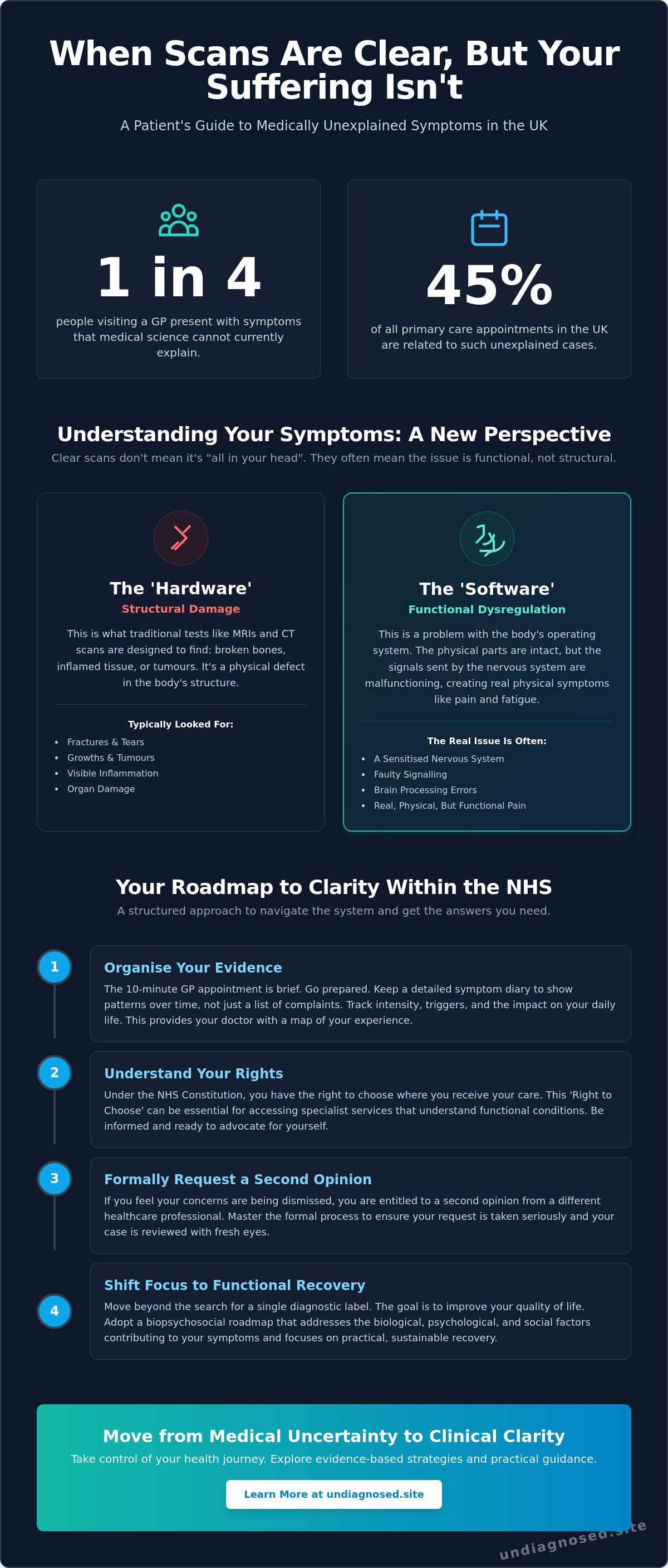
Approximately 1 in 4 people who visit a GP in the UK present with physical symptoms that medical science cannot currently explain. These cases account for up to 45% of all primary care appointments; they represent a significant portion of healthcare yet often receive the least clarity. If your scans are clear but your suffering is constant, you are likely searching for what to do when doctors can't find what's wrong uk. It's a heavy burden to carry the relief of a "normal" test result alongside the quiet terror that a serious illness has been overlooked. You aren't imagining your symptoms, and you aren't alone in your frustration.
We understand that being told "nothing is wrong" doesn't stop the pain from being real. This guide provides a logical framework to help you move from medical uncertainty to clinical clarity. You'll learn how to navigate the NHS constitution to secure second opinions, understand the vital distinction between structural damage and nervous system dysregulation, and discover self-help tools to reclaim your quality of life. By shifting the focus from finding a broken hardware part to optimising your internal software, you can finally begin the journey toward genuine recovery and lasting relief.
Key Takeaways
- Discover the definitive clinical and administrative steps for what to do when doctors can't find what's wrong uk, including how to exercise your 'Right to Choose'.
- Differentiate between structural pathology and functional dysregulation to understand how debilitating symptoms can exist even when medical hardware appears intact.
- Master the formal process for securing a second opinion within the NHS to ensure your concerns are met with thorough investigation rather than dismissal.
- Explore evidence-based self-regulation strategies designed to stabilise a sensitised nervous system and provide relief from persistent physical distress.
- Adopt a biopsychosocial roadmap that shifts the focus from an elusive diagnostic label toward a practical, sustainable path to functional recovery.
Navigating the Paradox of 'Normal' Test Results in the UK
Receiving a "normal" test result should be a moment of relief. For many patients in the UK, however, it feels like a door closing. You know your body is struggling, yet the clinical data suggests everything is fine. This disconnect creates a state of "diagnosis limbo" that is as exhausting as the symptoms themselves. It's a common experience within the NHS, where the search for a visible cause often overlooks the reality of invisible distress. When you are stuck in this cycle, knowing what to do when doctors can't find what's wrong uk begins with understanding that a lack of evidence is not evidence of absence.
The medical system is traditionally built to identify structural damage. It looks for the broken bone, the inflamed tissue, or the malignant growth. This approach is vital for acute care, but it often fails those with Medically unexplained physical symptoms. Standard tests rule out what is "broken" but rarely investigate what is "malfunctioning". You aren't imagining your pain; you're simply experiencing a functional issue that a structural test cannot see. This realisation is the first step toward reclaiming your health.
The Limits of Modern Medical Imaging
Think of your body in terms of hardware and software. An MRI or a CT scan is a high-resolution photograph of the hardware. It can show if a part is missing or damaged, but it cannot show how the electricity is flowing through the circuits. Most chronic, unexplained symptoms in the UK are software issues. They are processing errors in the nervous system rather than physical defects in the organs. Clear scans do not equal an absence of symptoms; they simply confirm that the physical structure remains intact whilst the internal signalling has gone awry.
Communicating Effectively with Your GP
The standard 10-minute GP consultation isn't designed for complexity. To get the most out of your appointment, you must move beyond a simple list of complaints. Keep a detailed symptom diary that tracks not just the intensity of your pain, but the specific triggers and the impact on your daily life. This provides your doctor with a map of your experience rather than a snapshot of a single moment. By presenting patterns instead of isolated incidents, you help your GP see the functional nature of your condition. For more guidance on this, read our advice on How to Talk to Your Doctor About Functional Symptoms. Understanding what to do when doctors can't find what's wrong uk requires you to become an active partner in the diagnostic process, shifting the focus from "what is it?" to "how do we fix the function?".
Understanding Functional Symptoms: When the Software is the Issue
The medical term for symptoms that persist despite normal test results is Medically Unexplained Symptoms (MUS). In the UK, this is a formal clinical classification, not a polite way of saying the doctor is stumped. It describes a state where the body's hardware—the organs, bones, and tissues—is structurally sound, but the software—the way the nervous system processes signals—is malfunctioning. This distinction is vital. If you are searching for what to do when doctors can't find what's wrong uk, you must first accept that your pain is physical, even if the cause is functional. You are experiencing a real physiological event, not a psychological invention.
Traditional medicine often looks for structural pathology, such as a tumour or a fracture. Functional dysregulation, however, is a matter of faulty signalling. The nervous system becomes "sensitised", meaning it lowers its threshold for detecting threat. In this state, normal bodily sensations are amplified and interpreted by the brain as intense pain or distress. This isn't "all in your head"; it is a measurable change in how your nerves and brain communicate. Current NHS guidance on unexplained symptoms acknowledges that these conditions are common and require a different management strategy than typical structural diseases.
The Neuroscience of Medically Unexplained Symptoms
The brain acts as the command centre for every sensation you feel. It doesn't just passively receive signals; it actively predicts them. When the brain is exposed to prolonged stress or past trauma, it can become hyper-vigilant, creating "protective" symptoms to alert you to perceived danger. This predictive processing can lock the body into a cycle of chronic pain or fatigue. Understanding The Neuroscience of MUS: Why Your Brain Creates Real Symptoms helps bridge the gap between your internal experience and clinical reality, moving you closer to a solution.
Common Functional Symptoms and Their Patterns
Functional symptoms rarely stay static. They often fluctuate, intensifying during periods of emotional fatigue and receding when the nervous system feels safe. Common markers include:
- Chronic Dizziness: A persistent sense of unsteadiness without a vestibular cause.
- Widespread Pain: Aching or burning sensations that migrate across different muscle groups.
- Profound Fatigue: Exhaustion that isn't resolved by sleep and feels disproportionate to activity.
These patterns highlight the profound mind and body connection that dictates our health outcomes. Recognising these fluctuations is a core part of knowing what to do when doctors can't find what's wrong uk. If you feel ready to explore the deeper mechanics of this connection, the book Undiagnosed: The Mind and Body Connection provides a comprehensive framework for navigating this complex internal landscape.
Your Rights and Next Steps Within the NHS
Navigating the NHS can feel like an administrative maze when you are already physically drained. Knowing what to do when doctors can't find what's wrong uk involves understanding your rights as a patient under the NHS Constitution. You are not a passive recipient of care; you are an active participant in your recovery journey. When standard tests fail to provide a label, the system's "wait and see" approach can feel like neglect, but you have specific levers to pull to ensure your care continues to move forward.
Whilst you don't have a legal right to a second opinion, GPs generally recognise that a fresh perspective can be clinically beneficial. If you feel your current doctor has reached a diagnostic dead end, ask for a review by another GP within the practice or a different specialist. In England, the "Right to Choose" is a powerful tool that allows you to select which consultant-led team or hospital provides your specialist care. This can be vital if local waiting lists are prohibitive or if you require a centre with specific expertise in functional disorders. If communication breaks down, the Patient Advice and Liaison Service (PALS) acts as a mediator to resolve issues without the need for a formal complaint.
There comes a point where the search for a new label becomes counterproductive. Transitioning from "seeking a diagnosis" to "managing symptoms" isn't giving up. It's a strategic shift toward the NHS guide to medically unexplained symptoms, which focuses on functional improvement rather than structural perfection. This shift allows you to stop waiting for a cure and start building a recovery.
Requesting a Specialist Referral
When asking for a referral to a neurologist or a pain management clinic, focus on your functional limitations. Use clear, objective language: "My symptoms are preventing me from working" or "I need a specialist review to explore the biopsychosocial factors of my condition." This approach aligns with modern UK pain clinics that look at the interplay of biological, psychological, and social influences on health. It moves the conversation from "what is it?" to "how do I function?".
Accessing Medical Records and Test Results
Under UK law, you have a right to access your medical records. Reviewing your own data can provide peace of mind or highlight patterns that were previously overlooked. Bringing a trusted advocate to your appointments ensures that you don't miss critical information during moments of stress. Knowledge is a stabilising force; it replaces fear with facts. By understanding your own history, you can better articulate what to do when doctors can't find what's wrong uk during future consultations.
Evidence-Based Strategies for Managing Symptoms at Home
Waiting for an NHS specialist can feel like being in a holding pattern. However, the period between appointments is an opportunity to move from a state of passive waiting to active self-regulation. When you are determining what to do when doctors can't find what's wrong uk, the most impactful steps often happen within your own home. By learning to calm a sensitised nervous system, you can reduce the volume of the signals your brain is sending, regardless of whether you have a formal diagnosis yet.
A common pitfall for those with functional symptoms is the "boom and bust" cycle. On days when symptoms feel manageable, there is a temptation to overexert to make up for lost time. This "boom" is almost inevitably followed by a "bust" as the nervous system reacts to the sudden surge in activity. Pacing is the antidote to this cycle. By organising your daily routine into sustainable blocks of activity and rest, you signal to your brain that the body is safe and predictable. This consistency helps lower the overall threat response over time.
Breathing and Vagus Nerve Regulation
The vagus nerve acts as the primary "brake" for your nervous system. When it is stimulated, it triggers the parasympathetic response, which counters the "fight or flight" state. Box breathing is a simple, evidence-based tool to achieve this. Inhale for a count of four; hold for four; exhale for four; and hold for four. Repeating this for just five minutes can lower your physiological arousal and dampen chronic pain signals. For a wider selection of techniques, you can explore our Mind-Body Balance Tools: A Roundup for Functional Symptom Recovery.
Sleep Strategies for the Mind-Body Connection
Restorative sleep is the foundation of nervous system health. Without it, "central sensitisation" remains high. This is the process where the brain becomes over-responsive to stimuli, making pain feel more intense. Creating a "sleep sanctuary" involves more than just a dark room; it requires a mental off-switch. If you struggle with night-time anxiety about your unexplained symptoms, try "scheduled worrying" earlier in the day. By giving your concerns a dedicated time slot, you prevent them from hijacking your rest. Stabilising your sleep is a critical part of what to do when doctors can't find what's wrong uk, as it allows the brain to repair its signalling pathways.
To deepen your understanding of these mechanisms and start your own journey toward relief, you can enrol in The Mind and Body Connection Online Course to build a personalised recovery plan.
The Biopsychosocial Roadmap: Moving Beyond the Search for a Label
The traditional medical journey is often viewed as a linear path: symptoms lead to tests, tests lead to a label, and a label leads to a cure. For many in the UK, however, this path breaks at the testing stage. It's vital to realise that a formal diagnosis isn't always a prerequisite for recovery to begin. The biopsychosocial model is the modern gold standard for managing complex health, as it looks beyond the search for a broken part. It examines the biological signals, the psychological state, and the social environment as one interconnected system. When you are deciding what to do when doctors can't find what's wrong uk, moving beyond the biomedical search for a "disease" is the most decisive step you can take toward health.
Recovery is less about finding a name for your suffering and more about understanding the mechanism behind it. By shifting your focus from structural pathology to functional dysregulation, you stop being a passive victim of an unknown illness. You become an active participant in your own nervous system regulation. This shift doesn't dismiss your pain; it validates it by providing a scientific framework that standard blood tests simply cannot capture. Education is the tool that facilitates this transition, acting as a catalyst for neurological change.
Why Education is the First Step in FND Treatment
The brain is a prediction machine that thrives on certainty. If it perceives a physical threat it doesn't understand, it maintains a state of high arousal, which in turn amplifies your symptoms. Understanding the "why" behind your physical sensations is therapeutic in itself. When you learn how the nervous system creates functional symptoms, the brain's threat response naturally lowers. Validation is the foundation of this process. Dr. Csaba Dioszeghy’s work bridges the gap for patients by translating complex neurological theories into a clinical roadmap that respects the individual's experience whilst offering a clear path to recovery.
Taking Control of Your Recovery Journey
Fragmented internet searches often lead to fear rather than clarity. A structured educational program replaces this confusion with a logical sequence of discovery. It moves you from a state of being "undiagnosed" to being "informed". The book Undiagnosed: The Mind and Body Connection provides this clinical yet compassionate guide, offering a roadmap for those whom traditional scans have failed. It isn't about ignoring your symptoms; it's about reinterpreting them through a lens of evidence-based optimism. Taking control means choosing to focus on function over pathology, marking the end of the diagnostic loop and the beginning of the recovery arc.
If you are ready to stop the search for a label and start the work of rewiring your system, the resources are available to guide you. You can Explore the Mind and Body Connection Online Course to begin your transition from medical uncertainty to functional health. Knowing what to do when doctors can't find what's wrong uk starts with the decision to lead your own recovery.
Reclaiming Your Health Beyond the Diagnosis
The transition from medical uncertainty to functional recovery requires a fundamental shift in perspective. You've moved from the frustration of clear scans to an understanding of nervous system dysregulation; you've progressed from seeking a label to securing your rights within the NHS. Knowing what to do when doctors can't find what's wrong uk means accepting that while your hardware is intact, your internal software requires recalibration. This isn't a journey you have to navigate through fragmented internet searches or clinical isolation.
True progress begins with an evidence-based framework that respects your physical reality. Written by a Consultant Physician with years of NHS experience, the "Undiagnosed" curriculum is designed specifically for those whose tests are normal but whose symptoms persist. It offers a structured, clinical roadmap to rewiring the mind and body connection. You can start your recovery journey with 'Undiagnosed: The Mind and Body Connection' by Dr. Csaba Dioszeghy and move beyond the search for a name toward the reality of relief. Your path to recovery is no longer hidden; it's simply waiting for you to take the first step with confidence and clarity.
Frequently Asked Questions
Is it possible for my symptoms to be 'all in my head'?
Symptoms are never 'all in your head'; they are physiological events occurring in the body. Whilst your tests may be clear, the pain or dizziness you feel is the result of real signalling errors within the nervous system. This is a functional issue where the brain misinterprets normal bodily sensations as threats, creating a very real physical experience that requires a clinical rather than a psychological solution.
Can I get a second opinion on the NHS if my tests are normal?
You can request a second opinion on the NHS, although it is not a guaranteed legal right. Most GPs understand the value of a fresh perspective when symptoms persist without a clear cause. You may ask to see a different doctor at your current practice or request a referral to a specialist in another hospital via the 'Right to Choose' framework to ensure your case is reviewed thoroughly.
What is Functional Neurological Disorder (FND) and could I have it?
Functional Neurological Disorder (FND) is a condition where the brain's 'software' fails to send or receive signals correctly. It affects an estimated 50,000 to 100,000 people in the UK and is the second most common reason for neurology appointments. If your physical structure is intact but your body isn't functioning correctly, FND is a clinical possibility that should be explored with a specialist neurologist.
How long does it typically take to get a diagnosis for unexplained symptoms in the UK?
The diagnostic timeline for unexplained symptoms in the UK is often prolonged, sometimes spanning several months or even years. This delay is frequently due to the 'wait and see' culture and extensive NHS waiting lists. Understanding what to do when doctors can't find what's wrong uk helps you navigate this period by focusing on symptom management and self-regulation whilst waiting for specialist reviews.
What should I do if my GP refuses to refer me to a specialist?
If a referral is refused, you should politely ask the GP to document the refusal and the specific reasoning in your medical records. This often encourages a more thorough review of your case. Alternatively, you can seek a second opinion from another GP in the same practice or contact the Patient Advice and Liaison Service (PALS) to help mediate the situation and protect your rights.
Why does stress make my physical symptoms feel so much worse?
Stress acts as a volume dial for your physical symptoms by increasing the 'threat response' in your brain. When you are stressed, your nervous system becomes hyper-vigilant and sensitised. This means that signals which might usually be ignored are instead amplified into intense pain, fatigue, or dizziness, creating a feedback loop between your emotional state and your physical health.
Can breathing exercises really help with physical pain and dizziness?
Controlled breathing exercises are highly effective because they stimulate the vagus nerve to lower your body's physiological arousal. By slowing your breath, you send a physical signal to the brain that the body is safe. This can reduce the intensity of dizziness and chronic pain by calming the overactive signalling pathways that create functional symptoms, providing a practical tool for what to do when doctors can't find what's wrong uk.
What is the biopsychosocial approach to medicine?
The biopsychosocial approach is a medical model that views health as an interplay between biology, psychology, and social environment. Rather than searching for a single 'broken part', this gold-standard approach looks at how stress, past experiences, and physical health combine to create your symptoms. It provides a comprehensive roadmap for recovery when a traditional biomedical label is missing or inadequate.