
What if a "normal" test result isn't the conclusion of your medical journey, but simply a sign that the right questions haven't been asked yet? When you're living with persistent, unexplained symptoms, being told there's "nothing wrong" can feel like a dismissal of your lived reality. It's a common frustration in a system where, as of March 2026, over 7.11 million people are waiting for consultant-led care. Learning how to get a second opinion on the NHS is not about challenging your doctor's integrity. It's about prioritising your health through a collaborative, evidence-based approach.
You deserve a pathway that respects both clinical science and your personal experience. This guide provides a clear roadmap to help you manage the referral process, from utilising Martha's Rule in hospital settings to requesting a new specialist through your GP. We'll provide the practical communication tools needed to turn a brief appointment into a meaningful partnership. You'll discover how to advocate for yourself with quiet confidence, ensuring your symptoms are investigated rather than ignored as you seek a resolution that honours your physical truth.
Key Takeaways
- Understand the distinction between legal entitlement and clinical guidelines to navigate the NHS system with clarity rather than confusion.
- Discover exactly how to get a second opinion on the NHS by following a structured referral pathway through your GP or current specialist.
- Reframe "normal" test results as an invitation to explore a biopsychosocial model that honours your physical experience whilst seeking deeper answers.
- Master the art of the consultation by creating a chronological symptom diary that transforms vague concerns into clinical evidence.
- Transition from diagnosis to recovery by integrating medical reviews with practical tools designed to address the mind-body connection.
Navigating Your Rights: Do You Have a Legal Entitlement to a Second Opinion?
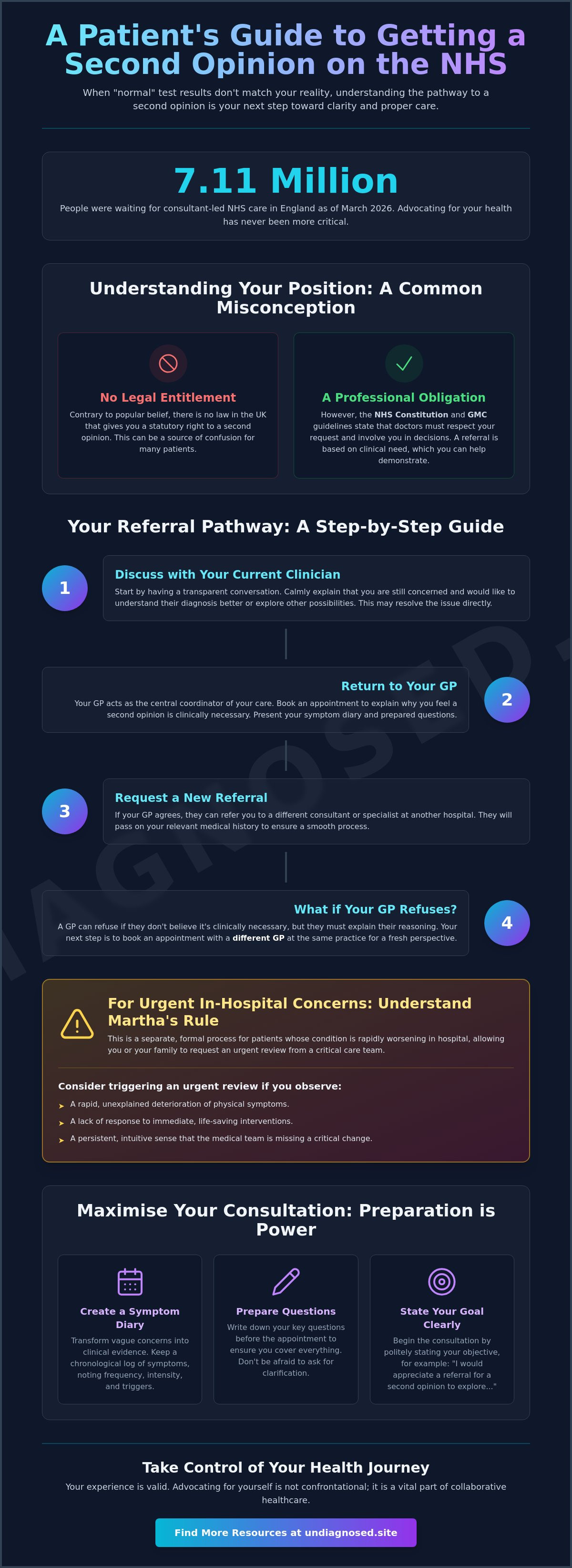
Clarity often begins where confusion ends. Many patients believe they possess a statutory legal right to a second opinion; however, the reality is more nuanced. While no such law exists in the UK, the professional framework of British healthcare is designed to support your autonomy. Understanding how to get a second opinion on the NHS starts with knowing the difference between a legal entitlement and a professional obligation. You don't have a "right" in the way you have a right to emergency care, but you do have a powerful set of guidelines that clinicians are expected to follow.
The NHS Constitution for England establishes the principle that you should be involved in all decisions about your healthcare. This involvement includes the opportunity to seek further perspective when a diagnosis feels incomplete or a treatment plan seems ineffective. If you feel your concerns are being overlooked, you aren't fighting against the system; you're simply asking the system to uphold its own standards of patient-centred care.
The General Medical Council (GMC) and Patient Choice
The General Medical Council (GMC) sets the professional standards for every doctor in the UK. Their guidance is explicit: doctors must respect a patient's request for a second opinion. It isn't a personal slight against the clinician's expertise; it's a recognition that medical science is a collaborative process. Clinical necessity acts as the primary driver for NHS referrals, ensuring that resources are directed where they can provide the most significant diagnostic or therapeutic benefit. Whilst a GP can technically refuse a referral if they believe there's no clinical reason for it, they must still act with integrity and explain their reasoning clearly.
Martha’s Rule: A New Era of Patient Advocacy
By 2026, the implementation of Martha’s Rule has fundamentally shifted the power dynamic in hospital settings. This initiative, which completed its rollout across all acute inpatient settings during the 2026/27 period, provides a formal mechanism for patients and families to escalate concerns. It's designed for acute situations where a patient's condition is visibly deteriorating, providing a rapid review by a critical care team. It's a vital safety net for those moments when you feel the current clinical path is failing.
It's vital to distinguish between an urgent review and a standard second opinion for chronic conditions. You might consider triggering an urgent review under Martha’s Rule if you observe:
- A rapid or unexplained worsening of physical symptoms whilst in hospital.
- A lack of response to immediate, life-saving interventions.
- A persistent, intuitive sense that the current medical team is missing a critical change in status.
For chronic or unexplained symptoms like persistent pain or fatigue, the process is slower but equally valid. If your GP refuses a referral, your next step isn't to give up; it's to seek a consultation with a different GP within the same practice to gain a fresh perspective on your clinical necessity.
The Referral Process: How to Organise a Second Opinion via Your GP or Consultant
The transition from clinical uncertainty to diagnostic clarity requires a methodical approach. Whilst you may feel hesitant to question a specialist's verdict, the process for how to get a second opinion on the NHS is a standard administrative pathway. It begins with a transparent conversation with your current clinician. If their explanation remains unsatisfactory, the next logical step is to return to your GP, who acts as the primary coordinator of your care. They can facilitate a new referral, ensuring your medical history is contextualised for a fresh pair of eyes.
Requesting a Referral from Your GP
Your GP is the gatekeeper of secondary care. They possess the authority to refer you to a different specialist if they agree that a second perspective is clinically necessary. If your relationship with your current GP is the source of your frustration, you're entitled to book an appointment with a different doctor within the same practice. When requesting this, be specific. Ask for a referral to a consultant with a particular sub-speciality interest in your symptoms. This targeted approach ensures the next consultation is more than just a repeat of the first; it's an escalation of expertise.
Internal vs. External Referrals
An internal referral involves seeing a different consultant within the same hospital. This is often faster because your records and scans are already on the local system. However, an external referral to a different NHS Trust offers a truly blank slate, free from the previous team's institutional biases. Under the "Right to Choose" legislation, you can often select which hospital you're referred to, provided they offer the required service. This choice is a powerful tool for patients seeking a specialist centre that may have more experience with rare or complex presentations.
Managing your medical records is a critical part of this journey. Your previous scans, blood tests, and clinical notes are usually shared electronically between departments. This prevents unnecessary duplication of tests, though a new consultant may still order fresh investigations to capture a current snapshot of your health. Understanding the physiological drivers behind your symptoms is often the first step in regaining control, as explored in the Mind and Body Connection Online Course.
Finally, consider the impact on waiting times. As of March 2026, the median waiting time to start treatment was 11.3 weeks. Whilst the NHS met its target of treating 65.3% of patients within 18 weeks in early 2026, a second opinion effectively resets your position in the queue for that specific pathway. You aren't "jumping" the list, but you are ensuring that when you do reach the front, you're receiving the correct treatment for the right diagnosis.
Seeking Clarity Amongst Uncertainty: When "Normal" Tests Require a New Perspective
Living with chronic pain, dizziness, or fatigue whilst being told your results are "normal" is a uniquely isolating experience. It creates a rift between your physical reality and the clinical data on the screen. When standard investigations fail to yield a structural cause, the traditional medical response often reaches a stalemate. However, a clear scan isn't a sign that your symptoms are imaginary; it's often an indication that the diagnostic lens is too narrow. A constructive second opinion shouldn't merely repeat the same scans. Instead, it should pivot towards a biopsychosocial model that examines the interplay between biology, psychology, and social factors.
This framework acknowledges medically unexplained symptoms (MUS) as a valid clinical challenge rather than a dead end. Understanding the process for seeking a second opinion allows you to request a specialist who views your health through this broader, more compassionate lens. If your current clinician has reached the limit of their expertise, seeking a fresh perspective is a logical step in your diagnostic journey. Learning how to get a second opinion on the NHS for these "invisible" conditions requires moving beyond the hunt for a broken part and looking at the system as a whole.
The "Normal Test" Paradox
A clear MRI or blood panel doesn't mean your body is functioning correctly. In many cases of persistent pain, the issue isn't structural damage but a software glitch in the nervous system. The neuroscience of MUS reveals that the brain can generate very real physical pain even in the absence of tissue injury. Central sensitisation acts as a key factor in chronic functional symptoms, where the nervous system remains in a state of high reactivity, amplifying signals that the brain interprets as pain. You aren't imagining the sensation; your brain is simply processing data through a sensitised filter.
Choosing the Right Specialist for Functional Health
Finding the right consultant is vital when your symptoms don't fit a standard diagnostic box. Look for specialists who work within multidisciplinary teams (MDTs), as they often collaborate with physiotherapists and psychologists to provide integrated care. A second opinion from a specialist in functional neurological disorder (FND) might provide the missing link you've been searching for. These clinicians are trained to recognise that whilst the hardware of the body is intact, the software communication between the brain and body requires recalibration. Identifying a consultant who prioritises this holistic approach can be the turning point in your recovery.
Maximising the Consultation: How to Prepare Your Case for a Secondary Review
Preparation is the bridge between feeling dismissed and being heard. A secondary review is a finite window of time where your preparation dictates the depth of the diagnostic outcome. When you understand how to get a second opinion on the NHS, you realise the consultation is your opportunity to present your case with clinical precision. It isn't just an appointment; it's a structured presentation of your lived experience. By arriving with a clear agenda, you move from a passive recipient of care to an active partner in your recovery.
Start by creating a chronological symptom diary. Track your triggers, the frequency of flares, and the specific nature of the sensations you feel. This data transforms vague complaints into a measurable pattern that a consultant can analyse. Pair this with a clear statement of your goals. Are you seeking a definitive new diagnosis, a different treatment plan, or simply a better explanation for your "normal" results? Bring a trusted friend or family member to act as an advocate. They can take notes whilst you focus on the conversation, ensuring you don't miss key details under the pressure of the clinical environment.
The Patient Advocacy Script
Opening the conversation with a new consultant requires a balance of respect and assertiveness. Use this three-sentence template to set the tone: "I am here because my current treatment hasn't resolved my symptoms, and I'm seeking a fresh clinical perspective. My daily behaviour is significantly restricted by these physical sensations, and I want to understand the underlying drivers. I'm looking for a collaborative approach to explore all possible causes, including functional ones." Focus on "I" statements that describe the impact on your quality of life. Instead of saying the pain is severe, explain that the pain prevents you from sleeping more than four hours a night. This anchors your experience in observable reality.
Organising Your Medical History
Summarise your previous treatments on a single page. List the medications you've tried, the dosages, and the specific reasons they were discontinued. A one-page summary of your current medications and their effects is an invaluable tool for a busy specialist. Be honest about your own research and your interest in the mind-body connection. A confident clinician values an informed patient who is willing to look beyond superficial solutions. For a deeper framework on how to structure your clinical history and advocate for your health, the book Undiagnosed: The Mind and Body Connection provides practical tools for this very purpose. Your history is the map; your honesty is the compass that leads to a more accurate destination.
From Diagnosis to Recovery: Integrating the Mind-Body Connection into Your Care Plan
A second opinion is often perceived as a final verdict. In reality, it is the threshold of a new treatment journey. Once you have navigated how to get a second opinion on the NHS, the focus must shift from the validation of symptoms to the activation of recovery. This transition requires a move from a "search for a cause" mindset to an "active recovery" strategy. It is the moment where clinical discovery meets personal application. Dr. Csaba Dioszeghy’s work has been instrumental in this space, bridging the gap between complex neuroscience and practical clinical practice to help patients understand that their bodies are not broken, even whilst they remain sensitised.
Effective recovery is not a passive event that happens to you. It is an intentional process you lead. By integrating mind-body balance tools into your daily routine, you create a secondary layer of support that works alongside your medical treatment. These tools are designed to lower the baseline of your nervous system's reactivity, providing a stabilizing influence whilst you work through the NHS referral pathway. Recovery is rarely a straight line, but with the right framework, it becomes a predictable progression rather than a series of random events.
Moving Beyond the Medical Label
A diagnosis is a map, not a destination. It is only helpful if it leads to actionable recovery strategies that improve your quality of life. Education plays a vital role in this process; understanding why your body creates symptoms is the first step in desensitising a hyper-reactive nervous system. When you use biopsychosocial resources alongside your NHS care, you address the internal environment that allows symptoms to persist. You aren't just treating a condition; you're recalibrating your entire physical and emotional response system.
Practical Next Steps for Self-Management
The concept of neuroplasticity offers a realistic foundation for optimism. It proves that the brain and nervous system possess the inherent ability to reorganise and heal. This isn't a miracle; it is a biological reality. To support this clinical process, you must move from being a seeker of answers to a practitioner of health. The book Undiagnosed: The Mind and Body Connection provides the intellectual rigour needed to understand this shift, whilst our structured online course offers the practical application required for long-term change.
Your journey doesn't have to end with a "normal" test result or a frustrating consultation. You have the tools to advocate for yourself within the system and the resources to support your body outside of it. Explore our Mind and Body Connection course to take control of your recovery today.
Reclaiming Your Health Through Informed Advocacy
Mastering how to get a second opinion on the NHS is the first step in moving from clinical stagnation to diagnostic discovery. You've learned that your rights are supported by professional standards and that a "normal" test result is often an invitation to look deeper into the mind-body connection rather than a reason to stop searching. By preparing your case with precision and focusing on a biopsychosocial approach, you transform a brief medical consultation into a meaningful partnership for recovery.
Whilst the NHS provides the framework, your recovery requires a deeper understanding of the science behind persistent symptoms. To bridge the gap between clinical theory and physical reality, Download the "Undiagnosed" Book to Understand the Science Behind Your Symptoms. Written by Consultant Physician Dr. Csaba Dioszeghy, this resource utilises the latest evidence in neuroscience to provide practical tools for managing symptoms when tests are normal. You don't have to navigate this uncertainty alone. With the right insights and a structured plan, you can shift your focus from simply seeking a label to actively regaining your quality of life. Your symptoms are real, and your path to recovery is ready to be explored.
Frequently Asked Questions
Do I have a legal right to a second opinion on the NHS in 2026?
You don't have a legal right to a second opinion on the NHS, but GMC guidelines require doctors to respect your request. Understanding how to get a second opinion on the NHS starts with recognising it as a professional obligation rather than a statutory right. Most clinicians will facilitate the process to ensure you feel confident in your care plan and understand your diagnostic journey.
Will asking for a second opinion make my original doctor angry or offended?
Requesting a second opinion is a standard professional procedure and shouldn't offend your doctor. Clinicians understand that medical science is complex and that a fresh perspective can often clarify a difficult or unexplained diagnosis. Approaching the conversation with transparency helps maintain a collaborative relationship focused on your long-term well-being and clinical progress.
How long is the waiting list for an NHS second opinion?
In March 2026, the median waiting time for treatment was 11.3 weeks. Whilst the NHS met its 18-week target for 65.3% of patients that month, your specific wait will depend on the urgency of your condition and the specialist required. Seeking a second opinion effectively starts a new referral process, meaning you'll join the queue at the point of the new request.
Can I get a second opinion from a private doctor and then return to the NHS?
You can choose to see a private consultant for a second opinion and then return to the NHS for ongoing treatment. This is a common route for those looking to bypass long waiting lists for a specific consultation. You'll need to ensure your private consultant provides a detailed report to your GP so your NHS records can be updated with the new findings.
What happens if the second doctor gives the same diagnosis as the first?
If a second doctor provides the same diagnosis, it offers a powerful form of clinical validation. Whilst it might feel frustrating if you were hoping for a different answer, it confirms that the current path is evidence-based. This clarity allows you to stop searching for a cause and start focusing on active management and mind-body recovery strategies instead.
Can my family or carer request a second opinion on my behalf?
A family member or carer can request a second opinion on your behalf, but they must have your explicit consent. If you're unable to provide consent due to a lack of mental capacity, the request must be made by someone with the legal authority to do so, such as a Power of Attorney. This ensures your medical autonomy is respected whilst allowing advocates to support you.
What is Martha’s Rule and how does it help me get a second opinion?
Martha’s Rule is a patient safety initiative providing the right to request a rapid review from a critical care team if a patient's condition worsens in hospital. The rollout to all acute inpatient settings is expected to be complete during 2026/27. It provides an urgent avenue for a second opinion in life-critical situations where time is of the essence and families feel unheard.
What should I do if my GP refuses to refer me for a second opinion?
If your GP refuses a referral, your first step is to book an appointment with a different doctor within the same practice. You can also contact the Patient Advice and Liaison Service (PALS) for support in navigating the system. Learning how to get a second opinion on the NHS involves knowing that you can advocate for yourself through administrative channels if necessary.