
What if the reason you're feeling dismissed by my GP isn't because your symptoms are imaginary, but because the traditional medical model is simply looking for the wrong clues? It's a deeply isolating experience to sit in a consulting room and watch a doctor scan clear reports whilst your body feels anything but healthy. You know your symptoms are real. You deserve more than a dismissive shrug or a suggestion that your experience is purely psychological. A 2026 survey revealed that 44% of patients view strong communication as a critical component of their care; yet, many still leave appointments feeling unheard and misunderstood.
We believe that clear scans don't equal a clean bill of health. This guide provides the validation you've been seeking and the practical tools to change the narrative of your care. You'll discover how to translate your symptoms using the biopsychosocial approach, moving from a state of medical uncertainty to a position of informed advocacy. We'll provide a specific script for your next appointment and explore the scientific link between brain and body. This is your first step toward shifting from a passive patient to an empowered partner in your own health journey.
Key Takeaways
- Understand why feeling dismissed by my GP is frequently a failure of the traditional biomedical model rather than a rejection of your physical pain.
- Master the Three Symptom Rule to prioritise your concerns and communicate the functional impact of your condition with precision and clarity.
- Utilise specific, non-confrontational scripts to guide your doctor toward a management strategy that respects both clinical evidence and your lived experience.
- Transition from a state of medical uncertainty to one of informed advocacy by embracing the biopsychosocial connection between the brain and the body.
- Discover how structured patient education serves as a primary tool for recovery, allowing you to regain control over your health when standard tests remain clear.
The Weight of Being Brushed Off: Understanding Medical Dismissal
The experience of sitting in a consulting room and feeling dismissed by my GP is a unique form of isolation. It is the moment where your internal reality meets a wall of clinical indifference. You describe your pain, your fatigue, or your neurological tremors, only to be met with a nod that feels like a dismissal. This isn't just about a lack of politeness; it's about a fundamental breakdown in the diagnostic process. When your physical reality isn't reflected in the blood work or the imaging, a gap opens up. You aren't just battling symptoms; you're battling for the right to have those symptoms recognised as real.
In the UK healthcare system, this often manifests as "medical gaslighting." This term refers to a situation where a patient's concerns are downplayed or attributed to psychological factors without adequate investigation. For a foundational understanding medical dismissal and the psychological dynamics involved, it's helpful to look at how these patterns of denial can undermine a person's trust in their own senses. There's a vital distinction between a "normal" test result and a "healthy" patient. A clear scan only means the specific tool used didn't find what it was designed to see. It doesn't mean you aren't in pain. It simply means the technology has reached its limit before your symptoms have.
Recognising the Signs of a Dismissive Consultation
The standard 10-minute NHS appointment is a significant hurdle for complex cases. Within this narrow window, a GP must triage, assess, and document. This pressure often leads to a "protocol-first" approach. You might notice your doctor looking at the screen more than at you. They might interrupt your explanation or suggest "it's just stress" before you've finished your first sentence. Whilst these are often systemic failures caused by a strained system, they feel deeply personal. True dismissal occurs when the GP stops being curious about your case and starts treating you as a series of boxes to be ticked.
The Psychological Toll of the 'All in Your Head' Narrative
When your symptoms are invisible to scans, the suggestion that they are purely psychological can trigger a "fight or flight" response. This physiological stress actually increases the severity of your physical pain, creating a cycle that is difficult to break. Social stigma around functional conditions often makes you feel like you have to "prove" your illness to friends, family, and professionals. Medical dismissal is the fundamental mismatch between a patient's lived experience and the limited resolution of current clinical tools. This mismatch doesn't make you "crazy"; it makes you a person waiting for the science to catch up with your body.
Why GPs Struggle: The Gap Between Neuroscience and Traditional Medicine
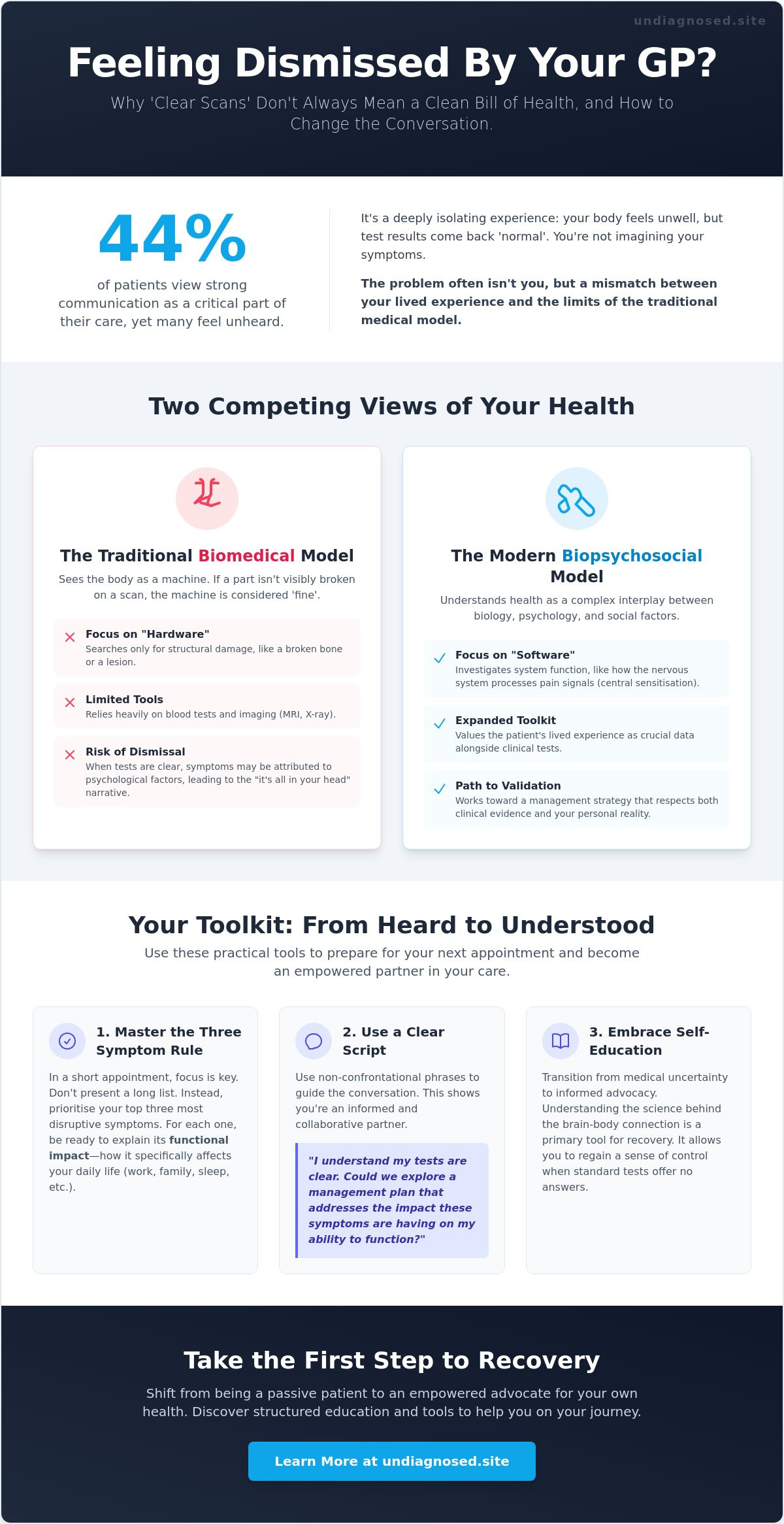
The traditional biomedical model operates on a rigid binary: the body is either structurally damaged or it's healthy. This framework treats the human form like a machine with interchangeable parts; if a specific component isn't visibly broken on an MRI or blood test, the machine is assumed to be functioning perfectly. For many patients, this clinical blind spot is the primary source of feeling dismissed by my GP. When your internal experience of pain or fatigue doesn't produce a "positive" test result, the biomedical model reaches its limit, often leaving the doctor with no further tools to offer.
Modern neuroscience has moved beyond this simplistic view, embracing the biopsychosocial lens as the gold standard for care. This approach acknowledges that health is a complex interplay between biological signals, psychological states, and social environments. For those Understanding Medically Unexplained Symptoms, the shift from a search for "broken parts" to an analysis of "system function" is transformative. It moves the conversation away from what is missing and toward how the system is actually behaving.
The Paradox of Normal Test Results
Clear blood tests and MRIs do not mean your pain is imaginary. They simply mean there is no structural damage to the "hardware" of your body. In many chronic conditions, the issue lies in the "software," specifically the way the nervous system processes signals. This is often referred to as central sensitisation, where the central nervous system becomes stuck in a state of high reactivity, amplifying even minor signals into significant pain. Effective consultation preparation involves learning how to describe these functional disruptions rather than just pleading for more tests that are likely to return as normal.
Moving Beyond the Search for a 'Broken Part'
GPs are trained primarily to exclude life-threatening pathology. Once they've ruled out cancer, infection, or acute injury, their diagnostic mission is often considered complete. However, the brain is capable of creating very real, physical sensations in response to neural pathways that have become over-learned or "sensitised" over time. A normal scan is often the start of a mind-body investigation, not the end. Understanding that your brain can generate physical symptoms without a localised injury is not an admission of a mental health problem; it is an acknowledgement of complex neurobiology.
Bridging this gap between your lived experience and your GP's training requires a new vocabulary. By shifting the focus from structural damage to functional impact, you can help your doctor move past the limitations of the biomedical model. Gaining a deeper insight into these mechanisms is the first step toward recovery, a concept explored in detail within Undiagnosed - The Mind and Body Connection.
Consultation Preparation: Moving from 'Heard' to 'Understood'
Effective communication within a ten-minute NHS window requires a shift in strategy. If you are tired of feeling dismissed by my GP, the most powerful tool at your disposal is the way you curate your information. Doctors are trained to recognise specific clinical patterns; providing a disorganised list of twenty symptoms can unintentionally obscure the very pattern you want them to see. By adopting the 'Three Symptom Rule', you ensure your most debilitating concerns receive the focus they deserve. Select the three issues that impact your life most significantly and lead with these. This approach prevents 'symptom fatigue' and allows the GP to engage deeply with a manageable amount of data.
Advocating for yourself whilst remaining calm is a delicate balance. The weight of feeling dismissed by my GP can often be lightened by changing the way you present your case. It's helpful to remember that a lack of a clear diagnosis is often a limitation of the system, not a personal failing. When the clinical tools don't match your experience, it can lead to medical gaslighting, where your symptoms are minimised or misattributed. To counter this, shift your language from what you feel to what you can no longer do. This focus on functional impact provides the GP with concrete evidence of your condition's severity, making it much harder to dismiss your experience as 'just stress'.
The 'Impact Diary' vs. The 'Symptom List'
GPs often find 'intensity scores' like 8/10 pain difficult to quantify. Instead, use an Impact Diary to document how your symptoms interfere with daily life. For example, 'I can no longer walk to the shops' provides more clinical utility than 'my leg hurts'. Use your diary to track how your physical state fluctuates alongside sleep quality, mood, and stress levels. Presenting a one-page summary that highlights these correlations at the start of your appointment helps facilitate a biopsychosocial discussion, moving the focus from a single 'broken part' to your overall system function.
Defining Your Goal for the Appointment
Clarity about your desired outcome is essential for a productive visit. Are you seeking a cure, or are you looking for a management pathway? Utilise the 'ICE' method to structure your thoughts: Ideas (what do you think is happening?), Concerns (what are you most worried about?), and Expectations (what do you want from this specific visit?). Remaining calm whilst advocating for your favourite outcome, such as a referral to a specialist clinic or a specific management plan, demonstrates that you are an active participant in your care. If you feel you've reached a dead end, it's perfectly acceptable to ask for a second opinion or a referral to a specialist centre, such as a functional neurological disorder (FND) unit or a dedicated pain management clinic.
The Biopsychosocial Script: Specific Phrases to Use with Your GP
When you are feeling dismissed by my GP, the natural response is often one of frustration or withdrawal. However, the most effective way to bridge the communication gap is to adopt the language of modern clinical practice. By using specific, evidence-based phrases, you can shift the consultation from a search for a broken part to a discussion about system function. This isn't about challenging your doctor's authority; it's about providing them with a framework that allows them to help you more effectively. You are moving from a state of passive suffering to a position of active partnership.
A powerful linguistic tool in these settings is the use of binary oppositions. For example, stating, "I am not looking for more tests, but for a management strategy," immediately signals to the GP that you accept the clinical data whilst still requiring care. This reduces the doctor's defensive need to justify "normal" results and opens the door to a biopsychosocial discussion. Understanding The Neuroscience of MUS allows you to speak confidently about how the brain creates real physical symptoms, ensuring the conversation remains grounded in biology rather than just psychology.
Phrases to Redirect the Conversation
If your GP suggests that "it's just stress," don't dismiss the observation. Instead, redirect it toward functional recovery. You might say, "I agree that my nervous system is under pressure, but how do we manage the physical symptoms this stress is generating?" This "yes, and" approach validates the GP's perspective whilst insisting on a plan for your physical reality. Other useful phrases include:
- "I understand my tests are normal, but my symptoms are disabling. What is the plan for functional recovery?"
- "How can we address the mind-body connection in my treatment plan?"
- "I've been reading about the biopsychosocial model; how does that apply to my specific symptoms?"
Negotiating for Better Care
Negotiation requires a collaborative rather than an adversarial tone. If the GP feels they've reached the limit of their expertise, ask for a specialist referral with precision. Use the phrase, "If you can't help me further, who in the trust specialises in functional disorders or chronic symptom management?" This focuses on the solution rather than the impasse. If a specific request for a referral or a certain management pathway is declined, you can politely ask, "Could you please note in my records that we discussed this option and decided not to pursue it today?" This often prompts a more thoughtful reconsideration of your request.
Mastering these scripts is a vital part of regaining your agency. To deepen your understanding of these communication strategies and the science behind them, explore the resources in The Mind and Body Connection Online Course.
Taking the Lead: Self-Education and the Path to Recovery
Waiting for a GP to "fix" a functional condition is often a recipe for stagnation. Whilst the medical system is designed to identify and repair structural damage, it is frequently ill-equipped to recalibrate a sensitised nervous system. If you are tired of feeling dismissed by my GP, it's time to shift your perspective from passive recipient to active architect of your own health. In the context of Functional Neurological Disorder (FND) and Medically Unexplained Symptoms (MUS), patient education is not merely a preparation for treatment; it is the first line of treatment itself. Recovery is not a destination provided by a clinician, but a process facilitated by the individual.
A 2026 report highlights the rise of the "empowered patient," where individuals take an active role in interpreting their own health data. When you move beyond the frustration of clear scans, you can begin the work of retraining your neural pathways. Digital resources and structured self-study bridge the gap created by long NHS waitlists, providing immediate access to the tools required for nervous system regulation. This shift from seeking external validation to building internal insight is the most decisive step you can take on your journey toward wellness.
The Power of the Mind and Body Connection
When you understand that your symptoms are a result of a protective brain response rather than a structural failure, the internal threat level begins to drop. The brain creates pain or tremors as a "danger" signal; by learning the science of your condition, you effectively lower the volume on that signal. Recovery involves implementing practical, daily interventions that signal safety to the body. These include:
- Regulated breathing techniques to soothe the autonomic nervous system.
- Optimising sleep hygiene to allow for neural repair.
- Mindfulness and relaxation practices that act as clinical interventions for sensitisation.
You can find a comprehensive guide to these techniques in our Mind-Body Balance Tools. These are not "lifestyle choices" but essential components of a functional recovery plan.
Next Steps: The Undiagnosed Book and Course
Dr. Csaba Dioszeghy’s work is designed to provide the clinical validation and scientific framework that standard consultations often miss. By engaging with this curriculum, you transition from a patient who feels overlooked to a person who is empowered by knowledge. You no longer need to wait for a doctor to believe you, because you finally understand the biological reality of your own experience. This clarity is the foundation upon which physical recovery is built. Explore the Undiagnosed course and book to begin your recovery today.
Bridge the Gap to Functional Recovery
The experience of feeling dismissed by my GP is often the result of a medical system reaching its diagnostic limit; it is not a reflection of your physical reality. By shifting your focus from structural damage to functional impact, you can transform the nature of your clinical interactions. You now possess the tools to prioritise your concerns, utilise specific biopsychosocial scripts, and embrace the science of the mind-body connection. These strategies move you beyond the frustration of clear scans and toward a structured, evidence-based path of recovery.
True progress begins when you replace medical uncertainty with clinical insight. Founded by Consultant Physician Dr. Csaba Dioszeghy, our curriculum is designed specifically for those whose symptoms persist despite normal test results. Our approach is not about more testing, but about better management. Take control of your recovery with the Undiagnosed - The Mind and Body Connection book and discover a philosophy built on scientific rigour and compassionate validation. Your symptoms are real, and your path to being understood starts today.
Frequently Asked Questions
What should I do if my GP says 'it's just stress'?
You should acknowledge the role of stress whilst asking for a management plan for the physical symptoms it generates. Stress is a biological trigger that affects the nervous system; it's not a psychological excuse to ignore your pain. Ask your GP how you can address the physiological impact of this stress on your body rather than accepting it as a diagnostic dead end.
Is it possible to have real pain if all my medical tests are normal?
Yes, it's absolutely possible to experience debilitating pain even when scans and blood tests are clear. Medical tests primarily detect structural damage or inflammation, but they cannot measure the "software" of your nervous system. Pain is a signal created by the brain. If your nerves are sensitised, they'll send real pain signals regardless of what an MRI shows.
How do I ask for a second opinion on the NHS without being rude?
You can request a second opinion by calmly stating that you'd appreciate a fresh perspective on your complex case. It's helpful to frame the request as a collaborative step toward finding a management plan rather than a rejection of the current GP's skill. You have the right to ask for a referral to another clinician or a specialist clinic if you feel the current approach has reached an impasse.
What is medical gaslighting and how can I tell if it's happening to me?
Medical gaslighting occurs when a healthcare professional downplays your physical symptoms or incorrectly attributes them to psychological factors without sufficient investigation. You might notice this if you're feeling dismissed by my GP during discussions about chronic pain or fatigue. Signs include being told your symptoms are "normal for your age" or having your concerns interrupted before you can explain their functional impact.
Can the mind-body connection really cause physical symptoms like dizziness or tremors?
The mind-body connection is a biological reality that can produce intense physical symptoms such as dizziness, tremors, and limb weakness. These aren't "made up" sensations; they're functional disruptions in how the brain sends and receives signals. When the nervous system becomes over-sensitised, it can trigger involuntary physical responses that are just as real as those caused by structural injury.
What are Medically Unexplained Symptoms (MUS) and are they permanent?
Medically Unexplained Symptoms (MUS) are physical sensations that don't currently have a structural or pathological diagnosis. They aren't necessarily permanent. Many patients find that their symptoms improve or resolve once they address the underlying nervous system sensitisation. Recovery involves moving away from a search for a "broken part" and toward retraining the brain's response to internal and external triggers.
How can I prepare for a 10-minute GP appointment to ensure I'm heard?
If you're tired of feeling dismissed by my GP, bringing a concise one-page summary can change the dynamic of the room. Lead with your top three symptoms and describe their specific impact on your daily life. Focus on what you can no longer do rather than just what you feel. This provides the GP with clear, actionable evidence within the narrow time limit.
What is the biopsychosocial approach and how does it differ from a normal check-up?
The biopsychosocial approach considers the complex interaction between biological, psychological, and social factors in your health. A normal check-up often follows a biomedical model, which focuses exclusively on structural damage or infection. By contrast, this modern lens acknowledges that your environment, stress levels, and beliefs about your health directly influence the severity and persistence of your physical symptoms.