What if the most effective tool to rewire your nervous system wasn't a pill or a procedure, but a deeper understanding of how your brain actually functions? You've likely felt the exhaustion of normal test results whilst your body presents very real, physical challenges. It's common to feel invalidated when medical professionals use the term functional, especially when FND accounts for approximately 15% of all patients seen in specialised neurology services. You aren't imagining your symptoms, and they aren't a sign of permanent damage.
We're here to show you that FND education is far more than just reading about a condition; it's a critical clinical intervention designed to help you retrain your nervous system and resolve persistent symptoms. By bridging the gap between clinical science and your personal experience, we can transform confusion into a clear strategy for recovery. This article explores the biology of the brain-body connection and outlines a structured path toward self-management through targeted resources like the Undiagnosed book and our comprehensive online course. You don't have to stay stuck in a cycle of uncertainty; you can begin the work of reclaiming your movement and your life today.
Key Takeaways
- Learn why FND is a functional "software" issue rather than structural damage; this explains why traditional scans appear normal whilst symptoms remain debilitating.
- Discover how clinical FND education acts as a powerful neurological intervention by reducing the brain's internal threat response and calming the nervous system.
- Understand the Biopsychosocial Model to move beyond a narrow biological focus and address the emotional and environmental factors influencing your recovery.
- Identify the essential components of a structured curriculum that replaces "miracle cure" myths with evidence-based strategies for retraining your brain.
- Explore how a structured pathway, such as the Undiagnosed book and online course, bridges the gap between complex science and practical self-management.
Understanding FND: Why Education is Your First Step to Recovery
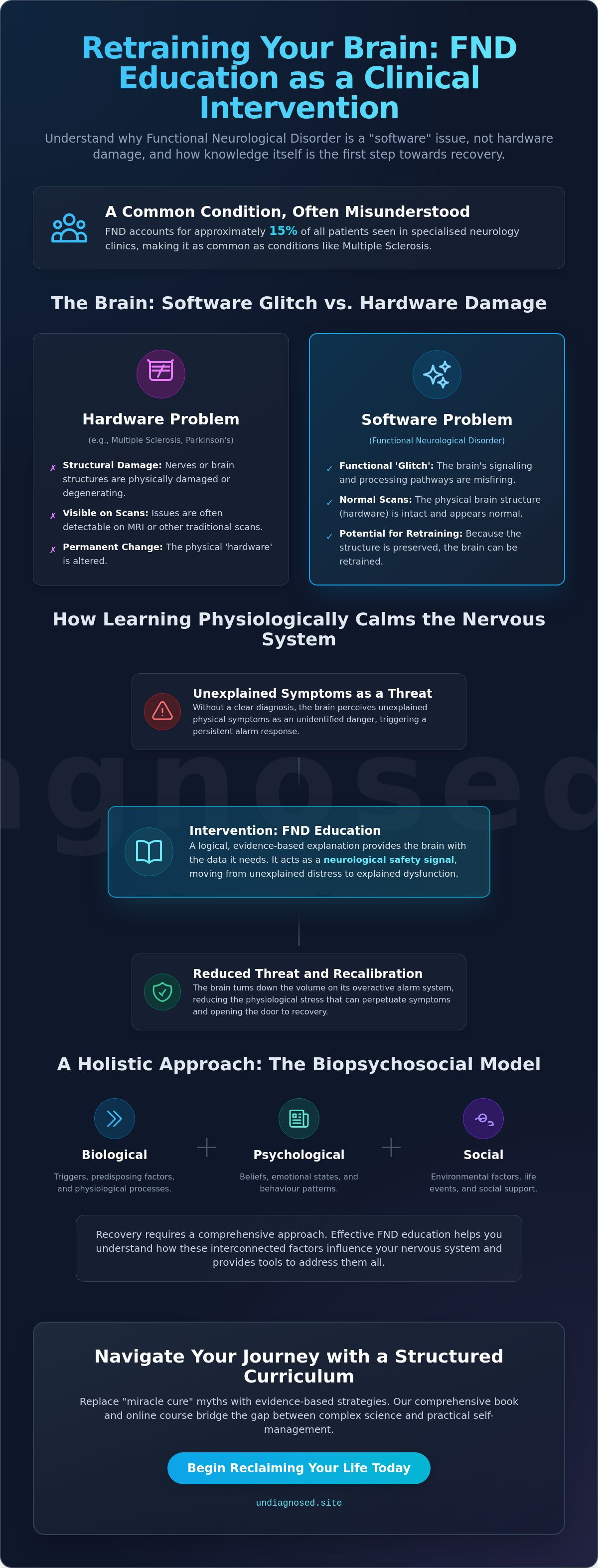
You may have sat in a consultant's surgery, clutching a stack of normal test results whilst your body feels like it is failing you. It is a frustrating paradox. Your MRI scans are clear, your blood tests are perfect, yet your tremors, weakness, or seizures are undeniably real. This disconnect often leads to a diagnosis of Functional Neurological Symptom Disorder, a condition that accounts for approximately 15% of all patients seen in specialised neurology clinics. To move forward, you must first accept a fundamental truth: your symptoms are physical, they are debilitating, and they are not your fault.
The traditional medical model often struggles with FND because it looks for structural damage. When it finds none, patients are frequently left feeling dismissed or confused. However, FND education serves as the bridge between clinical data and your lived experience. By understanding the mechanisms behind your symptoms, you begin to lower the "threat" signal in your nervous system. This isn't just passive learning; it is the first active step in retraining your brain to function correctly again.
The Software vs. Hardware Distinction
To understand FND, it helps to view the brain through the lens of modern computing. In conditions like Multiple Sclerosis or Parkinson’s disease, there is a "hardware" problem. The nerves themselves are physically damaged or degenerated. In FND, the hardware is perfectly intact. If you were to take the brain apart, every wire and circuit would look exactly as it should. The issue lies in the "software." The brain is sending and receiving signals incorrectly, leading to a glitch in how your body moves or perceives sensation. This distinction is vital. It means your nervous system isn't broken; it is simply misfiring. Because the structure is preserved, the potential for retraining and recovery remains high.
Moving Beyond the Stigma of "All in Your Head"
For decades, functional symptoms were wrongly labelled as purely psychological or "imagined." Modern neuroscience has moved past this outdated binary. We now recognise that the mind and body are a single, integrated system. A biopsychosocial approach is now the gold standard for care, acknowledging that biological triggers, emotional states, and environmental factors all influence neurological function. Validating your experience means acknowledging that while the trigger might be complex, the physical result is a measurable disruption in brain connectivity. FND education empowers you to stop searching for a hidden "break" and start focusing on the functional patterns that can be changed. You aren't "crazy," and you aren't making it up; your brain is simply stuck in a protective, dysfunctional loop that needs careful, evidence-based recalibration.
The Neuroscience of Knowledge: How Learning Calms the Nervous System
The brain is not a passive receiver of information. It is an active prediction machine. It constantly scans your environment and internal state to anticipate what happens next. In the absence of a clear, logical diagnosis, the brain perceives unexplained physical symptoms as an unidentified threat. This uncertainty triggers a persistent alarm response in the autonomic nervous system, which can maintain or even worsen functional symptoms. When you engage in FND education, you provide the brain with the data it needs to stop predicting danger.
A logical explanation acts as a neurological safety signal. By understanding why your limbs shake or why your speech falters, you move from a state of unexplained distress to explained dysfunction. This shift is not just psychological; it is a profound physiological intervention. Accessing reliable Functional Neurologic Disorder Information helps the brain recalibrate its expectations. It effectively turns down the volume on an alarm system that has been stuck on high alert.
Reducing the Brain's Threat Response
Learning about the neuroscience of MUS can physiologically lower cortisol levels by providing a sense of agency. The predictive processing model suggests that the brain creates symptoms based on its best guess of what is happening. If the brain expects pain or weakness because it doesn't understand the underlying glitch, it will continue to produce those sensations. Naming the problem is the first essential step in taming it. Accurate knowledge replaces primal fear with a structured framework for recovery, allowing the nervous system to settle.
From Central Sensitisation to Regulation
Persistent symptoms often stem from central sensitisation. This is a state where the nervous system remains in a high-reactivity mode, similar to what we see in the neuroscience of chronic pain. Education helps you down-regulate this overactivity by proving to the brain that there is no structural damage to fear. Consistent, evidence-based learning leads to more favourable outcomes because it builds a foundation of safety. To begin this process of regulation, many find that a structured approach like the Undiagnosed online course provides the clarity needed to silence the internal alarm. This isn't about collecting abstract facts; it's about changing the very predictions your brain makes about your health.
The Biopsychosocial Model: A Framework for Real-World Recovery
Recovery from FND is rarely found in a single pill or a solitary scan. It requires a broader lens. The Biopsychosocial Model provides this framework by examining three intersecting pillars: biology, psychology, and social environment. Whilst traditional medicine often focuses solely on the biological "hardware," this narrow approach fails most FND patients because it ignores the intricate stress impact on health. This neglect creates a destructive feedback loop where physical symptoms cause emotional distress, and that distress further destabilises the already sensitive nervous system.
True resolution requires us to address all three pillars simultaneously. We must look at the neurological misfiring (bio), the emotional patterns that drive the nervous system (psycho), and the environmental triggers that sustain the state of alert (social). This third pillar, the social, is often overlooked, yet your relationships, work environment, and support systems play a vital role in maintaining or reducing the threat signals your brain receives. By integrating these perspectives, FND education moves beyond a simple diagnosis and becomes a comprehensive roadmap for tangible, real-world change.
Why Clinical Education Outperforms Passive Treatment
Passive treatments, such as pharmaceutical prescriptions, often suppress symptoms without addressing the underlying dysfunction. They position the patient as a bystander in their own health. Effective mind-body recovery demands the opposite. It requires active participation. Education transforms you from a recipient of care into a knowledgeable manager of your own nervous system. This shift builds the resilience needed for long-term stability, ensuring you have the cognitive tools to navigate future challenges without regressing into a state of physical crisis.
Addressing the Emotional and Physical Intersection
The brain is a master translator. It can take internal emotional distress and convert it into external physical signals such as tremors, dizziness, or seizures. This translation is not a conscious choice. It is a subcortical survival mechanism. For many individuals, childhood experiences or significant life stressors have "sensitised" the nervous system, making it more prone to these functional interruptions in adulthood. Recognising the patterns in your symptom flares allows you to identify triggers before they manifest physically. We don't look at emotions to blame the patient; we look at them to understand the fuel that keeps the neurological "glitch" active. Addressing this intersection is not about admitting a psychological flaw. It's about mastering a physiological reality.
What Comprehensive FND Education Should Include
Information is only as good as its source. For those living with FND, the internet can be a minefield of "miracle cures" and anecdotal dead ends that often lead to more confusion than clarity. High-quality FND education must be built on the bedrock of clinical evidence, moving away from superficial advice and towards a structured, step-by-step curriculum. It isn't enough to simply know what the disorder is; you must understand the specific mechanics of how your brain functions and misfires. This transition from theory to practical application is what turns a passive reader into an active participant in their own recovery.
A comprehensive programme should be designed by clinicians who specialise in the mind-body connection. These professionals act as scientific mentors, translating complex neurological concepts into actionable insights. When education is delivered through a logical framework, it provides the brain with a sense of order. This order is essential for a nervous system that has become habituated to chaos and unpredictable physical symptoms. By mastering the "why" behind your experiences, you gain the authority to change the "how" of your body's responses.
Identifying Credible Evidence-Based Resources
You must be able to distinguish between sensationalist claims and reliable, peer-reviewed neuroscience. Credible resources don't promise overnight fixes or "miracle" healings; instead, they offer realistic, evidence-based optimism. Look for information that aligns with current research from established neurological institutions. Peer-reviewed data provides a stabilizing influence, ensuring that the strategies you adopt are grounded in scientific truth. If a resource relies more on emotional testimonials than on biological mechanisms, it may lack the depth required for long-term symptom resolution.
Practical Tools for Daily Symptom Management
Effective education must provide a toolkit of practical strategies that you can use the moment a symptom flares. This includes mastering specific breathing techniques and relaxation strategies designed to shift the autonomic nervous system out of a high-alert state. Furthermore, understanding the role of sleep hygiene and paced movement is vital for retraining the brain's predictive pathways. Your education should help you build a personal management plan that addresses your unique triggers and physical patterns. To begin building this foundation with a structured, clinician-led approach, you can explore the Mind and Body Connection online course. This resource moves beyond generalities to provide the specific, evidence-based tools necessary for retraining an overactive nervous system and reclaiming your daily life.
Navigating Your Journey with the Undiagnosed Curriculum
Understanding the "software" nature of your brain is the foundation, but applying that knowledge requires a map. Dr. Csaba Dioszeghy’s "Undiagnosed" approach serves as a vital bridge between complex clinical science and your daily recovery practice. By providing a unified framework, this method moves away from the fragmented advice often found online and towards a cohesive strategy for retraining the nervous system. Engaging with structured FND education ensures that your efforts are targeted, evidence-based, and sustainable. It replaces the exhaustion of "trial and error" with a logical, clinical progression.
This approach doesn't just offer information; it offers a transformation in how you perceive your body's signals. When you move from a state of unexplained distress to one of explained dysfunction, you change the predictive environment of your brain. This shift is the catalyst for physical change. By committing to a structured pathway, you provide your nervous system with the consistency it needs to unlearn old patterns and establish new, healthier ones. You are no longer navigating a medical mystery alone; you are following a documented route toward resolution.
A Structured Pathway to Mind-Body Connection
Relying on isolated articles or social media anecdotes often leads to a disjointed recovery process that can actually increase your internal threat level. In contrast, a curated curriculum provides a stabilising influence. The "Undiagnosed" book simplifies the intricate neuroscience we have discussed into actionable, manageable steps. Additionally, the digital resources provided alongside the curriculum offer lifetime access. This ensures you have ongoing support as your recovery progresses, allowing you to revisit key concepts whenever your nervous system requires a reminder of its own capacity for change. It is a long-term resource for a long-term journey.
Empowering the Patient through Expert Guidance
True recovery happens when the patient is treated as an active partner rather than a passive recipient of care. Whilst clinicians provide the scientific map, you remain the expert on your own body's internal signals. This approach restores the dignity and agency that is so often lost during years of clear scans and confusing terminology. By combining your lived experience with expert clinical insight, you can move from a state of being overlooked to a state of being empowered. You have the ability to influence your nervous system, and education is the key that unlocks that potential. Explore the Undiagnosed course and book to begin your recovery journey.
Reclaiming Control Through Neurological Insight
The path from debilitating symptoms to recovery begins with a fundamental shift in perspective. You've seen how FND is a functional glitch in the brain's software rather than permanent structural damage. By addressing the biological, psychological, and social factors that maintain this state of alert, you can begin to silence the internal alarm. Quality FND education provides the essential map for this journey, transforming complex neuroscience into a practical toolkit for daily life.
You don't have to navigate this process without expert guidance. Founded by Consultant Physician Dr. Csaba Dioszeghy, our curriculum offers an evidence-based biopsychosocial approach designed specifically for both patients and clinicians. Start your recovery journey with the 'Undiagnosed' online course today to bridge the gap between clinical science and your personal experience.
Your nervous system possesses a remarkable capacity for change. With the right tools and a structured pathway, you can move beyond the frustration of clear scans and begin the work of retraining your brain for a more stable, predictable future.
Frequently Asked Questions
Is FND a mental health condition or a physical one?
FND is a neurological disorder, meaning it is a physical condition involving the brain's function. Whilst it is understood within a biopsychosocial framework, the symptoms are real and measurable. It represents a disruption in how the brain sends and receives signals rather than a primary psychiatric illness. You are experiencing a physical "software" glitch in a structurally normal nervous system.
Can education really help with physical symptoms like seizures or paralysis?
Yes, clinical education acts as a neurological intervention that can help resolve physical symptoms. By understanding the functional nature of the condition, you reduce the brain's internal threat response. This calming effect on the nervous system is often the necessary precursor to retraining movement patterns and reducing the frequency of debilitating functional seizures.
How long does it take for FND education to start making a difference?
The timeline varies, but many individuals report a reduction in distress immediately after receiving a logical explanation. Whilst retraining the nervous system is a gradual process, the initial shift in understanding can lower cortisol levels. Significant changes often begin within weeks of starting a structured FND education programme as the autonomic nervous system starts to down-regulate.
Why did my doctor say my tests are normal if I am in so much pain?
Your tests appear normal because traditional scans like MRIs look for structural damage or "hardware" issues. Pain in FND results from a "software" glitch where the brain's processing of sensory signals is disrupted. The pain is physically real and often coexists with FND in 86% of cases, but it doesn't stem from a lesion that standard scans can detect.
What is the difference between FND and other neurological disorders?
The primary difference lies in the distinction between structure and function. Disorders like Multiple Sclerosis involve physical damage to the nerves. FND involves a nervous system that is structurally intact but functionally misfiring. This is why FND is now diagnosed using "rule-in" clinical signs, such as Hoover’s sign, rather than being a diagnosis of exclusion.
Do I need a formal diagnosis before starting an FND education programme?
Whilst a formal diagnosis from a neurologist is essential for medical clarity, you can begin learning about the mind-body connection at any time. Understanding the mechanisms of central sensitisation provides immediate value. Our FND education resources, including the Undiagnosed book, are designed to support anyone experiencing unexplained neurological symptoms as they navigate their clinical journey toward recovery.
Is recovery from FND actually possible through mind-body techniques?
Recovery is highly possible and is the primary goal of multidisciplinary retraining. Because the brain is neuroplastic, it can unlearn dysfunctional patterns and relearn normal ones. Mind-body techniques are not merely "relaxation" exercises; they are evidence-based methods for recalibrating the nervous system's predictive processing to restore physical function and long-term stability.
How does stress impact my FND symptoms if I don't feel particularly stressed?
Stress impacts the nervous system subcortically, meaning your body can be in a state of high alert even if you feel emotionally calm. Physical triggers, past experiences, or the uncertainty of your symptoms can keep your autonomic nervous system in "threat" mode. This physiological stress maintains the neurological loops that produce tremors, weakness, or seizures.